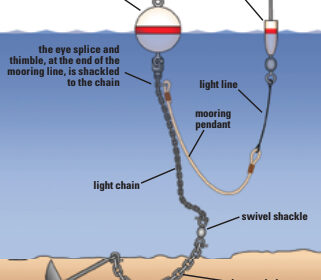
Pick up a mooring with grace and élan Issue 66 : May/Jun 2009 A mooring-and-buoy system consists of an anchor, a length of chain, and a mooring buoy that both holds up the chain and marks the location...

Resources, Boat Data & Interactive Calculators
Pick up a mooring with grace and élan Issue 66 : May/Jun 2009 A mooring-and-buoy system consists of an anchor, a length of chain, and a mooring buoy that both holds up the chain and marks the location...

Getting a grip on a slippery problem Issue 70 : Jan/Feb 2010 Just as Imelda Marcos was addicted to footwear, I confess I’m addicted to tools. And not just any tools, either. I’m addicted to pliers. At...

A modern adaptation of an old tradition Issue 70 : Jan/Feb 2010 On sailing ships, an opened cask, or butt, of water was often placed near the galley scuttle. This “scuttlebutt” was where the crew coul...

Color-coded coils take stress out of docking Issue 70 : Jan/Feb 2010 When cruising, it helps to have aboard an assortment of docklines of various lengths so you can secure your boat in a variety of tr...

Turn, turn, turn on the lights Issue 71 : Mar/Apr 2010 Do you remember the Green Lantern, the DC Comics superhero of the 1950s? This article isn’t about him; it’s about my multi-function, crank-powere...
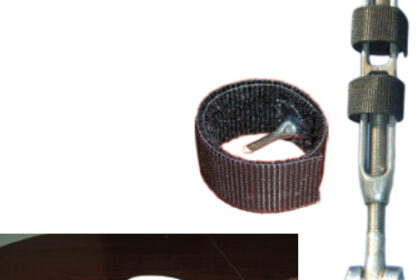
Security without using pliers or rigging tape Issue 71 : Mar/Apr 2010 I was in a fabric store buying sticky-back Velcro tape for use on insect screens when I saw a Velcro product named One-Wrap. This ...
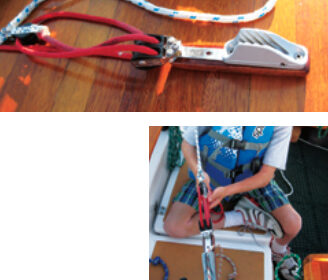
Make your own handy-billy Issue 71 : Mar/Apr 2010 Most good old boats have all the mechanical muscle a person could want in the form of powerful winches. Boats at the smaller end of the scale, however...

Basic insights into how they work Issue 71 : Mar/Apr 2010 Much complicated mathematics lies behind the deceptively simple appearance of a boat’s propeller, but it can be described and specified with a...
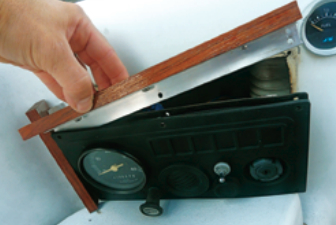
Crucial dials and controls go under cover Issue 72 : May/Jun 2010 Scrambling around my boat’s cockpit, or watching someone else (especially kids) doing the same, has usually left me wondering when, no...

Meticulous planning ensures a perfect anchor platform Issue 72 : May/Jun 2010 When Bruce King designed the Ericson Cruising 31, he gave it a sharp entry. As a result, the deck at the stemhead is rathe...

A weatherproof housing for cockpit electronics Issue 72 : May/Jun 2010 I recently swapped out my 22-year-old, obsolete Autohelm 3000 wheel pilot. Neither original nor aftermarket parts were available ...

Ensure your first line of safety really is safe Issue 72 : May/Jun 2010 Lifelines are designed to reduce the chances of your going overboard. On many boats, however, these systems are poorly designed ...

Creating confidence through a safe boarding experience Issue 73 : Jul/Aug 2010 Few things complement the pleasure of boating like a proper boarding ladder. For children, parents, and grandparents alik...

A seagoing ketch gets a brand-new steering system Issue 73 : Jul/Aug 2010 Over the past nine years, my partner, Magali, and I have been steadily modifying our ketch, Sigfrid, to turn her into a practi...
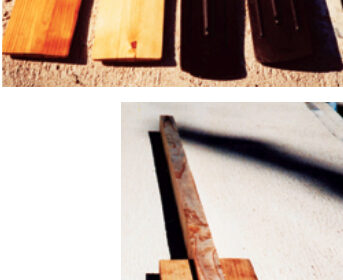
An inflatable dinghy gets a homemade upgrade Issue 74 : Sept/Oct 2010 Before my partner, Magali, and I left England on Joass, our 32-foot wooden gaff cutter, in the spring of 1998, we bought ourselves...
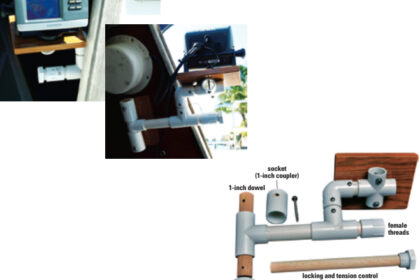
Protect your investment from weather and covetous knaves Issue 75 : Nov/Dec 2010 Many GPS chart plotters are designed for bulkhead mounting but, if they’re visible, thieves love them. With that in min...
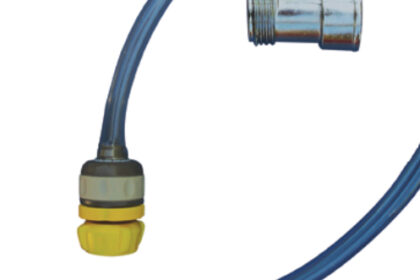
An in-line valve eliminates the on-dock sprint Issue 75 : Nov/Dec 2010 Upon coming into a marina, our first priority is what we like to call “watering the boat.” The procedure begins with filling her ...

Habitual tinkering comes up trumps Issue 75 : Nov/Dec 2010 Self-steering is the elusive silent partner of every singlehander. Dozens of commercial products have been devised to deliver this blessed gr...

Flat, yes; horizontal, no Issue 76 : Jan/Feb 2011 Finding charts we’d stored on board our 34-foot Creekmore, Eurisko, used to be a constant game of hide and seek. When we put charts on the navigation ...

A hard dinghy becomes a rigid inflatable Issue 76 : Jan/Feb 2011 Twenty years, two kids, and a dog later, I finally had to face facts — the family dinghy no longer fit the family. My wife and I had ac...

A little pram dinghy is a workhorse and a comfort Issue 76 : Jan/Feb 2011 We wouldn’t cast off without our 8-foot pram in tow. It’s convenient to have her in the water and ready to go when we finally ...

Recycle shrinkwrap and save time and money Issue 77 : Mar/Apr 2011 It was the worst of times: I didn’t know if I would launch our beloved 33-foot Cape Dory, Femme du Nord, in spring. I didn’t know if ...

Two-axis mounts make solar panels adjustable for greater gain Issue 77 : Mar/Apr 2011 Having cruised through the South Pacific twice, we knew the value of solar panels for keeping our batteries charge...

Cooling the cost of a warm cabin Issue 77 : Mar/Apr 2011 A warm boat is a great comfort in the rainy Pacific Northwest. Boats stay in the water year-round here and the shoulder cruising seasons have a...

Pressing pure water out of the sea Issue 77 : Mar/Apr 2011 Osmosis is a natural process in which molecules of a liquid spontaneously pass through a semi-permeable membrane. The direction of fl ow acro...

Thinking beyond the pail Issue 78 : May/Jun 2011 Aboard Mystic the “ship’s bucket” is an important piece of gear. When it’s inactive, it holds the vacuum cleaner and is buried deep in the port cockpit...

Secure electrical wiring against chafe Issue 78 : May/Jun 2011 While preparing to run the AC and DC electrical wiring in the refi t of my 33-foot Hallberg-Rassy Mistral, Vera May, I found few products...

A custom box at the helm was the answer Issue 79: July/Aug 2011 After making the decision to add radar to Olo, our 1986 O’Day 35 (see “Radar on the Level,” May 2011), I faced the challenge of where an...

A propane locker that won’t blow the budget Issue 78 : May/Jun 2011 A standard propane locker from a marine catalog seemed ridiculously expensive ($650 or more) when I was refurbishing my Cape Dory 27...

A home-built tower with manumatic leveler Issue 78 : May/Jun 2011 Several years ago, my wife, Kari, and I decided to venture beyond the relative safety of our normal cruising grounds in the Apostle Is...