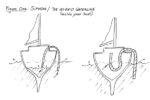
In galleys, engine compartments, and heads, seacocks and thru-hulls are everywhere
Issue 1 : June 1998
Every thru-hull fitting below the waterline is a potential boat sinker. That fact is enough to raise these lowly devices to equipment of prime importance to the mariner and to provoke discussion on such subjects as thru-hull design, construction, and installation.
During the course of my research for this article, I discovered that a vast number of thru-hulls as installed probably don’t comply, in one way or another, with the limited voluntary standards of the American Boat and Yacht Council (ABYC) and Underwriters Laboratories Inc. (UL) voluntary standards. These standards, both what is in them and what is currently not in them, are a useful way to look at this subject. First, here are some definitions:
- A thru-hull fitting is “a device that penetrates a hull, and which is designed to accept a pipe, hose or valve on its inboard end.”
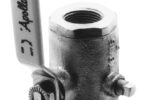
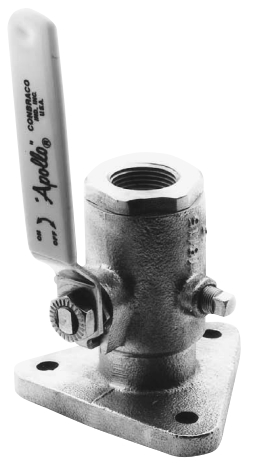
- “A seacock is a type of valve used to control intake or discharge of water through the hull. It is operated by a lever-type handle usually operating through a 90-degree arc, giving a clear indication of whether it is open or shut.”
Note the distinction between the fitting that passes through the hull, the thru-hull — and the valve that may or may not be used to seal its inboard end — the seacock. Put another way, even if a seacock is supplied with an integral thru-hull fitting, there are still two distinct components here.
The ABYC standards go on to state that: “All piping, tubing, or hose lines penetrating the hull below the maximum heeled waterline and under all normal conditions of trim shall be equipped with a seacock to stop the admission of water in the event of a failure of pipes, tubing or hose.” In other words, if the thru-hull is ever likely to be under water, it has to have an attached seacock. This is an obvious safety requirement that is frequently violated. (The ABYC does allow one or two exceptions, including cockpit drains that are above the waterline when the boat is at rest.)
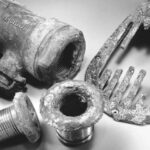
Both the ABYC and UL define the “maximum heeled waterline” on powerboats as a 14-degree angle of heel (there are moves to change this to 7 degrees). On sailboats the “maximum heeled waterline” is considered to be the waterline when the boat is heeled to the point at which the midships sheerline is down to the surface of the water. On most sailboats this puts much of the hull below the heeled waterline, meaning that almost all thru-hulls should have an attached seacock. A quick look at most boats will reveal thru-hulls that don’t meet this standard. A glance at marine catalogs will show that the industry itself has not grasped the significance of this standard: I have several catalogs that contain comments to the effect that thru-hulls without seacocks should not be installed below the waterline “as per ABYC H-27.” In my admittedly incomplete survey, I haven’t seen a single catalog that refers to the heeled waterline.
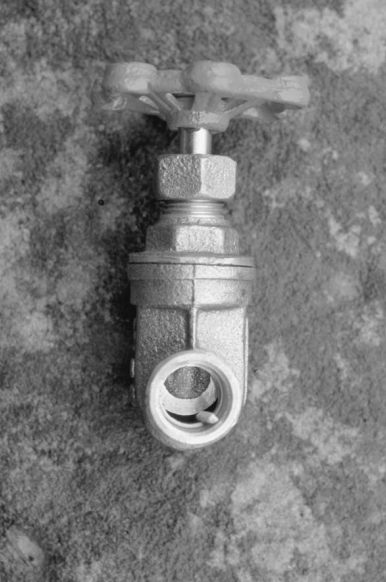
Turning now to the definition of a seacock, the wording that I have italicized, which was only added in recent years, is quite significant. A “lever-type handle” eliminates all gate and globe valves from consideration as seacocks (gate and globe valves are the type that are operated by handwheels requiring multiple turns to open and close). This makes sense. Despite their widespread use, gate and globe valves have four design flaws in seacock applications:
- The valve operating stems have a narrow cross section and as such can be relatively easily sheared. Given the fact that seacocks are often obstructed by marine growth and calcium, and as a result are hard to operate, these valves are especially prone to failure.
- Any marine growth or obstruction occurring on the seat of the valve is next to impossible to clean off without valve disassembly, and it is very difficult to get the valve to seat properly until it is cleaned off (as opposed to other types of valves which are wiped clean in operation).
- The mechanism is indirect (the handle turns a gear which operates the valve) which makes it less reliable than the direct mechanism of a seacock (the handle turns the drum or ball).
- It is not possible to tell by looking at the valve handle whether the valve is open or closed.
The last point relates to the other part of the italicized definition which calls for the operating handle to move through a 90-degree arc, “giving a clear indication of whether the valve is open or shut.” This requirement is normally met by having the handle line up with the body of the valve when the valve is open and having it at right angles to the body of the valve when the valve is closed: a quick look is all that is needed to see if the valve is open or closed. Positive stops limit the movement in both directions.
Corrosion concerns
With metal thru-hulls, corrosion is a major concern. The ABYC H-27 standard states: “All materials shall be corrosion-resistant in the marine environment and shall be galvanically compatible.”
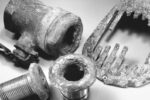
Widespread problems have occurred through the use of brass valves as opposed to bronze. Brass is an alloy of copper and zinc. If these two metals are electrically interconnected (which occurs automatically in an alloy) and are then immersed in an electrolyte (salt water and all but the purest fresh water), a galvanic cell is established which results in the dissolution of the zinc, leaving a soft and porous casting (often identifiable by its reddish hue). Most gate and globe valves are brass, rather than bronze (another reason for not using them). And even those with bronze bodies may have brass internal components. (Editor’s note: For more on this subject, refer to Dave Gerr’s article on Page 16.)
Among the bronzes there are many different alloys, some of which also contain zinc and, as a result, are more susceptible to corrosion than nonzinc alloys. Clearly, most buyers are not going to be able to make metallurgical tests to determine whether the alloy in a valve or thru-hull is suitable for marine use. Our best guarantee of a quality fitting is to dig into our pockets and buy only recognized marine name brands. To try to cut costs by buying cheaper industrial products or those of unknown origin seems to be the height of foolishness.
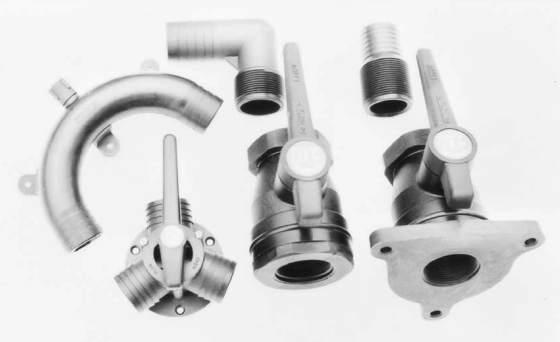
The internal parts of a valve have to be galvanically compatible, or non-interactive, with its body. Traditional drum-type valves have a drum machined from the same stock as the body, i.e., ball-type valves mostly have chrome-plated bronze balls riding in Teflon seals, with the chrome providing excellent corrosion resistance and the plastic seals electrically insulating the ball from the bronze body; and then there is the rubber-plug type of valve in which the rubber eliminates all galvanic interaction between the plug and its body. Other materials that have been used in seacocks are stainless steel and aluminum. However, most grades of stainless steel are not suitable in any permanently wet application. When stainless steel is submerged in stagnant water (precisely the conditions inside many seacocks) it will lose its stainless quality and corrode much like regular steel. Even when used for such items as handles, unless a high quality (and expensive) grade is used, stainless steel will corrode in time, especially if coated with plastic.
Aluminum is often used for welded thru-hulls on aluminum boats and sometimes for seacocks. The key consideration here is to use only a high-quality marine-grade aluminum, making sure that it is also galvanically compatible with the hull (i.e., of the same or a similar grade of material).
Bonding questions
The question then arises as to whether metal thru-hulls and seacocks should be given cathodic protection. Aluminum fittings, if welded to the hull, will automatically be included in the hull’s protection system. The debate centers on whether or not to connect bronze fittings in wood or fiberglass hulls to the boat’s bonding system and zincs. In general, the answer is “no,” for a couple of reasons:
- Bronze will almost certainly be the “most noble” metal on board. As such, it is not likely to suffer from galvanic corrosion. If wired into the bonding circuit and, therefore, electrically connected to other “less noble” metals on the boat, it will simply accelerate the consumption of the boat’s zincs. If the zincs are neglected, the bronze will actually accelerate corrosion of the other metals.
- The added galvanic activity caused by wiring the bronze into the bonding circuit will generate alkaline hydroxides in the vicinity of the bronze. This will blister paint and destroy wooden backing blocks in fiberglass boats and the hull planking on wooden boats.
This opposition to bonding bronze thru-hulls and seacocks is based on the assumption that without a bonding connection, the thru-hull or seacock will be electrically isolated, which is almost always the case, particularly if the inboard connection is made with a rubber hose. However, if there is any chance of the thru-hull or seacock being part of a path for stray currents (for example, installation below the normal accumulation of bilge water or a hard metal connection from a bilge pump to a thru-hull) the fitting should be bonded. This is done to forestall the possibility of devastating stray current corrosion. Note that it is not the bonding-circuit zinc that is now protecting the fitting from stray current corrosion, but the fact that the bonding circuit is connected to the battery negative.
Stray-current corrosion occurs when a metal fitting discharges a current into water. It cannot be stopped with zincs. However, it can be forestalled by providing a direct path for the stray current back to the battery negative, instead of allowing the current to be discharged into the water. The bonding circuit forms this path. If thru-hulls or seacocks in fiberglass or wooden hulls are bonded for any reason, the vessel is going to need a proper lightning protection system (it should have one anyway) containing a separate immersed ground plate of at least one square foot in surface area (an external ballast keel or metal rudder will suffice; otherwise a ground plate will have to be fastened to the hull). Without such a ground plate, the bonded thru-hulls may become the path to ground for a lightning strike. Lacking adequate surface area to safely dissipate a strike, they may heat up to the point at which they melt, burn, or explode out of the hull.
Plastic thru-hulls and seacocks
It is these kinds of corrosion and corrosion-prevention problems associated with metal thru-hulls and seacocks that make using plastic units such an attractive alternative. Plastic fittings are totally non-corrosive and require no corrosion prevention strategies; in addition they are lighter, frequently easier (and therefore cheaper) to install, and often cheaper to buy in the first place. There can be drawbacks of course: reduced physical strength compared to metal, less abrasion resistance, susceptibility to damage from ultraviolet degradation and chemicals, a limited ability to tolerate temperature extremes, and embrittlement with age.
When looking at these drawbacks, it is possible to distinguish two somewhat different sets of issues: the suitability of different plastics for use in manufacturing thru-hulls and seacocks; and whether the fittings, as manufactured, will withstand the rigors of thru-hull and seacock service.
Finding suitable plastics
The best treatment I have found on this subject is a 1985 paper, titled “Selection Criteria for Plastics Used in Through-Hull Fittings,” written by A.B.F. Fraser-Harris, M.D., and Jerry J. Leyden and presented to the Seventh Chesapeake Sailing Yacht Symposium of the Society of Naval Architects and Marine Engineers. The authors identify the necessary physical characteristics for any plastic to be used in thru-hull or seacock construction and then review the available plastics to see which ones have these properties. Their list of requirements includes:
- Impact resistance. From time to time boats have a violent motion. Externally, there will be impacts from crashing into waves; internally, there may be severe shocks from loosely stowed objects or falling bodies.
- Flexibility, tensile strength, and good memory. A boat’s hull is constantly flexing while machinery and other sources impart vibration. Any fittings attached to the hull must be able to absorb this flexing and vibration without damage or permanent distortion in shape.
- Abrasion resistance. They must be able to handle normal situations, such as sand and other particles in cooling water and bilge water, as well as abnormal situations, such as groundings.
- Tolerance of temperature extremes. They may be subjected to everything from the high temperatures associated with engine manifolds and hot fluids down to sub-zero conditions.
- Resistance to a broad range of household chemicals, hydrocarbons, effluent, and the byproducts of various forms of marine growth.
- No ultraviolet degradation.
- “Continuous freedom of movement.” If a seacock is left undisturbed in one position for a long period of time, the plastics in the various internal components must not bond together or otherwise cause the valve to seize up.
- The ability to be drilled, threaded, and otherwise machined without developing internal stresses that may result in later failure.
Given the fact that no authority had established any quantifiable standards for plastics used in thru-hulls and seacocks, Fraser-Harris and Leyden set their own threshold levels. Based on their assessment of available plastics, they concluded that the only ones suitable for thru-hull and seacock manufacture were nylons, acetals, and PBTs (polybutylene terephthalate), and that these are only suitable when reinforced with between 20 percent and 33 percent fiberglass and when UV inhibited. They specifically ruled out polyvinyl chloride (PVC), chlorinated polyvinyl chloride (CPVC), and acrylonitrile butadiene styrene (ABS), which are all, from time to time, found in thru-hull fittings (note that these materials may be suitable for less demanding situations, but not for thru-hulls and seacocks).
Bob Foresman of Forespar®, the manufacturer of the well-known Marelon® line of fiber-reinforced nylon thru-hulls and seacocks, concurs. Forespar® nylon thru-hulls have 13 percent fiber reinforcement, and their seacocks have 33 percent. The company has been selling these fittings for 14 years without experiencing problems with the material (although there have been some minor design glitches, see Page 14).
What’s more, as Bob Foresman is happy to point out, fiber-reinforced nylon has been used in agricultural valves, for which the conditions are in some ways far more demanding, for more than 40 years, so there is a great deal of anecdotal evidence and experience to support its use.
There is also a great deal of anecdotal evidence to support the position that other nonfiber-reinforced and non-UV inhibited plastics are not suitable for thru-hulls and seacocks. This evidence includes numerous boat sinkings caused by fittings that failed from UV degradation, embrittlement with age, inability to withstand temperature extremes, and inadequate resistance to shock, fatigue, and abrasion.
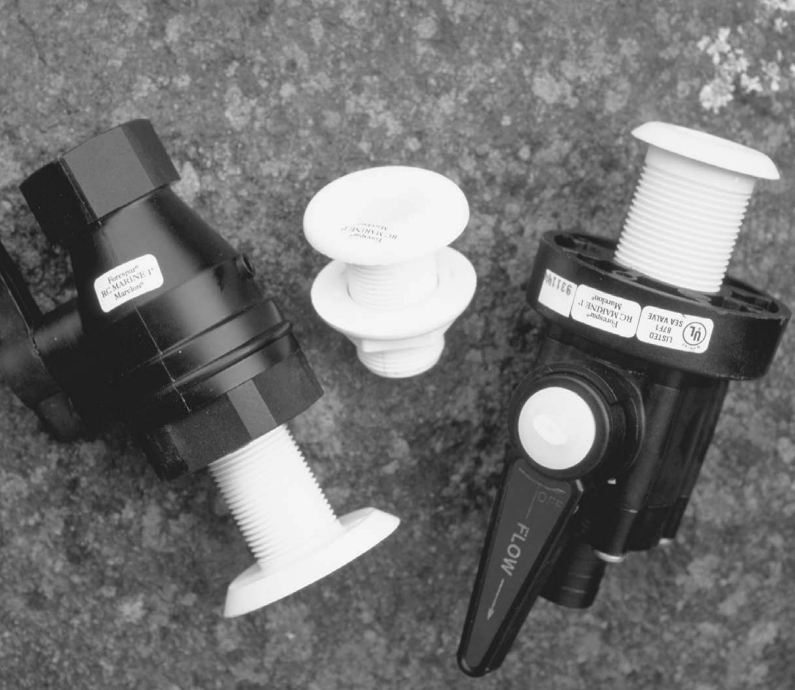
Plastic fitting design
It is one thing to find a plastic that is acceptable for thru-hull and seacock use; however, it is quite another to design a fitting suitable for such use. Fraser-Harris and Leyden comment on this subject, which is also in part addressed by UL and ABYC standards.
The most conspicuous design and manufacturing weakness with plastic seacocks has been the operating handles. Failures have been relatively common among some early designs.
I have been told that handles only break when valves freeze up from a lack of use (all seacocks, both metal and plastic, should be tested at least once or twice a season) and a lack of lubrication. This is probably true. Given this lack of maintenance, the explanation continues, the handle, as the weak link, is protecting the valve from being overstressed. I personally find this attitude unacceptable. If I have a failed hose and water is flooding into my boat, when the handle breaks off the seacock it’s going to be small consolation to know that the broken handle is protecting the valve from damage! It is significant that most manufacturers have beefed up their handles over the years, but even so I still get nervous around a tight plastic seacock (as opposed to the old tapered bronze seacocks which you can give a good whack with a hammer to loosen up!).
Editor’s note: There are two hex “nuts” on some valve designs. One is intended to tighten the valve to the thru-hull, and one is intended for assembly and disassembly of the valve. Take care not to overtighten the hex intended for disassembly; it can make the ball too tight, which can (in some designs) lead to breakage of the operating handle. Use the hex closest to the hull for tightening the valve to the thru-hull.
In addition, UL and the ABYC specify that any threaded components must have at least five full thread engagements, that the valve position once set (open or closed) must not be altered by shock or vibration, that the valve must still operate with marine growth inside it, and that it must have a drain (unless it can withstand the pressure of freezing water without damage).
Testing procedures
In order to establish quantifiable standards for these and other requirements, UL has devised a number of tests that any thru-hull or seacock (metal or plastic) must pass to receive the UL stamp of approval.
- Fittings are subjected to temperature extremes — seacocks with no drain plugs are filled with water and frozen hard.
- A special machine is used for shock and vibration testing.
- Fittings are driven through two feet of dry sand 10,000 times to test for abrasion.
- Seacock operation is tested in both dry and saturated conditions (some plastics swell up and seize when wet).
- Both thru-hulls and seacocks are submerged in hydrocarbons, bleach, ammonia, and salt water.
- Plastics are subjected to an accelerated UV test and then tested for retention of at least 70 percent of their original strength.
Lastly there’s UL’s static load test, otherwise known as the “500-lb. man test.” The static load test consists of mounting a thru-hull or seacock in a simulated hull section and then applying a static load of 500 lbs. to its inboard end (this is done by hanging a 500-lb. weight from the fitting). The fitting must be able to support the weight for 30 seconds without suffering damage or deformation that impairs its performance (with seacocks, the test is followed by a leak test to see that the valve still seals properly).
The static load test is the ultimate test of plastic thru-hulls and seacocks, and of the smaller sizes of bronze fittings (some 1/2-inch and 3/4-inch bronze fittings fail). Bob Foresman reports that the smaller (1/2-inch and 3/4-inch) sizes of their Marelon® fittings as originally designed (the “old series”) could not pass this test. The company had to redesign and retool, changing the original, straight pipe threads on the fittings to a buttress thread. The company now produces this “new series” of thru-hulls and valves which are UL-tested and are listed alongside the “old series” which are not UL-listed. The new series is sold primarily to boatbuilders; the old series to the after-market (marine chandlers and catalogs).
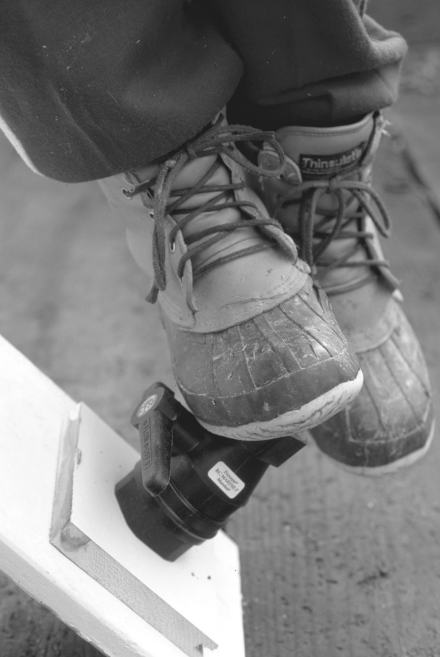
Editor’s note: The reason that Forespar continues to build the straight pipe thread valve for chandlers is that it will mate with a straight pipe thread thru-hull fitting which is likely to be encountered in an aftermarket situation. The boat builder can control these parts better, and ensure that only buttress threads are used on both the valve and thru-hull.
As far as I know, there are no other plastic thru-hulls and seacocks intended for below-the-waterline use that are UL-listed, although there may be some that the manufacturer describes as “meeting the UL standard.” The distinction is that the UL-listed classification means that not only has UL done the requisite testing, but has also established a factory inspection program to ensure that the manufacturing facility will reliably turn out products meeting the standard. In the second instance, the manufacturer has either itself, or through an outside laboratory, tested its own products to see if they will pass the UL tests — UL has in no way validated the results, and there is no factory inspection program.
Installation
Even if a product is UL-listed, this is still no guarantee that it will be installed correctly. Key issues here are protecting the hull in way of the fitting, maintaining watertight integrity at all times, providing adequate fastening, making sure that the fitting as installed will withstand the 500-lb. static load test (as opposed to only passing on the test bench), and placing seacocks in readily accessible locations. Particularly in fiberglass hulls, thru-hulls and seacocks need some kind of a backing block, faired to the shape of the hull and providing a level surface on its inboard side on which to seat the retaining nut or seacock.
This helps spread to a larger area of the hull the inevitable shocks, stresses, and vibrations experienced by the fitting. Clearly the thru-hull needs to be bedded or bonded in place in such a way that it will not develop leaks over time. This is most essential in cored hulls, where even a small leak can do extensive and expensive damage to the core (the core should be removed and the two skins bonded together in the area of the thru-hull). Threaded fittings should be wrapped with Teflon tape.
At one time the ABYC required seacocks to have flanges that could be securely (i.e., independently) fastened to the hull. This is no longer part of the standard, although many bronze seacocks are still installed in this manner. In this case the fasteners must be galvanically compatible with, and at least as noble as, the seacock itself (otherwise the fasteners will soon suffer from galvanic corrosion).
Plastic seacocks are invariably held in place by the thru-hull fitting, with maybe some additional bonding inside the hull. With the integrity of the installation riding solely on the thru-hull, it is essential to have a thru-hull that is properly qualified (preferably UL-listed but, at a minimum, fiber-reinforced); that is not vulnerable to external damage (for example, being broken off if the boat bangs against a dock); that has at least five full threads engaged with its seacock or retaining nut; and that is properly installed with the seacock or retaining nut bedded to a backing block.
To meet the ABYC standard, an installed seacock must pass the 500-lb. static load test (the UL standard is a test-bench standard; the ABYC standard is an “in-the-boat” standard). If a seacock is supplied with an integral thru-hull and the entire assembly is UL-listed, it will automatically pass the static load test if it is properly installed (according to the manufacturer’s instructions).
Mixing and matching problems
However, problems arise when thru-hulls and seacocks are mixed and matched. Even if the individual components are UL-listed, a specific combination of thru-hull and seacock may not pass the static load test (notably when an unsupported seacock, or a seacock and raw-water filter, is on the end of a thru-hull extending some way into a boat). Because it is next to impossible to rig up the static load test inside a boat, an installation generally cannot be tested for compliance with the ABYC standard. For this reason, it is best to ensure that the thru-hull and seacock are a matched pair. If not, a certain amount of common sense is needed with thru-hull and seacock installations, viewing each one from the perspective of: “Will it hold if a heavy person, a loose battery, or a tool box is thrown violently against it?”
Finally, the last installation requirement in the standards, which would be too obvious to state if it were not for the fact that it is routinely ignored, is to make sure that all seacocks are readily accessible. A seacock is nothing more than an insurance policy designed to protect against the failure of the hose that is attached to the thru-hull. If the hose does fail and if the operator can’t get at the seacock to close it, then the seacock won’t do a bit of good and might just as well not have been there in the first place. Accessibility is also necessary for maintenance and to drain the seacock when winterizing the boat (make sure the drain is on the lower side).
In days gone by, there was only one choice when it came to a “proper” thru-hull and seacock installation: bronze. Today, with plastic fittings having proven themselves after many years of service, there seems to be a bewildering array of choices. However, a closer inspection reveals that very few of these choices meet even the limited standards (UL and ABYC) that pertain to these products. These standards are, of course, voluntary, but I know that on my boat I wouldn’t want any below the-(heeled)-waterline thru-hull fittings that didn’t meet the standards.
With this point in mind, the choices are still fairly limited — basically either bronze or fiberglass-reinforced nylon. Given that there is not much of a cost difference between the two, the choice of which to use is largely a matter of the brute strength of bronze as opposed to the lighter weight and freedom from corrosion that comes with plastic.
Either approach is an excellent choice, just as long as the thru-hull and seacock are properly installed and maintained.
This is a revised version of an article which was published in Ocean Navigator, Sept. 1996.
Thank you to Sailrite Enterprises, Inc., for providing free access to back issues of Good Old Boat through intellectual property rights. Sailrite.com