A hard dinghy becomes a rigid inflatable

Issue 76 : Jan/Feb 2011
Twenty years, two kids, and a dog later, I finally had to face facts — the family dinghy no longer fit the family. My wife and I had acquired Melelu, an 8-foot fiberglass Dyer knockoff, while living aboard in Hawaii. Because she served us so well over the years, I tended to ignore or even sugarcoat the signs indicating the need for something with a bit more carrying capacity. After all, if rowing to shore once is good for the ticker, then twice or even three times to ferry dog, kids, and supplies is even better, right?
My false logic finally hit shoal water when I clamped my newly purchased outboard on the dinghy transom and loaded up the family for an oar-free victory lap around the harbor, an event that nearly ushered the entire Lanier clan into Davy Jones’ Locker. Both Melelu and my wife let me know that they’d reached their limits and that something had to be done . . . now!
Decisions, decisions
Like most sailors, I craved the benefits of a hard dinghy (durability, the ability to sail, superior rowing) but lusted after the increased stability and carrying capacity of an inflatable. A rigid-hull inflatable seemed to offer the best of both worlds, but the prices seemed out of this world, particularly as Melelu was still in great shape. What’s a tightwad sailor to do? The idea came to me while looking at a Walker Bay dinghy on display at a local chandlery.
To increase stability and carrying capacity, Walker Bay dinghies can be fitted with a one-piece tube kit. While looking at one of their dinghies with the tube option installed, I noticed the dimensions and overall shape of the Walker Bay were very similar to my own dinghy, although the Walker Bay has a finer bow.
After I made some rough initial measurements and inspected how the tube was attached, I felt confident I could use the Walker Bay kit to retrofit Melelu with minimal effort. A closer look was in order to confirm my theory and to compare the cost of the Walker Bay tube with other options.
The Walker Bay RID (Rigid Infl atable Dinghy) tube kit for their 8-foot dinghy comes in two models, the 275R (with a PVC tube) and the 275H (with a Hypalon tube). Each kit contains the tube (a single U-shaped affair with four separate air chambers), four sections of pre-drilled aluminum mounting track, a tube/valve repair kit, a foot pump, and all the hardware required to install the tube on a Walker Bay dinghy.
Mounting the tube on a Walker Bay dinghy is straightforward, particularly on those models where the hull has been pre-drilled to accept the tube’s mounting tracks. The kit also includes instructions and patterns for drilling and mounting the tracks and tube on non-RID-ready Walker Bay dinghies (a plus for my particular project). Once the tracks are bolted to the hull, the tube is then fed into the track (via an attachment similar to a boltrope) starting at both sides of the bow and working toward the stern.
As the aluminum tracks were designed to match the fi ner bow of the Walker Bay, I knew some minor bending would be required for them to fit the more rounded bow of my older dinghy. This didn’t appear to be much of an issue as the tube (rather than the tracks) does the actual curving around the bow. Just to be sure I wasn’t overlooking some subtle detail, I called the folks at Walker Bay, told them about my plan, and asked for their thoughts.
No one there had seriously considered selling their tube kits for use on other manufacturers’ dinghies. This is understandable. Since Walker Bay is in the business of selling dinghies, they designed their tube kits to enhance the sale of their own products. After some consideration, representatives there agreed that, while it could probably be done, they didn’t recommended this unconventional use for their kits. This was mainly due to the wide variety of possible hull shapes and track modifications that would be necessary. The final quality of the alteration would, naturally, depend on the skills of the individual doing the work.
They raised the possibility of voiding the tube’s warranty due to non-standard installations. However, no one told me definitively that that would be the case. I learned that the company later took a harder line, perhaps after giving the idea further thought. Brigitta Shore, the company’s media relations specialist, was quoted in Practical Sailor as saying, “Walker Bay Boats cannot guarantee their product if it is not used for the intended purpose. In this case, the tube kits are built to fit Walker Bay’s boats, a custom manufactured product. If they are used for any other purpose, the warranty is void. The reason is that hull shapes differ, as do their materials, which can cause strains, wrinkles, and stresses.”
The options
Blissfully unaware of Walker Bay’s stance, and not too worried about warranties anyway, I began comparing prices. West Marine was selling the 275R PVC tube kit for about $800, while the 275H Hypalon tube kit was running approximately $1,200. The difference in price is primarily due to Hypalon’s touted superior resistance to UV degradation. While both materials are advertised as being rugged and durable, Hypalon is particularly recommended for use in warmer climates. Bear in mind that warmer doesn’t necessarily mean tropical; Walker Bay recommends Hypalon for use in my home port of Norfolk, Virginia.
A quick Internet search showed that rigid-hulled inflatables in the 8-foot range with Hypalon tubes started out at around $3,000. Buying a Walker Bay 8-foot dinghy, at $800, and the 275H tube kit would total approximately $2,000. I could save $400 if I chose the Walker Bay dinghy and PVC tube kit. Or I could upgrade Melelu for the cost of a Walker Bay tube kit alone.
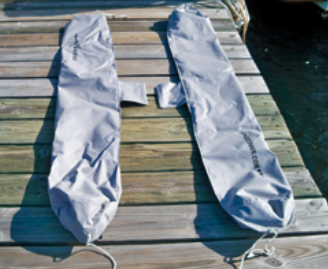
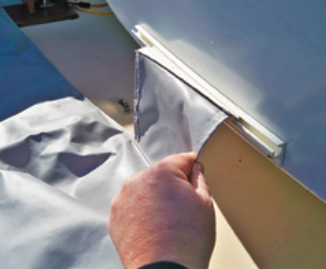
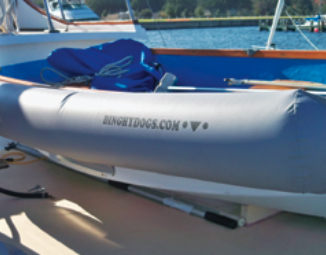
About this time, I discovered another viable alternative that warranted serious consideration. This was another tube kit made to retrofit hard dinghies offered by Dinghy Dogs. This kit consists of two tubes 84 inches long and 10 1/2 inches in diameter that attach to the port and starboard sides of a hard dinghy using lines and four 3-inch nylon cleats. The cleats are mounted at the bow and stern on each side of the dinghy. Each tube is also attached near the waterline using an 18-inch length of PVC track. A flap/boltrope attachment slides into this track. The track is attached utilizing industrial-grade double-sided foam tape and/or stainless-steel screws. The kit includes both attachment options. Each kit contains everything needed to attach the tubes, along with a foot pump for easy inflation.
The company’s website says the tube construction consists of an inner bladder of 10-mil polyurethane fabric and an outer covering of super-tough polyester-reinforced vinyl fabric with UV inhibitors.
Two immediate benefits stood out when looking at the Dinghy Dogs option: the price (approximately $425) and ease of installation. As the tubes are separate and attach to the sides, they can easily be mounted on most hard dinghies, regardless of bow shape. They can also be more quickly and easily removed than the Walker Bay tube should the need arise.
I had the opportunity to view an installation of the Dinghy Dogs and, although I appreciated the benefits associated with them, I really liked the look provided by the one-piece Walker Bay tube. I also wanted the Hypalon fabric for its longevity. Hypalon was not an option with the Dinghy Dogs kits.
Based on the options above (material, estimated savings, and my loyalty to our good old family dinghy) I ordered Walker Bay’s 275H tube kit.
The installation
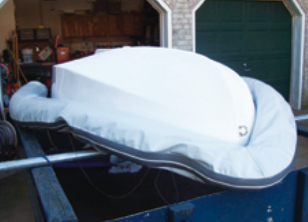
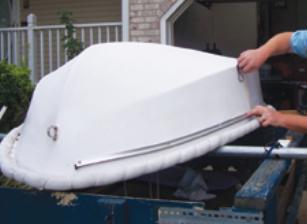
Walker Bay’s instructions for the tube kit were thorough and helpful, particularly the section on retrofitting non-RID-ready Walker Bay boats. The crucial part of the installation for my dinghy was proper placement of the track assemblies to ensure the tube would look right and perform correctly. Not surprisingly, the paper template provided to drill and mount the boltrope tracks on non-RID-ready Walker Bay boats didn’t work on my dinghy without some creative interpretation (primarily due to Melelu’s more rounded bow).
The first thing I did was to partially inflate the tube and dry-fit it around the upturned hull of my dinghy to get a feel for fit and appearance. After supplementing the template directions with measurements taken from a fully assembled Walker Bay RID, I found the minor bending of the tracks required to fit the bow of my dinghy turned out to be relatively simple and well within the ability of most do-it-yourself sailors. Probably the most critical aspect (from a track-mounting standpoint) was making sure the distance they were mounted below the dinghy’s gunwales remained constant (roughly 2 1/2 inches) throughout their entire length.
The results
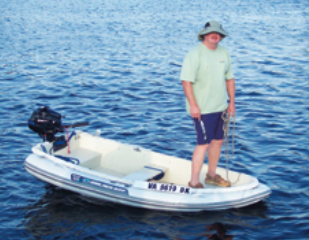
Now that we’ve used our upgraded Melelu for more than three full seasons, we agree that the difference has been nothing short of amazing. Not only did the tube provide a huge increase in stability and safe load-carrying capacity (under power and sail), the retrofit also looks great and provides additional protection to the topsides of the mother ship when the dinghy’s tied alongside.
Although the upgrade was a bit unconventional, the installation worked well for us, and I wouldn’t hesitate to recommend it. Like-minded sailors should weigh each option carefully before deciding if it’s the right choice for them.
Frank Lanier is an avid boater and SAMS-accredited marine surveyor in Norfolk, Virginia. His first boat was a 1974 Ericson 34 that he and his family lived aboard while cruising the Hawaiian Islands. These days, he sails on Chesapeake Bay with his wife Marilou; children, Tristan and Alyssa; and dog, Biscuit the sea schnauzer, aboard their 1978 Union 36, Melelu (Marilou in Hawaiian). Frank can be reached via his website, www.captfklanier.com.
Thank you to Sailrite Enterprises, Inc., for providing free access to back issues of Good Old Boat through intellectual property rights. Sailrite.com