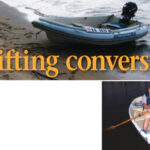
A little pram dinghy is a workhorse and a comfort
Issue 76 : Jan/Feb 2011
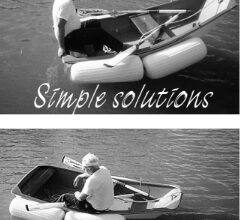
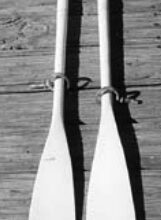
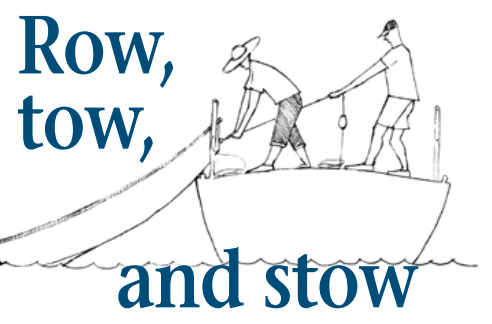
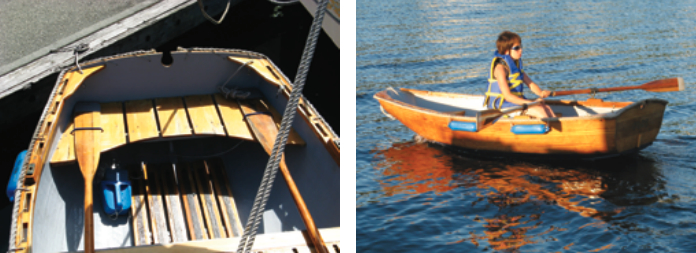
We wouldn’t cast off without our 8-foot pram in tow. It’s convenient to have her in the water and ready to go when we finally drop the hook for the day. We secure the oars with bungee cord when under way, and there is a sculling notch in the transom to enable the use of one oar, just in case.
Sailing through narrow passages and miscalculating the tide at anchor make occasional groundings all but inevitable, and we’ve saved the day more than once by getting the kedge out fast. Also, when sailing singlehanded, it’s nice to know there is something trailing at some distance in the wake of the mother ship to grab hold of in the event of a misstep on the foredeck.
Whether in the chop and whirlpools of a tide against wind sea under the Tacoma Narrows Bridge, or crossing the Strait of Juan de Fuca, or rolling and pitching in the wakes of big powerboats, she tows remarkably well, seldom shipping enough water to fill a teacup.
A reliable towline
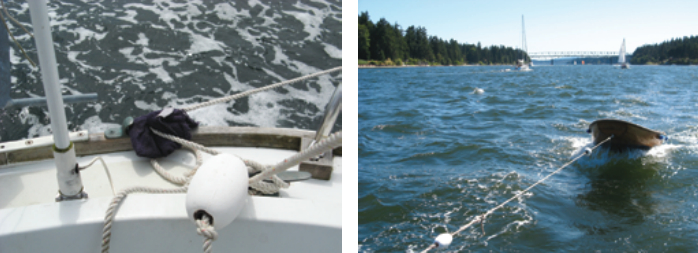
We tow our dink with a line made up in two parts. First there’s a 20-foot painter of 3⁄8-inch nylon. This is permanently fastened to a bow eye with an eye and thimble in the towline. The other end is whipped and ready to bend to a 50-foot line with a trusty bowline. I’ve used polypropylene for a towline, but it’s nasty stuff to work with: it doesn’t knot well and its splices and eyes are unreliable. It doesn’t have the springiness of nylon and a friend of mine learned that it doesn’t always float; he got into a lash-up with his prop when backing down on it one night.
The nylon I prefer to use will sink, but I’ve threaded it through some fishing-net floats held in place by stopper knots to prevent it from sinking and tangling with the prop or rudder. I can judge speed roughly by looking back to see how many floats are in the air. Ripples and sounds are also good indications of speed and reminders that the dink is still back there. It’s surprising how far you can get before you notice there’s no tender following along. It’s good to get into the habit of looking over your shoulder from time to time. I’ve replaced the painter this year as it was showing signs of chafe and there’s no telling what the sun’s done to it.
I run the towline through a large chock and bend it to the starboard stern cleat. I used to tow with a bridle going to both stern cleats but, due to the MOB ladder and a few other stern obstructions, I find it more convenient to use the starboard cleat. With this arrangement, I can deal with the chafing gear at the chock — currently a scrap of old towel — more easily, changing it as I vary the towline length to match wave patterns.
No nighttime nudging
When anchored or moored to a buoy at night, I’ve found the best method of securing the dinghy is to put a fender on either side of the lifeline gate and bend the painter to the starboard midships cleat. Her stern line is made fast to a jibsheet cleat. This method keeps the dinghy from nudging or slamming the big boat in the night as the tide changes. It works in most situations except when large powerboats come close by and the dinghy tries to roll and pitch in their wakes. Keeping one fender a little higher than the other on these occasions helps, but sometimes the only solution is to get her aboard.
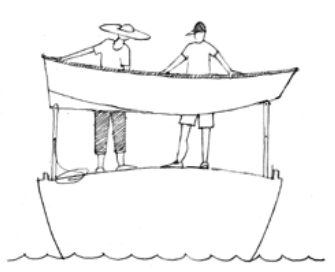
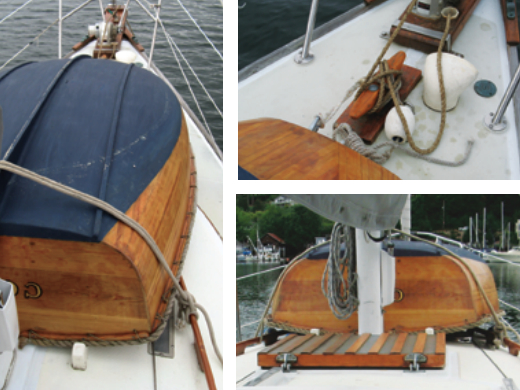
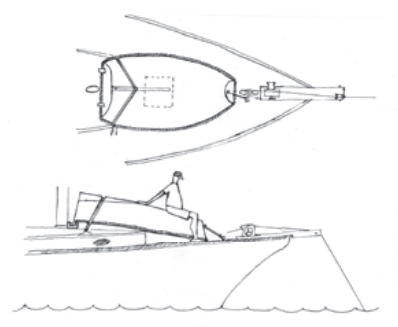
When on board, the pram’s inverted transom rests just forward of the mast in chocks. Her bow rests on deck just short of the windlass. I made the chocks of 1 1⁄2 -inch Douglas fir. They’re through-bolted to the deck with backing plates in the fo’c’s’l.
Match the dinghy to the deck
It’s important to carry a dinghy whose size and shape doesn’t prevent the normal safe and efficient operation of the boat. Our boat is a 31-footer and, though a 9-footer would have advantages, an 8-foot pram is a good compromise between carrying capacity, stability, weight, and available space. There is room to get around the dinghy’s 4-foot beam to get at the bow mooring cleat, work the manual anchor windlass, and sort out snarls in the roller furler. Our 8-foot plywood-transomed inflatable can use the same chocks. One drawback is that both dinghies cover the fo’c’s’l hatch . . . which brings out certain claustrophobic tendencies in my good wife.
Getting the dinghy aboard
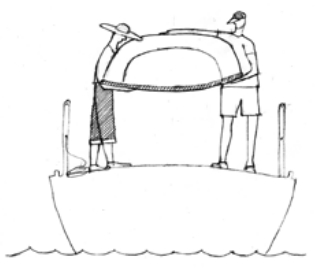
The best location is one thing; getting the little dink there is quite another. I’ve considered davits, but they don’t go well with our curvy transom and can interfere with visibility and the general simplicity we strive for. A halyard or other sort of hoisting system may make the job easier. For now, we just pull her up and over the rail.
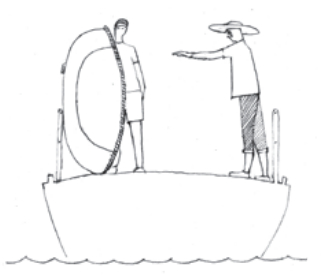
The routine starts with the lower port lifeline. Normally, it’s secured to the bow pulpit with a lashing of 1⁄8-inch line and a few half hitches. We release this and carry the lifeline back to the first stanchion where it’s out of the way. The two of us then grab the painter and haul the dinghy on board between the top lifeline and the toerail. (My to-do list reminds me to fit a stainless-steel rub strake to protect the teak.) Now, she’s beached on deck with her bow lying on the upper lifeline on the starboard side. We then work the stern around to rest on the port-side upper lifeline.
That’s the easy bit. At this point, she’s on board but athwartships and right side up. The next step is less straightforward; she must be turned to point fore and aft with her bow forward . . . and inverted. (This is easier said than done and takes a little practice to do smoothly and well.) Once she’s turned, we place her starboard rail inside the mother ship’s port toerail. We carefully lower her, inverted, and fit the transom to the chocks.
Tying her down
We attach a designated 3⁄4 -inch hold-down line with a bowline to the port handrail a foot or so forward of the transom. We run this line across the dinghy’s bottom to the opposite side, back again, and over again before we secure it with a half hitch to the starboard handrail. We attach the painter to the bow mooring cleat or a through-deck eye. I don’t like the idea of fixing the stern hold-down to the cabintop handrail because of the strain on the bedding compound, but it will suffice until I install a couple of eyes. I’m also thinking of notching the dinghy’s skeg to hold the tie-down lines forward a little.
This is an arrangement that calls for improvisation. Whatever your method, try not to lash the dinghy down in a way that impedes any activity on the bow or your ability to go forward. Beware of securing lines that might cause the crew to trip.
To tow or to stow?
There are advantages in towing your tender and keeping her in the water day and night, where she is immediately available for any purpose, pleasurable or otherwise. Occasionally, however, when you’ve charted a difficult passage and bad weather threatens, or if you have to haul out in the middle of a cruise, or if the boat and its tender must be left unattended for long stretches of time, or for many other good reasons, it is well to have a method for bringing the little dink on board, safely and independent of the help of others.
It’s taken years to develop our routine and almost every season we find new and better ways of doing things. It’s why we sail.
Richard Smith is a contributing editor with Good Old Boat. In addition to sailing and writing about boats, he’s an architect, and he designs and builds very small houses. He and his wife, Beth, live in a house with a 16-foot beam and an LOA just a few feet shorter than their Ericson Cruising 31, Kuma, which they sail on the reaches of Puget Sound.
Thank you to Sailrite Enterprises, Inc., for providing free access to back issues of Good Old Boat through intellectual property rights. Sailrite.com