Ensure your first line of safety really is safe
Issue 72 : May/Jun 2010
Lifelines are designed to reduce the chances of your going overboard. On many boats, however, these systems are poorly designed and installed and receive little maintenance. They’re the most overlooked and least inspected hardware on deck.
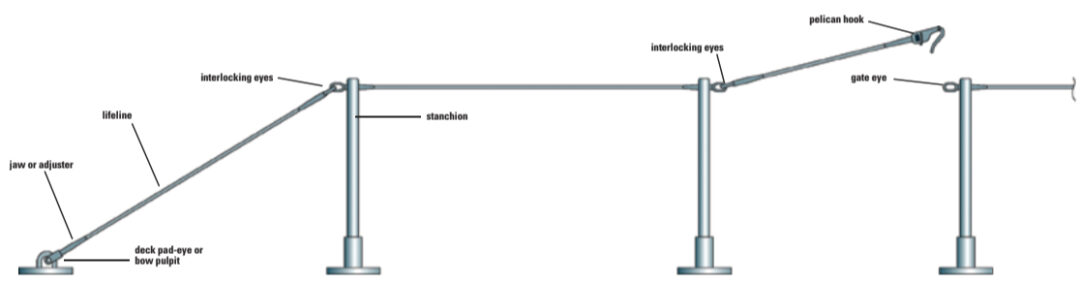
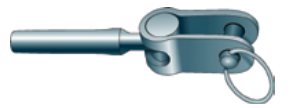
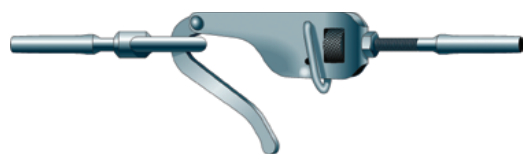
The lifeline system consists of the lifelines themselves, terminal fittings, stanchions, stanchion bases, and the bow and stern pulpits or deck pad-eyes to which the lifelines connect.
Lifeline material
Lifelines on cruising boats are most commonly made of 1 x 19 wire rope (the same type used for standing rigging) covered by a vinyl coating, although you might find 7 x 7 or 7 x 19 wire rope in some installations. The wire inside the vinyl coating is usually 302/304 stainless steel. Although vinyl-coated stainless-steel wire looks and feels nice, the coating can foster corrosion in the wire by trapping moisture inside and eliminating the oxygen that keeps stainless steel stainless. What’s more, the coating hides the corrosion.
To be on the safe side, saltwater sailors should replace vinyl-coated lifelines every five years. When doing so, it is far better to use a larger-diameter uncoated wire as it will be stronger, last longer, and simplify inspection. For uncoated lifelines, 302 or 304 stainless steel offers adequate corrosion resistance. For a brighter, less corrosion-prone lifeline, 316 is a good choice, but it is considerably more expensive. Also, it is not quite as strong as 302/304 stainless steel, so an increase in diameter is indicated.

Swaged and swageless fittings
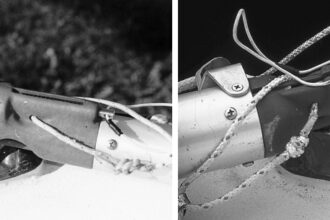
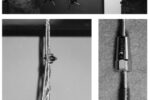
Swaged fittings, such as those used on the standing rigging of most sailboats, are pressed onto wire rope by machine and make a strong terminal connection. Many sailboat lifelines have terminal fittings that are similar in appearance to machine-swaged fittings but are in fact hand-crimped onto the wire rope with a special tool.
Inspect your fittings to see what type they are. The sleeves of hand-crimped fittings have thinner walls than those of machine-swaged fittings and are longer. They are usually crimped in three places, leaving three indentations on the sleeve. A swaging machine, on the other hand, presses the sleeve uniformly along its entire length.
Due to their lesser strength, hand-crimped fittings should not be used in high-load applications, such as standing rigging, and I have strong reservations about using them for lifelines also.
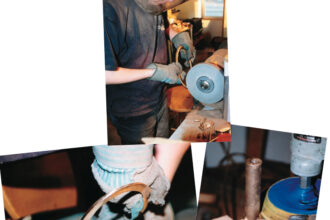
Swageless fittings have become the standard standing-rigging fitting on world cruisers because of their higher strength and greater longevity than swaged fittings and because they can be reused. They are now available in all the terminal configurations used in lifeline systems and offer the do-it-yourselfer a means of creating a stronger lifeline system when the time comes to replace the old lifelines. Swageless terminals are easy to assemble using simple hand tools.


Lifeline height
Currently, the minimum height for lifelines recommended by the American Boat & Yacht Council (ABYC) is 24 inches, but there is an industry move to raise that to 28 inches. If the height is greater than 24 inches, ABYC recommends a second lifeline be fitted at mid-height. This may prevent an adult from rolling underneath but will not stop children or pets from going overboard; for them, it’s necessary to install lifeline netting to fill the gap. The Offshore Racing Council (ORC) requires a minimum height of 24 inches and double lifelines on sailboats over 28 feet in length.
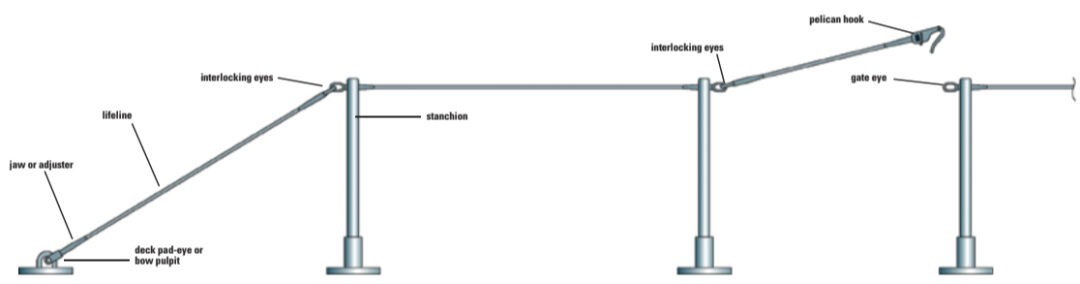
Stanchions and bases
The stanchions that support the lifelines must be very strong and their bases must be very securely fastened to the deck. The higher the stanchion, the stronger it and its base need to be to withstand the longer lever action created by a load on the upper lifeline.
To distribute this load, stanchion bases must be through-bolted to large backing plates. These backing plates are normally 1⁄8-inch stainless steel or aluminum or 3⁄16- to 1⁄4 -inch fiberglass. On sandwich decks, the core material should be dug out and replaced with epoxy to prevent the deck from being crushed. The combination of a stainless-steel stanchion and an aluminum base is a disaster waiting to happen because the initial strength of the base is less and the inevitable corrosion between the dissimilar metals will lead to early failure.
Don Launer, a Good Old Boat contributing editor, has held a USCG captain’s license for more than 33 years and has sailed the East Coast from Canada to the Caribbean. He built his two-masted schooner, Delphinus, from a bare hull. His newest book is The Galley: How Things Work.
Thank you to Sailrite Enterprises, Inc., for providing free access to back issues of Good Old Boat through intellectual property rights. Sailrite.com