Flat, yes; horizontal, no
Issue 76 : Jan/Feb 2011
Finding charts we’d stored on board our 34-foot Creekmore, Eurisko, used to be a constant game of hide and seek. When we put charts on the navigation station (a logical choice), one of the kids would move them to get into the refrigerator underneath. The dinette table is big enough for charts, but it’s also used as a school and computer desk, so charts would often stay there for all of five minutes before they were moved. Every horizontal space is walked upon, sat upon, or used to store something else.
After months of moving charts from one spot to the next, with one of us always hunting for them after someone else hid them, I suggested storing them rolled. My husband vetoed that idea the first time he tried to plot a course on a chart that curled around his parallel rule.
Finally, after considering every horizontal space, I started looking at empty, flat, vertical surfaces. I found the perfect spot below the hanging locker doors.
A web of webbing
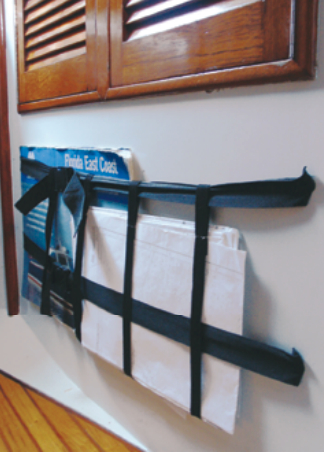
I decided the simplest way to hold the charts against the wall was to strap them in. After a few mockups, I built a sort of pocket out of nylon webbing for the charts to slide into.
The area I had to work with is 46 x 27 inches. I chose to make the pocket 40 x 16 inches, knowing that the bottom would sag and that charts could stick out the top a few inches. I began with 2-inch nylon webbing, the widest we had on board, though I would have preferred 3-inch webbing. For the two horizontal straps, wider is better.
Because nylon stretches and the number of charts to be stored there varies, I made each horizontal strap out of two pieces buckled together. I screwed the outer ends of each of these straps to the bulkhead using finish washers to spread the load. Their ends are 40 inches apart because, when centered, this leaves an aesthetically pleasing border around the charts on the bulkhead. It’s also larger than the folded charts, so they can overlap and not stand out from the bulkhead as far as they otherwise would. This is important since we have a swinging door that barely clears that bulkhead. Besides, 40 is easily divisible by 5.
Next, I cut four pieces of 1-inch nylon webbing 20 inches long. I folded one end of each back on itself and stitched it to form a 3-inch loop through which to slide the top horizontal strap. I drew a light pencil line 6 inches below the bottom horizontal strap and marked it every 8 inches to divide it into five parts. At these marks, I screwed the bottoms of the four straps to the bulkhead. Again, I used finish washers and folded the webbing over, screwing through only the bottom layer. This hides the screw heads.
With these six straps in place, I filled the pocket with charts. We frequently store as many as 100 charts in this pocket. Occasionally, I have to adjust the straps. The buckles make this an easy job. After eight years with our chart pocket, we still consider it to be a good solution. And we always know where our charts are hiding.
Connie McBride , her husband, Dave, and their three sons have been living aboard their 34-foot Creekmore, Eurisko, for 10 years. Now that two of the boys are in college, Connie has time to post experiences and wisdom gained from their cruising life on her website www.simplysailingonline.com.
Thank you to Sailrite Enterprises, Inc., for providing free access to back issues of Good Old Boat through intellectual property rights. Sailrite.com