Meticulous planning ensures a perfect anchor platform
Issue 72 : May/Jun 2010
When Bruce King designed the Ericson Cruising 31, he gave it a sharp entry. As a result, the deck at the stemhead is rather skimpy. And, without the bowsprit of its cutter-rigged sister ship, the Ericson Independence, the bow of the Cruising 31 seems to lack definition. Some owners of the 31, myself included, believe an anchor sprit or platform would make a practical and good-looking addition to this handsome boat.
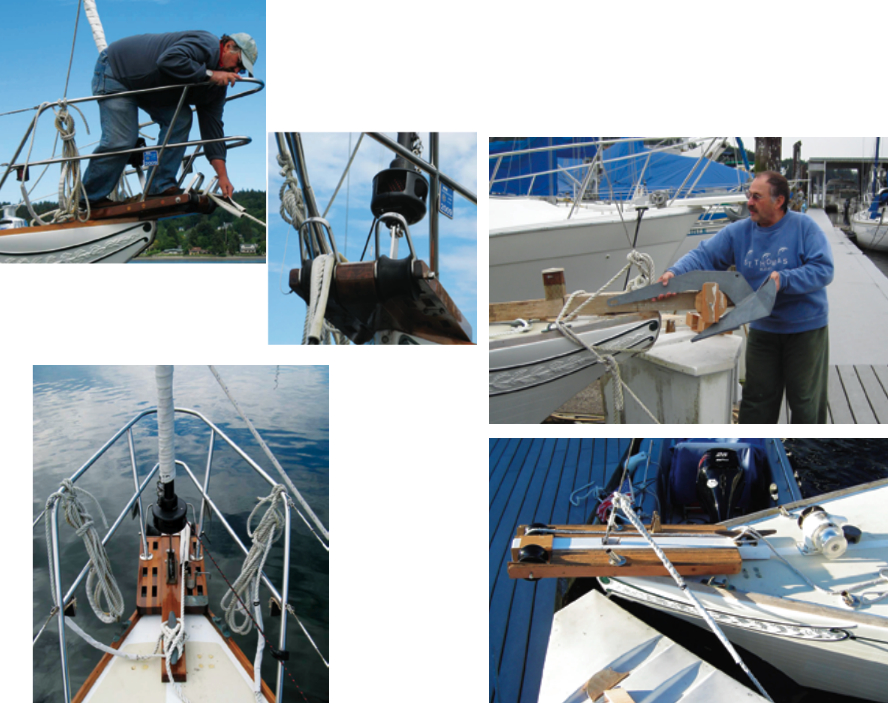
A platform keeps an anchor off the deck and forward of the forestay and roller-furling drum, simplifying and improving anchor handling. It can provide a foothold when changing headsails or checking anti-chafing gear on the bow roller on a dark and windy night, and it’s something to get a foot on when leaning over the roller to clear away seaweed and sort out other surprises that come up with the chain. It also helps prevent the anchor line from riding against the hull.
A platform can make handling docklines safer because it keeps the deck clear of anchor clutter and clean of seaweed and mud. A well-designed anchor platform can also provide a good perch from which to stare into fog or watch porpoises crossing your bows.
I built an anchor platform for my Ericson 31, Kuma, about 10 years ago. It’s been tried and tested in almost every imaginable situation and I’m pleased with it. If I did it again, I’d do it a little differently, but not much.
Same boat, different approach
My friend Gary Stoop, with whom I frequently cruise in tandem, also owns an Ericson Cruising 31 and has eyed my sprit for years. He finally decided to build one for his boat, Imagine, but he decided he’d make a few changes. It would have two rollers, larger and more strongly mounted than mine, and he’d leave off of the stainless-steel hold-down strap, the massive wooden mooring cleat, and the manual windlass that he felt spoiled the teak platform. Because the anchor would be well snugged-up when under way, he would eliminate the sacrificial wooden cleats I’d fitted to protect the sprit from getting banged up. Gary’s platform would be a bit more elegant — rather more in keeping with the rest of the boat.
When setting out to make a good old boat better, it’s well to look at examples of the sort of thing you have in mind, to assess what’s right and, certainly, what’s wrong with others’ solutions to the same problem. Most of our boats have been carefully designed to meet the needs of good sailors so, when planning alterations, the first rule is to do no harm.
Learning by looking
With this in mind, Gary and I began to walk the docks of local marinas looking at various ways of stowing anchors. Every bow had a lesson. Most boats over 30 feet or so had rollers fitted to one or both sides of the stemhead. Some had tiny rollers that could do little to reduce friction and wouldn’t do much to prevent the anchor from slamming against the hull when under way.
Some were over-designed — heavy and substantial enough to have served much larger boats — but most retrofitted platforms were flimsy and ill-considered. Many had awkward or tortured ways of getting the anchor chain and line below-decks. Others carried an off-the-shelf roller unit that appeared hastily stuck on and poorly positioned for best service. Some were badly mounted with poor lead angles, making chafing inevitable. Others showed little evidence of ever having been used, testifying to shallow thinking and corner cutting. But among these what-not-to-do examples, were many good platforms that provided ideas and inspiration of the best kind.
It was easy to lay a tape measure on the various platforms jutting over the dock. We made sketches and took a lot of photographs, from close up and from a distance to capture the effect of the platform on the profile of the boat. Gradually, after weeks of scrutinizing the work of others and perusing books and magazine articles, Gary began to form an idea of the sort of sprit he wanted.
Stout and finely styled
His 35-pound Delta anchor would be held snugly up against one of the two large rollers at the end of a stout teak platform. For reasons of strength as well as appearance, the platform would project as little as possible beyond the stemhead. The platform would simplify and coordinate the placement of deck hardware as much as possible while ensuring good lead angles and minimizing chafe. And while he was at it, Gary would install a power windlass. Apart from strength and convenience, Gary’s paramount concern was how the new anchor sprit would conform to the fine lines and general character of the Ericson Cruising 31.
With the aid of many carefully drawn sketches setting forth critical dimensions, Gary built several plywood mock-ups of the projected platform — about six in all. Each one addressed matters of function and appearance in different and increasingly specific and detailed ways.
He made the first mock-up of scrap pieces of door-skin plywood stapled together. It was his first attempt to deal with two exceptionally large rollers. Earl Hinz, in the definitive The Complete Book of Anchoring and Mooring, holds that rollers should never be smaller than 3 inches in diameter. Gary would use 4-inch diameter Delrin rollers. In comparison to rollers used by most other boats of a similar size along the docks, these were huge.
The first mock-up satisfied all practical problems but was a visual disaster: it made poor Imagine look like an anchor-delivery system. It took several more mock-ups before Gary could match the extraordinary-sized roller with all his other requirements.
Final mock-ups brought together correctly dimensioned pieces of wood and helped him decide exactly how the platform would lie on the deck and where fastenings and hardware, such as the bronze mooring cleat (earlier thoughts about a samson post were abandoned), chocks, and bails would be located. These mock-ups also permitted a more detailed appraisal of the platform’s appearance. Gary determined the locations of new pulpit pads after careful study to ensure that all stanchions and rails were placed correctly.
Crafted of teak
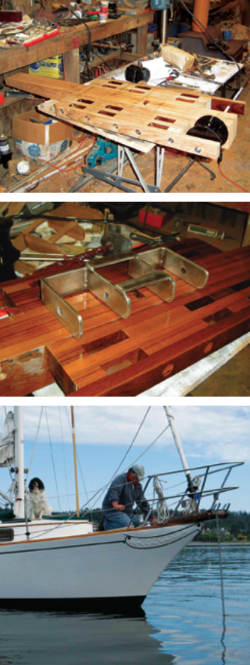
Gary based the overall dimensions of the platform largely on good examples, common sense, and what he thought looked right and built it from lengths of 1 x 1 1/2 -inch teak. The overhang was modest and didn’t seem to require addtional bracing to support the considerable loads the anchor and chain can impress on it. He separated the individual teak pieces with shorter lengths of the same stock, then glued them with epoxy and bolted them together to form a solid unit. He recessed and plugged the bolt heads and nuts and took care to ease and smooth all edges, particularly where the rode would ride when the boat sheered to the anchor and on the underside, where abrasion can occur.
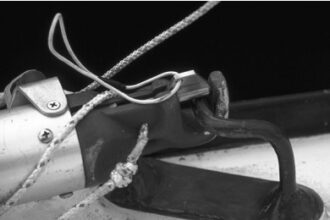
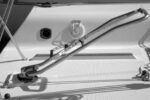
Specially fabricated stainless-steel channels house the Delrin rollers and have hefty strap bails welded to their tops to keep the rode from sliding or lifting off the rollers when the boat pitches. The platform is mounted firmly to the deck by the four bolts that secure the mooring cleat and forward by through-bolts that anchor the deck assembly and toerail to the hull. All bolts have 1/4 -inch aluminum backing plates under the deck. A retaining pin near the anchor’s fluke end, along with a pin through a U-bracket attached to the platform at the after end of the shank, prevents any movement of the hook when it’s stowed.
The platform projects beyond the stemhead to meet functional requirements but it also extends and accentuates Bruce King’s gracefully drawn sheer. The Delta’s flukes continue the line of the clipper bow upward, and the forward edges of the flukes line up with the top and middle rails of the pulpit. Even the bails are angled to echo the pulpit’s geometry. Such meticulous attention to details of form and function has made Gary’s anchor sprit an exceptional addition to a good old boat.
Richard Smith is a contributing editor with Good Old Boat. He has built, restored, and maintained a wide variety of boats and sailed them on Michigan lakes and Oregon reservoirs and from harbors and mud berths in the Irish Sea. He and his wife, Beth, sail Kuma, their Ericson Cruising 31, on Puget Sound.
Thank you to Sailrite Enterprises, Inc., for providing free access to back issues of Good Old Boat through intellectual property rights. Sailrite.com