Make your own handy-billy

Issue 71 : Mar/Apr 2010
Most good old boats have all the mechanical muscle a person could want in the form of powerful winches. Boats at the smaller end of the scale, however, may have a pair of sheet winches on the cockpit coamings but often have no mechanical means to pull the head of the sail that last inch or two necessary to get the desired tautness.
The time-honored way to accomplish this has been to “sweat up” or “swig up” the halyard. To do this, pull the sail up as far as possible and then take a turn around the base of a mast cleat, holding on to the halyard tail. Reach up a few feet above the cleat with your other hand and grab the halyard. Pull it straight out from the mast as though you were pulling a bow string to shoot an arrow. This will pull the sail up a little bit more. Take in the slack with your other hand. Repeat as often as necessary to get the halyard to the tension you want.
But what if your halyards don’t terminate at the mast and are instead led to the cockpit? Enter the poor man’s halyard winch. This is a modern version of a piece of gear found on almost all boats in days gone by: the handy-billy. This device was a portable 3- or 4-part tackle, often with a hook on each end, that could be used anywhere a little extra muscle was needed . . . sort of an early-version come-along.
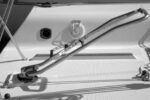
In my version, an aluminum Clamcleat replaces the hook at one end. This makes it easy to grab the halyard even when it has tension on it. (It can also be used to undo a winch override. Grab the sheet ahead of the winch with the Clamcleat, make the handy-billy fast to something solid, and take up on the tackle to relieve tension on the jammed winch.)
The other end of the tackle has a line with a loop that I can drop over a convenient cleat. Even though it’s nominally a 3-part tackle, it has a 4:1 mechanical advantage because the tail leads from the load, adding to the purchase. Using two double blocks or fiddle blocks in a 4-part tackle can give you a 5:1 advantage.
Made up from the parts drawer
To assemble my handy-billy, I used parts and blocks from my I-might-need-that-someday collection. I fastened the Clamcleat and one of the tackle blocks to a 6 1/4-inch length of 1 1⁄4 x 1⁄2-inch hardwood cut from a piece of leftover Brazilian teak, which is very dense and perfect for this application. I didn’t trust the strength of the wood alone so I added a 5⁄8 x 3-inch stainless-steel tang to structurally tie the tackle block to the Clamcleat. You could use a straightened-out eye strap instead. The Clamcleat will handle up to 1⁄2-inch line and is made of aluminum; the plastic ones tend to slip under load. Three #10 x 24 machine screws and nuts fasten everything to the wooden base. I used screws short enough that they wouldn’t extend beyond the underside of the wood and counterbored the screw holes on the underside to recess the nuts.
A little sanding and a couple of coats of varnish before final assembly will make the poor man’s halyard winch an elegant addition to your boat’s toolkit. Just as I have, you’ll no doubt find many other uses for this modern twist on the handy-billy.
Henry Rodriguez has written how-to articles for several publications and has been sailing his 23-foot 1974 Venture of Newport cutter, Chiquita, since buying her in 1978. Over the years, he has replaced or rebuilt every rope, line, wire, spar, and stick of wood on her and she, in turn, has taken Henry and his family on many cruises in the Great Lakes.
Thank you to Sailrite Enterprises, Inc., for providing free access to back issues of Good Old Boat through intellectual property rights. Sailrite.com