An in-line valve eliminates the on-dock sprint
Issue 75 : Nov/Dec 2010
Upon coming into a marina, our first priority is what we like to call “watering the boat.” The procedure begins with filling her main water tank but also entails filling the sun showers, spare water jugs (our main tank is only 10 gallons), and making sure the flush tank on the Porta Potti is full.
In the past, this really required two people, one to operate the spigot on the dock and another to move the hose from container to container. If I was alone, I would rush around putting the hose in here and there, run to the spigot (it’s always down the dock) to turn on the water, run back to see if the tank was filling, estimate when it was about full, and then run back to turn off the water . . . a bit like a Keystone Cop routine. As for all the bottles and jugs, I could pick them up, haul them to the spigot, fill them, then haul them all back on board.
I tried using a spray nozzle on the hose, but these are built to shoot a stream of water —great for rinsing off salt spray but not so good when you try to fill the water tank or a sun shower. What I needed was a shut-off valve at the boat end of the hose. While I was at it, a short section of hose after the valve would be nice so I could stuff the hose into whatever I was filling.
Early morning insight
I was lying awake at 3 a.m. when I came up with the solution. I had been helping my dad set up an irrigation system for watering his lawn. We didn’t want to resort to an in-the-ground sprinkler system so we set up a water manifold that would let him run several hoses off a single outside faucet.
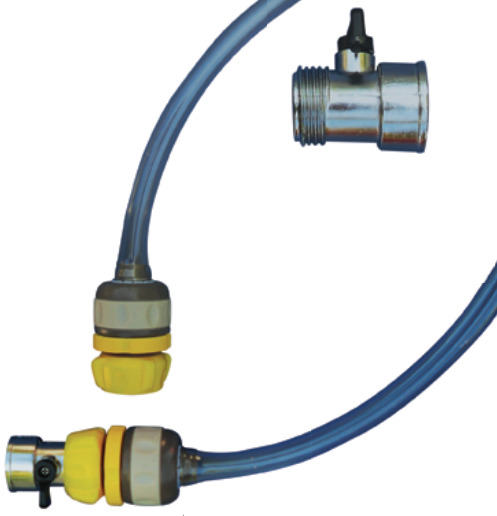
That led to a blinding flash of insight: how about a single in-line ball valve at the end of a hose? Wouldn’t this allow me to control the water flow without having to run down the dock to turn the water on and off? In a word, yes. That morning, we headed into town and found the parts I needed:
- 1 in-line screw-on hose valve, like a tiny seacock. This one was for 5⁄8-inch hose.
- 1 female hose-end fitting for 5⁄8-inch hose. The one I found was all plastic, with plastic fingers that tighten around the hose when you screw the collar down tight — somewhat like a Norseman fitting.
- 1 length of 5⁄8-inch hose, about a foot or two long. I used some clear plastic tubing that I had lying around.
To assemble these parts, I inserted the length of tubing into the female fitting and tightened it, then screwed this unit into the in-line hose valve. Next, I screwed that to the end of the hose. That’s it! Assembly time was two minutes, even for someone who is all thumbs, and I had invested less than $5 in the project.
Now when it comes time to water the boat, I lay out the hose along the dock (it’s cosmic law that the water faucet is always far from the boat), screw on the hose-valve assembly with the valve in the off position, walk back, turn the valve, and commence to fill all the tanks, jugs, and sun showers without having to run up and down the dock.
Dan Cripe and his wife started sailing in 1974 on a Snark Mayflower. They moved along to a MacGregor 21, a 26-foot Kent Ranger, a Bombay 31, and an O’Day 23. They have enjoyed many long family cruises, primarily in the Pacific Northwest. Dan wrote a book, Aye, a Lemming, about a British Columbia cruise.
Thank you to Sailrite Enterprises, Inc., for providing free access to back issues of Good Old Boat through intellectual property rights. Sailrite.com