
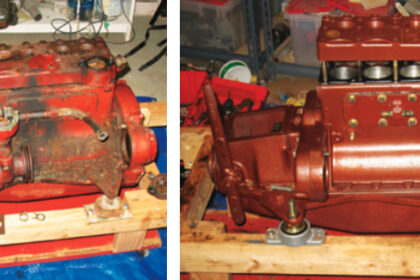
A hands-on rebuild saved both beast and budget Issue 76 : Jan/Feb 2011 Our 41-year-old C&C Corvette, Trillium, has the distinction of being built originally as a gift to retiring Ontario Premier J...

A hands-on rebuild saved both beast and budget Issue 76 : Jan/Feb 2011 Our 41-year-old C&C Corvette, Trillium, has the distinction of being built originally as a gift to retiring Ontario Premier J...
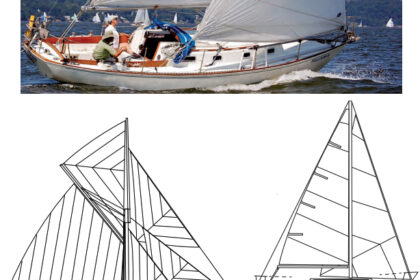
Why American sailors stuck with a movable appendage Issue 85 : Jul/Aug 2012 First, let me say it’s a humbling experience to take over the design comparisons in Good Old Boat from someone with the brea...
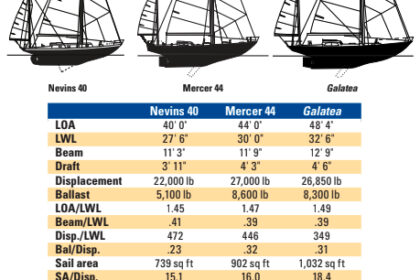
. . . and CCA centerboard contemporaries Issue 85 : Jul/Aug 2012 First built in 1960, and rigged as either a yawl or a sloop, the Mercer 44 goes back to the dawn of fiberglass boat-building. That made...

Many things — coastal enforcer to racing machine Issue 87 : Nov/Dec 2012 The term “cutter” has a long history in the sport of yachting. In the 1870s and ’80s it figured in a hotly debated controversy ...
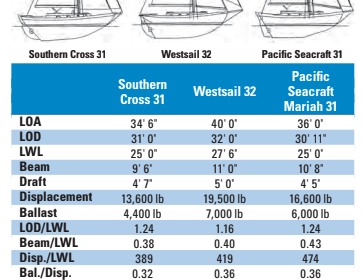
. . . and two more true double-enders Issue 87 : Nov/Dec 2012 In the September 2012 issue we looked at three “second generation” cruising boats that had fin keels and separate rudders on handsome cano...
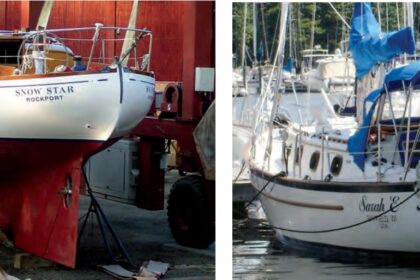
They grew from similar philosophies but have roots an ocean apart Issue 86: Sept/Oct 2012 When selecting comparison boats for the Pacific Seacraft 34 (see “The Pacific Seacraft 34 . . . and cano...
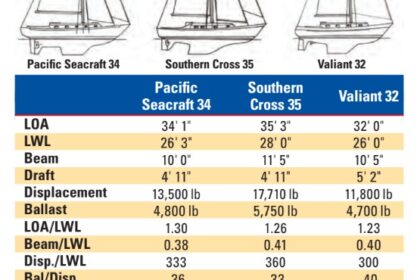
. . . and canoe-stern contemporaries Issue 86: Sept/Oct 2012 This really is a subset of yacht design: canoe-stern fin-keeled cruising boats. I say “canoe stern” rather than “double-ender” because, to ...

Persistence pays off with a solo solution Issue 90: May/June 2013 Almost every boat manufacturer eventually tries its hand at designing a mast-raising system, with varying degrees of success. While I ...

The evolution of the three-cornered mainsail Issue 89 : Mar/Apr 2013 The three boats in our comparison this issue have almost identical sail plans. Each is a masthead sloop with a Marconi mainsail. Th...
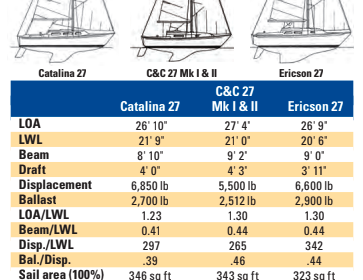
. . . and its club-racer contemporaries Issue 89 : Mar/Apr 2013 Almost every production builder in the late 1960s and early ’70s initially entered the market with a 27-footer, if not as its first boat...
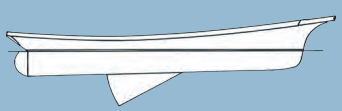
Movable appendages went almost full circle Issue 91 : Jul/Aug 2013 In the early history of yachting there were two distinct types of sailing craft, keelboats and centerboarders, and at the time, as th...
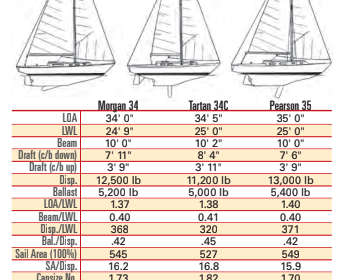
. . . and two fellow CCA keel/centerboarders Issue 91 : Jul/Aug 2013 I have to admit to having a prejudice toward keel/centerboarders — possibly due the fact that I own one — so I’m pleased to be look...
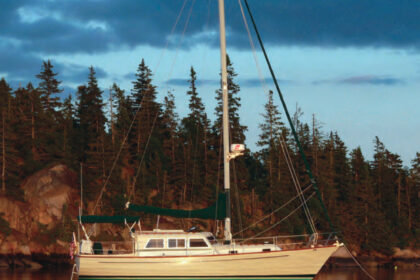
Shelter and a helm station are key features Issue 92 : Sept/Oct 2013 It’s a challenge to define what we mean when we refer to a pilothouse on a sailboat. Is inside steering a definite requirement? Wha...

What’s the D/L with the SA/D? Issue 93 : Nov/Dec 2013 Good Old Boat receives frequent letters from readers asking for an explanation of the formulas used to compare sailboats. We generally refer peopl...
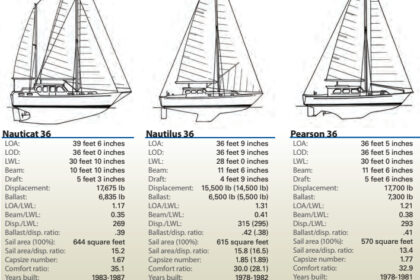
Evaluating three variations on a theme Issue 93 : Nov/Dec 2013 In the article, “Defining a Pilothouse,” in the September 2013 issue, we looked at how the aft end of a sailboat’s coachroof is designed ...
Designing by eye gives way to numbers Issue 94 : Jan/Feb 2014 We have discussed at length in recent issues the design formulas used to compare boats of different designs and reach conclusions regardin...
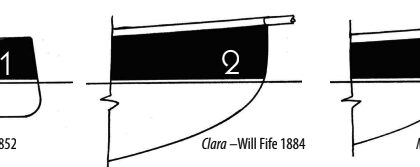
Fashion and formulas reshape the forefoot Issue 95 : Mar/Apr 2014 Nothing looks quite as “yachtie” or traditional as a clipper bow with a long bowsprit pointing the way ahead. Some of the most classic...
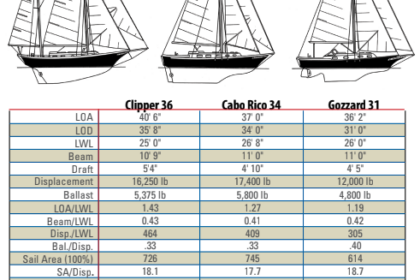
. . . and two more classic clippers Issue 95 : Mar/Apr 2014 The most obvious design feature of the Bill Luders Cheoy Lee Clipper 36 is the pronounced clipper bow, which is synonymous with the name of ...
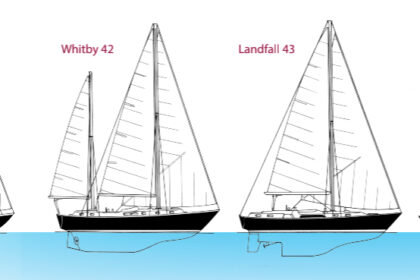
The elusive measure of comfort at sea Issue 97 : Jul/Aug 2014 The subject of seakindliness comes up any time the conversation turns to long-range cruising. Someone who asks about a particular boat, “H...
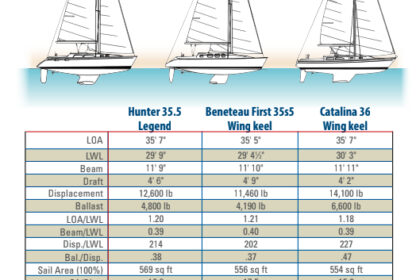
. . . and two high-production contemporaries Issue 99 : Nov/Dec 2014 The Hunter 35.5 was one of the many boats built by Hunter whose design credit reads “Warren Luhrs and the Hunter Design Team.” Over...
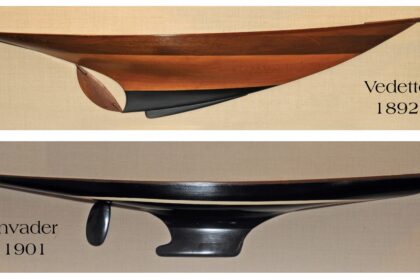
Current designs arrived via varied routes Issue 100: Jan/Feb 2015 All three of our comparison boats in this issue (see “The Vineyard Vixen 34 meets two canoe-stern cousins”, Issue 100) hav...
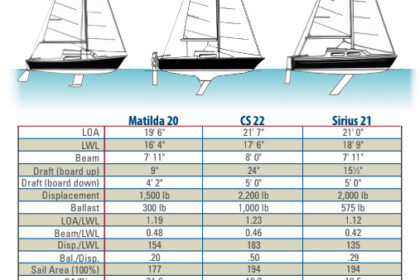
. . . and a pair of pocket trailerables Issue 99 : Nov/Dec 2014 Jim Luce, a good friend from the Nyack Boat Club, once described cruising in small boats as camping but with the added risk of drowning!...
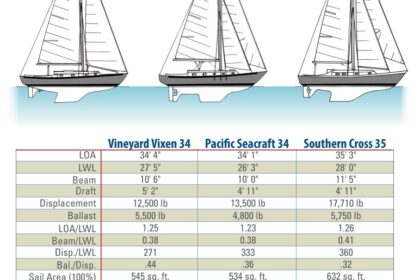
. . . meets two canoe-stern cousins Issue 100: Jan/Feb 2015 The Tom Hale-designed Vineyard Vixen 34 is a pretty little canoe-stern yacht much in the style of Bill Crealocks’ Pacific Seacraft 34 and Th...
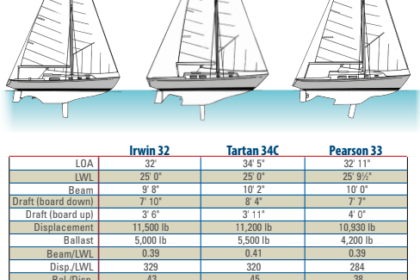
. . . alongside two contemporary keel/centerboarders Issue 101 : Mar/Apr 2015 Boats designed in the late 1960s and very early 1970s embody the later developments of the CCA Rule before the introductio...
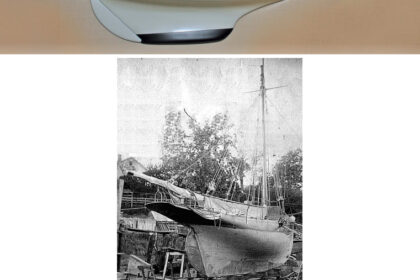
The long road to separation of keel from hull Issue 102 : May/Jun 2015 In a previous article (“How Sailboat Rudders Evolved,” January 2015), we looked at the evolution of the rudder on sailing yachts ...
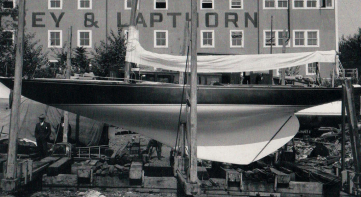
Separation achieved Issue 103 : Jul/Aug 2015 In part 1 of this series about the evolution of keels (May 2015), we looked at the early use of external ballast let into the keel timbers of early British...
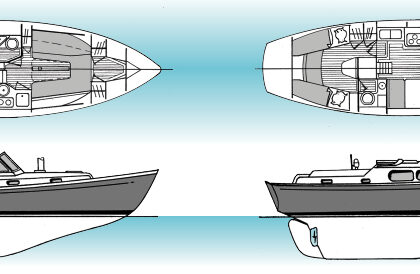
Two Chris-Craft 35s illustrate the designer’s dilemma Issue 103 : Jul/Aug 2015 When doing design comparisons for our feature boat articles, it’s important to find the proper variation of the model in ...
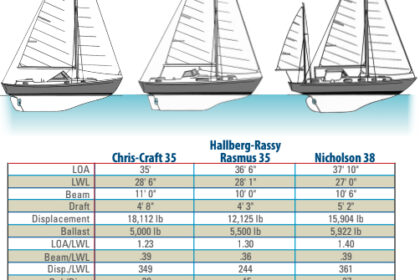
. . . and center-cockpit contemporaries Issue 103 : Jul/Aug 2015 The center-cockpit layout creates an ideal accommodation plan for cruising, especially for those cruising with another couple or kids. ...
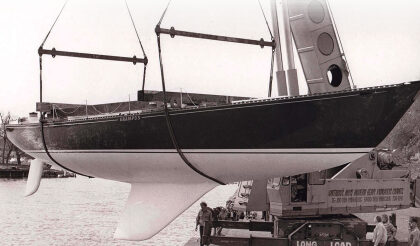
Bites, sweep, fins, bulbs, wings, and winglets Issue 104 : Sept/Oct 2015 In Part 1 (May 2015) and Part 2 (July 2015) of this narrative, we explored the evolution of the keel from a longitudinal struct...
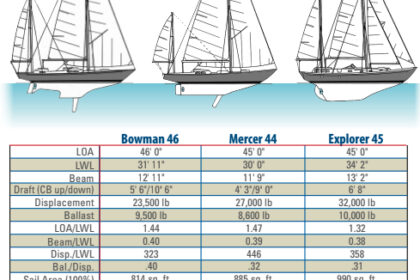
. . . and partners from the era of split rigs Issue 105 : Nov/Dec 2015 The Bowman 46 was designed originally with a deep-draft fixed keel and the majority of the boats built from that tooling retained...