Separation achieved
Issue 103 : Jul/Aug 2015
In part 1 of this series about the evolution of keels (May 2015), we looked at the early use of external ballast let into the keel timbers of early British and American cutters and the evolution of fin and bulb keels under the design genius of Nathanael Herreshoff. We also saw how the trend, considered to be unhealthy, toward light-displacement fin-keelers was thwarted by more restrictive design rules, such as the Universal Rule, that quashed departures from the norm. This led to very conservative and predictable hulls, once the basic dimensions had been established. While this had the desirable effect of not quickly obsoleting older boats, it did stifle innovation and design experiments.
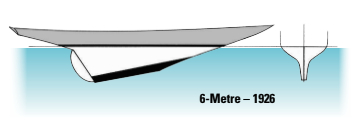
In the 1920s — especially after the success of international racing in 6-Metres for the Scandinavian Gold Cup, the British-American Challenge Series, and the Seawanhaka Cup — the Universal Rule soon gave way to the International Rule for “small boat” racing. The 6-, 8-, and 12-Metre classes dominated in this period with only the America’s Cup retaining the Universal Rule for J-Class designs. The International Rule still embodied the girth-difference factor that in the early version of the International Rule led to dramatic reductions in measured draft at the point amidships where the girth measurements were taken. This resulted in marked “drag” to the keel as seen in the 1926 6-Metre design.
The CCA years
As noted previously, new rules often promote new designers, and one of the first new American designers to find fame in designing 6-Metres was the young Olin Stephens. It was not long before he built on his success in the 6-Metre class in the design of his first ocean racer under the CCA Rule, which became the dominant rule in North America until the 1970s.
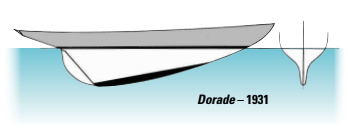
His 1931 Dorade incorporated the same “drag” in the keel, with the profile line a continuous convex curve from stem to rudder tip, as well as the narrow beam of his successful 6-Metre designs, even though the rule did not require or promote these features. In this design, the keel was again merged with the hull. This is reminiscent of “lifting body” concepts that came to the fore five decades later in the design of space shuttle re-entry shapes, where the fuselage and small integrated wings, rather than the wings alone, formed the lifting surface. That is, the fuselage and the small wings worked together to generate lift by shedding large vortices from the combined leading edge.
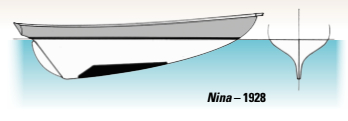
Olin Stephens was not alone in de-emphasizing the keel as a unique lifting surface, as illustrated by the profile of the famous offshore racing schooner, Nina, designed by Starling Burgess in 1928. As with Dorade, Nina’s profile is a continuous convex curve from stem to rudder, with the cast-lead ballast let into the backbone just as it had been done in Yolanda 50 years previously.
One rationale for this de-emphasis on the distinctiveness of the keel may be that, as ocean racers, these boats were not designed specifically for a racecourse guaranteed to have a high percentage of upwind work. But that is only speculation.
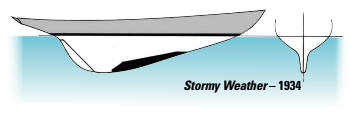
By the time Olin Stephens designed Stormy Weather in 1934, he was using substantially greater beam but, just as significant, he introduced a slight deflection in the profile curve to start a modest differentiation of the keel. Up to this time, the ballast casting, although merged with the wooden keel, was still only a portion of the keel. It certainly had not yet become a foil in its own right.
This continuous profile, or at most a slight deflection in the profile at the keel — combined with wineglass hull sections, slack bilges with generous keel fillets, and cast-lead ballast let into the deadwood of the keel — would remain the norm throughout the 1930s and ’40s and well into the ’50s and even ’60s. Ray Hunt’s Concordia yawl of 1938 and Phil Rhodes’ Bounty II of 1956 (one of the first fiberglass hulls built) are excellent examples, and each bears a marked resemblance to the Britannia “ideal” of 1893! So much for progress.
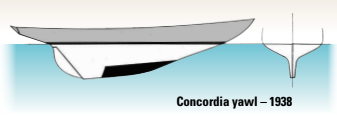
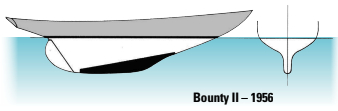
Well-known designers of the time stuck with these shapes, including Sparkman & Stephens and Carl Alberg, who employed them in designs for Pearson and Whitby Boat Works and never really departed far from them. S&S, though, did begin to make the transition to separate keel and rudder in their racing and production boats, most notably with the 1967 America’s Cup 12-Metre, Intrepid. However, boats like the Concordia yawl, the Bounty, and the Albergs certainly are beautiful examples of the art of yacht design, if not the science.
By 1963, the young Canadian designer George Cuthbertson and his design associate, George Cassian, had already established a growing business in the design of wooden and aluminum racing sailboats under the CCA Rule. That year they were approached by Gordon Fisher to design a larger replacement for his precious Cuthbertson & Cassian-designed La Mouette, built in strip-planked cedar at Metro Marine in Bronte, Ontario.
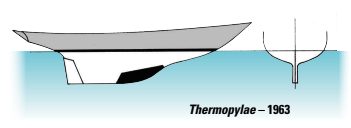
The new boat, named Thermopylae after the famous British tea clipper, was also built in strip-planked cedar by Metro Marine and when launched in 1964 represented the highest level of racing-yacht design and construction in the country, if not on the continent. Compared to the accepted norm of the time as exemplified by the Bounty, she had flatter bilges (fewer wineglass sections) and tighter and smaller keel fillets, but still a full keel and attached rudder with inset cast-lead ballast. The rudder was an extension of the keel, but it had a slightly more vertical stock, and the hull profile was still very reminiscent of Britannia and the Bounty, except for the change in rudder shape.

Fin-keel revival
Herreshoff’s 1891 vision of the light-displacement fin-keeler was about to make its second debut on the racing scene in 1963, when the Bill Lapworth-designed Cal 40 was launched in California. Like Dilemma 72 years previously, the lightweight Cal 40 sported a separate keel and rudder. Although not a true fin-keeler — it didn’t have a flat-plate fin and torpedo-shaped bulb — the Cal 40 did eliminate all the useless deadwood between the keel and rudder, creating two independent and much more efficient foils, one for control and the other for lift. The success of the Cal 40 in Trans Pac, SORC, and Bermuda racing in the mid-1960s essentially obsoleted everything that existed previously. However, the cast-lead ballast was still only a segment of the total fiberglass fin and was not cast as the entire fin.
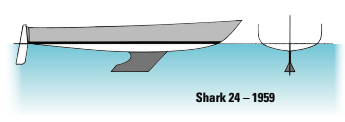
Although the Cal 40 drew attention back to the fin-keel configuration on the international stage, George Hinterhoeller had already designed and launched his little 24-foot Shark one-design in 1959 in Niagara-on-the-Lake, Ontario. (The following year he converted his construction from cold- molded plywood to fiberglass.) Like the Cal 40 that would soon follow, the Shark was light displacement, but with a small cast-iron keel modeled after the Uffa Fox 1947 Flying Fifteen design with the iron fin and ballast a single casting that was bolted directly to the hull. This concept of a one-piece casting would soon become the norm. The Shark could compete boat for boat with 50-foot ocean racers, especially on a heavy-air reach or run.
The success of the Shark and Cal 40 did not go unnoticed. The separated keel and rudder, after considerable tank testing, were applied by George Cuthbertson to the design of Red Jacket for Perry Connolly in 1966. While they have similar bow and keel profiles and hull sections, the biggest difference between the 1964 Thermopylae and the 1967 Red Jacket is the cutting away of the deadwood aft, creating a separate keel and rudder. Red Jacket won her division in the SORC in 1967 and the SORC overall in 1968. Her success led to the creation of C&C Yachts in 1969. She was to become the shape of yacht design for many years, at least until the introduction of the IOR Rule in 1973.
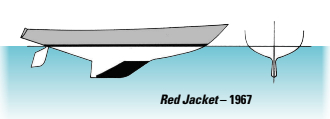
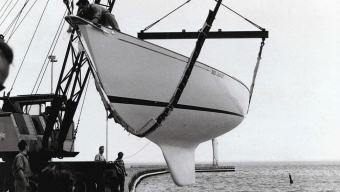
By 1970, the separate keel and rudder was the norm in performance-oriented boats. However, even with the keels on the Cal 40 and on Red Jacket, the cast-lead ballast was only a portion of the fin. The rest was occupied by a molded-fiber-glass sump or welded-aluminum water tank. The next step would be a one-piece ballast fin that was bolted to a separate “canoe body.” The only thing connecting them was a molded sump and fillet and this, too, would soon disappear. This is not to say that the more traditional Bounty-type hull would no longer be produced. Rather, it was now relegated to cruising and club racing, not the competitive racecourse.
Rob Mazza is a Good Old Boat contributing editor who, in his long career with C&C and in other design offices, designed many boats that are now good and old and thus contributed enormously to the enjoyment of those who sail and own them today.
Part 3 of this series, in the September issue, continues theevolution of the keel with bites, fins, bulbs, winglets, and more.
Thank you to Sailrite Enterprises, Inc., for providing free access to back issues of Good Old Boat through intellectual property rights. Sailrite.com