. . . and partners from the era of split rigs
Issue 105 : Nov/Dec 2015
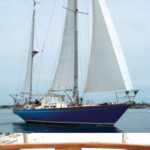
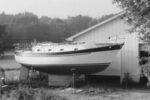
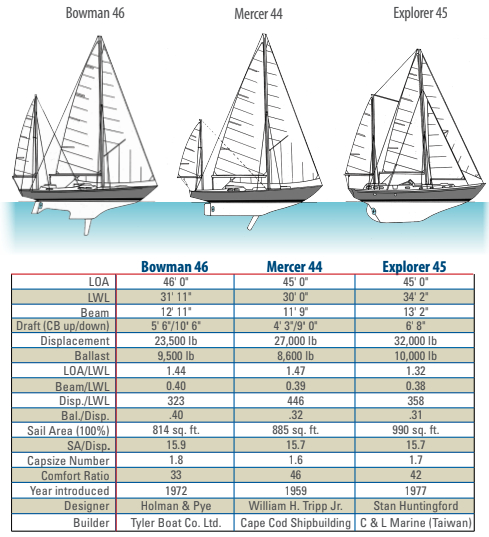
The Bowman 46 was designed originally with a deep-draft fixed keel and the majority of the boats built from that tooling retained that configuration. Mug Up, however, is one of the few built with a shoal-draft keel housing a high-aspect-ratio centerboard. Quite often in production sailboat building, interchangeable inserts in the hull mold are used to allow keel sumps of different lengths. The centerboard is usually housed in a keel with a longer chord length to add some area to partially compensate for the reduced draft, as well as to accommodate more ballast to achieve equal stability with the higher center of gravity. That does not seem to be the case with the Bowman 46, where it appears that draft has been reduced 18 inches without adding area other than with the centerboard. The original keel had plenty of area to begin with, so this reduction may not be that critical. I found no evidence that the ballast weight was increased to compensate for the reduced draft, so I have used the original ballast weight in this analysis.
One of the boats I chose to compare to the Bowman 46 is the Mercer 44, a Bill Tripp design from 1959, one of the first production fiberglass sailboats built and the subject of my very first design comparison in the July 2012 issue. It is also a centerboard yawl, but with a full-length keel common to the CCA designs of the period. The second boat is the Taiwanese-built Explorer 45 of 1979. Although this boat has a fixed keel and no centerboard, I included it for three reasons: it has a split rig, it has a center-cockpit layout like the Bowman, and I think it deserves attention as it is a very attractive boat. It was designed by the late Canadian West Coast designer Stan Huntingford, whose work should perhaps be better known.
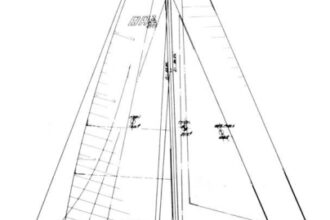
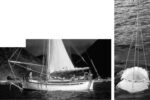
All three boats have split rigs. The Mercer and the Bowman are CCA yawl rigs, perhaps the most useless rig configuration ever devised. Yawls date to the 19th century, when the term referred as much to the type of boat as the rig. The yawl rig as we know it became popular in yachting in the early 20th century when a lot of aging racing sloops and cutters added the diminutive mizzen to achieve a more favorable time allowance. The mizzen could be easily added to the deck aft of the rudder with only a slight shortening of the main boom and minimal alteration of the sail plan. Some boats had a mizzen added as a cruising amenity, along with a shorter mainmast and a whole different suit of sails, but the rig received new momentum under the CCA Rule, when it was discovered that a large mizzen staysail incurred no rating penalty. The Mercer’s handkerchief of a mizzen is an egregious example.
Since its mizzen, although aft of the wheel, is stepped right above the rudder, the Explorer 45 could technically be called a ketch. It has the largest mizzen of the three relative to the size of the main and a much more workable sail plan as a result, especially with its double headsails and self-tacking staysail. You can picture this boat sailing in heavy weather under just the mizzen and staysail.
While its overall length lies between those of the other two boats, the Explorer 45 is the largest of the three, with a waterline 4 feet longer than the Mercer’s and a displacement 8,500 pounds greater than the Bowman’s. I question the 23,500-pound published displacement of the Bowman, though, since I have seen it listed as high as 26,000 pounds in brokerage literature. Using this lighter displacement gives the Bowman the lowest displacement/ length ratio of 323, compared to 358 for the longer-LWL but heavier Explorer, and a whopping 446 for the Mercer. However, the larger sail area of the Mercer results in almost equal sail area/displacement ratios for all three boats of about 15.7, which is quite acceptable for a cruising boat of this type.
A discussion of the relative performance of the three boats must include the three distinctly different underwater profiles. The Bowman, with its separate keel and rudder, would certainly have the lowest wetted surface with resulting better light-air performance. On the other hand, the deeper-draft Explorer, despite having greater wetted surface, may well have the edge upwind in a breeze due to the increased stability and sail-carrying ability imparted by its higher displacement and lower ballast center of gravity. The longer waterline would certainly give it an advantage as boat speeds increase, especially on a heavy-air reach.
It is interesting to note the long overhangs, especially aft, on the Bowman and the Mercer, so characteristic of boats from this period. All three boats have quite acceptable capsize numbers and comfort ratios, as befits their lineage and vintage. For bluewater cruising, I don’t think you could go wrong with any of these attractive, larger fiberglass cruising split rigs from the new age of sail.
Rob Mazza is a Good Old Boat contributing editor. In his long career with C&C and in other design offices, he designed many boats that are now good and old and has thus contributed enormously to the enjoyment of those who sail and own them today.
Thank you to Sailrite Enterprises, Inc., for providing free access to back issues of Good Old Boat through intellectual property rights. Sailrite.com