. . . up against a pair of two-stickers
Issue 109 : Jul/Aug 2016
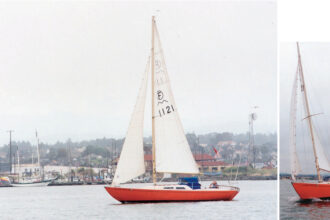
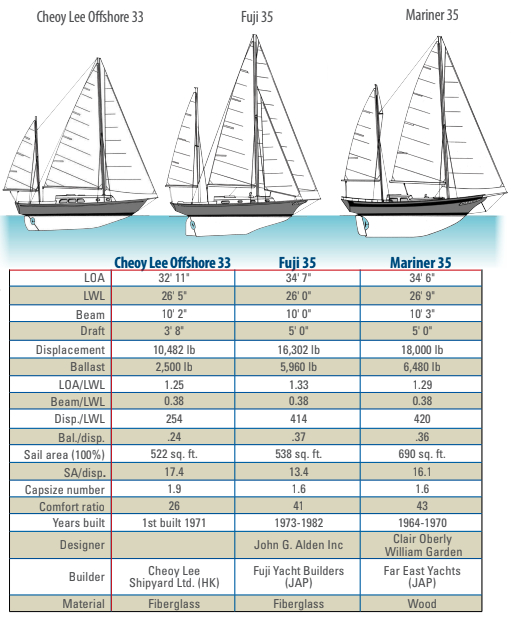
Here is a trio of cruising ketches in a very traditional style from the late 1960s and early ’70s. That is, split rigs with full keels and moderate draft. What I find interesting here is that their builders, two in Japan and one in Hong Kong, sought out very traditional and reputable American designers in John G. Alden and Bill Garden. This was at the time boats from the Far East were first being imported into the U.S. market, so using respected U.S. designers was smart marketing. Note, however, that no designer is listed for our feature boat, the Cheoy Lee Offshore 33. The Cheoy Lee Offshore 31 from 1968 is partially attributed to L. Francis Herreshoff, and any references to the design of the Offshore 33 say it is “in the Herreshoff style,” or “based on a former Herreshoff design.” However, there is no question that the drawings for both of those boats originated in the Cheoy Lee engineering offices and not with L. Francis Herreshoff, who stopped designing in the 1960s. He died in December of 1972, the year after Cheoy Lee introduced the Offshore 33.
Having looked at yawl rigs in past comparisons and commented on their popularity in early CCA designs, I find it interesting to look at these three ketches. The first thing to notice is that the mizzen is slightly larger than what was the norm in those yawls, and it also intrudes a great deal more into the cockpit area. The cockpit can get crowded enough with steering gear, sheet winches, and crew, not to mention biminis and dodgers, without the added complexity of a whole mast with standing and running rigging right in the middle of it all. However, the ketch rig certainly brings the mizzen-mast forward and makes handling the sail easier. In my whole design career, with three different design offices, I have only been involved in one ketch rig and no yawl rigs. That ketch rig was on a C&C 61, aptly named Ketch.
It is also interesting to note that, as well-known as L. Francis Herreshoff’s designs were for their clipper bows, the design attributed to him is the only one of our three without a clipper bow.
Let’s see what the numbers tell us about the relative performance of these three boats, recognizing once again that we are basing this study on published, numbers only, with displacement being the most suspect.
There is a great range of displacements between these three boats on very similar waterline lengths. The light 10,482-pound displacement of the Cheoy Lee is initially suspect, until we see that the weight of its ballast,
at 2,500 pounds, is less than half that of the Fuji (5,960 pounds) and the Mariner (6,480 pounds). This is listed as iron ballast. Could it be they used tooling made for lead ballast, but cast it in the lower density iron instead?
When the ballast weight is subtracted from the published displacement to get the “everything else” weight of each boat, the Offshore 33 still seems light at 7,982 pounds, compared to the Fuji 35 at 10,342 pounds and the Mariner 35 at 11,520 pounds. This produces displacement/length ratios of a reasonably sporty 254 for the Offshore 33 and a much more conservative 414 for the Fuji and 420 for the Mariner. The light displacement of the Offshore 33 gives it an equally sporty sail area/displacement (SA/D) ratio of 17.4. The Fuji 35, with a similar sail area, has a more conservative 13.4, while the Mariner, with a substantially higher sail area of 690 square feet, earns a better value at 16.1.
With its lighter displacement and higher SA/D ratio, the Offshore 33 will deliver better performance broad reaching and running in all conditions, but especially in a breeze. Its performance upwind will also be good in very light air, but as wind speed increases, the light displacement and very low ballast weight and ballast/displacement (B/D) ratio will not allow it to carry sail, resulting in very diminished performance. The heavier displacement and high B/D ratios, as well as the deeper draft, will benefit the two 35-footers in these conditions, resulting in similar performance, with the Mariner benefiting from a 9-inch longer waterline.
The lighter displacement of the Offshore 33 results in a more “lively” boat, and this is reflected in a comfort ratio of 26 compared to a little over 40 for the Fuji and the Mariner. That light displacement also results in a capsize number very close to the maximum advisable value of 2, while again the two 35-footers are much more conservative at about 1.6.
Rob Mazza is a Good Old Boat contributing editor. He is very familiar with the nature of good old boats because, during his long career as a yacht designer, he put a lot of thought and energy into creating good new boats.
Thank you to Sailrite Enterprises, Inc., for providing free access to back issues of Good Old Boat through intellectual property rights. Sailrite.com