. . . and center-cockpit contemporaries
Issue 103 : Jul/Aug 2015
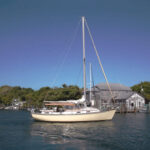
The center-cockpit layout creates an ideal accommodation plan for cruising, especially for those cruising with another couple or kids. Each couple has its own private living area, people aren’t crawling over each other, and individuals can retire to their own spaces but meet in the middle for cocktails and conversation. The two configurations of the Chris-Craft 35, designed by Sparkman & Stephens, offer two approaches to this layout.
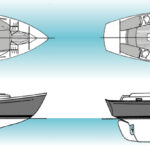
The real difference between these approaches is the height of the cockpit or, more specifically, on what surface the cockpit coaming sits. In the first configuration built, the Sail Yacht, the cockpit coamings sit on the sidedecks; in the later one, the Caribbean, they sit on top of the house (see “Something Gained, Something Lost,” page 16).
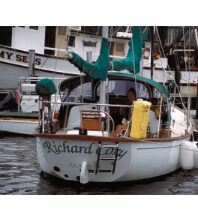
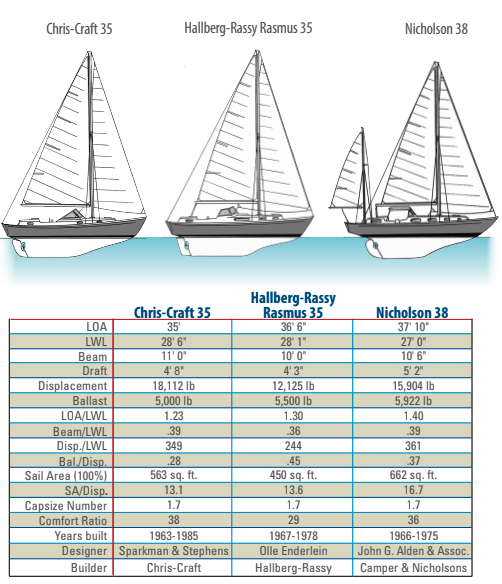
Wanting two full-keel boats to compare with the Chris-Craft Sail Yacht 35, I have chosen the Hallberg-Rassy 35 and the Nicholson 38, both of which have “low” center cockpits and coamings at deck level. All three boats also have fixed windshields, rather than removable canvas and isinglass dodgers, with the Nicholson going one step further and including a fixed hardtop over the cockpit supported by the windshield at its forward end. All three also have full keels with rudders attached and props in apertures. Note that the British-built Nicholson was designed by the John G. Alden office, although Alden himself died in 1962.
At 38 feet LOA, the Nicholson is 3 feet longer than the other two boats but is only 27 feet on the waterline, that is, a foot shorter than the Hallberg-Rassy and a foot and a half shorter than the Chris-Craft. The Nicholson also is yawl-rigged, typical of the CCA designs of the period, while the Chris-Craft and Hallberg-Rassy are sloop-rigged.
At first glance, the 12,125-pound displacement of the Hallberg-Rassy seems suspicious, and past readers know how skeptical I am of published displacements. However, comparing it to the C&C 35 Mk I from the same period, which displaces 11,000 pounds on a 27-foot 6-inch waterline, and the later C&C 35 Mk II that underwent a similar “update” at 13,800 pounds on a 30-foot 2-inch waterline, it is actually the Chris-Craft’s displacement at 18,112 pounds that seems out of whack. It’s possible it represents conservative “overkill” in the laminates of the first fiberglass hull Chris-Craft had ever built.
These are not race-oriented boats, so comparing their performance around a hypothetical racecourse may be misleading. This is especially true when considering their reduced rig size with each being shown generally with smaller headsails. Having said that, there is no question that the Hallberg-Rassy with a displacement/length (D/L) ratio of a very competitive 244 — compared to a hefty 349 and 361 for the Chris-Craft and Nicholson — certainly has an advantage in most conditions. However, with a sail area of only 450 square feet, resulting in a low sail area/displacement (SA/D) ratio of 13.6, she will suffer in light air. The Chris-Craft at 13.1, even with a sail area of 563 square feet, would not be much better.
In light air, therefore, the nod has to go to the Nicholson with a total sail area of 662 square feet, resulting in a respectable SA/D ratio of 16.7. Although the mizzen of the yawl rig may not be very effective, particularly upwind, that is still a lot of sail area for reaching and running, especially when the mizzen staysail is set.
Despite these three similar boats having a wide range in displacements, the ballast weights are quite consistent at 5,000, 5,500, and 5,922 pounds respectively. This results in ballast/ displacement ratios of only 28 percent for the Chris-Craft, 37 percent for the Nicholson, and a respectable 45 percent for the Hallberg-Rassy. This, combined with her low D/L ratio and moderate SA/D ratio, would make her the better boat upwind in light to moderate conditions. The slightly longer waterline of the Chris-Craft, combined with the larger displacement, would certainly come into effect upwind in stronger breezes where her low SA/D ratio would no longer be a liability.
Capsize numbers for all three are substantially less than 2, reflecting relatively narrow beam and higher displacements, and comfort ratios are also quite acceptable, with the Hallberg-Rassy having the lowest due to her lighter displacement.
We have here three very similar center-cockpit/full-keel concepts with a wide range in displacements. My preference for sailing would be the lighter-weight Hallberg-Rassy for its more sprightly performance, despite a dearth of sail area but, my goodness, the Chris-Craft Sail Yacht is still an extremely attractive boat!
Rob Mazza is a Good Old Boat contributing editor who, in his long career with C&C and in other design offices, designed many boats that are now good and old and thus contributed enormously to the enjoyment of those who sail and own them today.
Thank you to Sailrite Enterprises, Inc., for providing free access to back issues of Good Old Boat through intellectual property rights. Sailrite.com