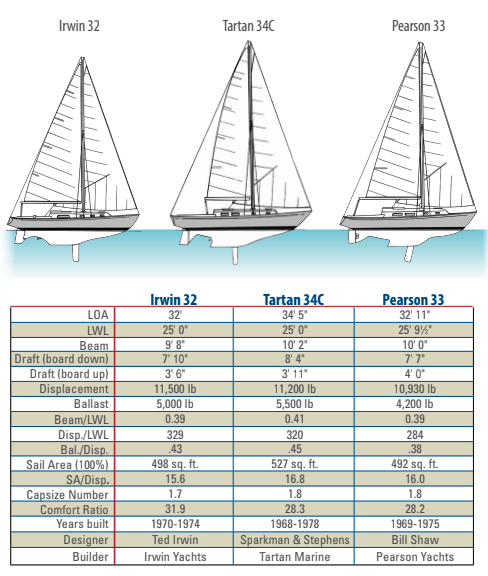
. . . alongside two contemporary keel/centerboarders
Issue 101 : Mar/Apr 2015
Boats designed in the late 1960s and very early 1970s embody the later developments of the CCA Rule before the introduction of the new IOR again changed the shape of racing yachts. The CCA Rule was not a pure design rule as such, since it laid down specific dimensions based on length and either rewarded or penalized departures from these dimensions. The result is that the three designs I chose for this comparison are very similar.
CCA designs also represented the last hurrah of the competitive keel/centerboarder on the racecourse, as exemplified by the race-winning performance of the Phil Rhodes-designed Carina and the Olin Stephens-designed Finisterre only a few years previously. The use of the centerboard greatly increases the cruising capabilities of these three boats, since raising the board allows access to cruising grounds with “thin” water. I have to admit a personal affinity for keel/center- boarders since our own C&C Corvette, Trillium, is of that configuration.
The Pearson 33 and Tartan 34C are very close sisters to the Irwin 32, since all are CCA-influenced keel/centerboarders from top designers and builders of fiberglass production sailboats of the day. Both Irwin and Pearson used “in house” staff designers; Ted Irwin designed his own boats and Bill Shaw of Pearson designed the Pearson 33. Tartan alone turned outside to the design firm of Sparkman & Stephens that had been so successful with previous Tartan products.
The other commonality between the three designs is the evolving separation of keel and rudder by the removal of the “deadwood” between the two in order to substantially reduce wetted surface area. This creates two separate specialized areas of lift: the keel and centerboard are primarily responsible for countering leeway and the rudder provides maneuverability and directional stability. This was a design trend established on the racecourse in the mid-’60s by the success of the Bill Lapworth-designed Cal 40 and the Cuthbertson & Cassian-designed Red Jacket. Note that all three comparison boats employ fixed skegs ahead of and supporting the rudder, with Irwin opting for a partial skeg with a “horn” on the rudder for improved balance.
Note as well that the Tartan and the Irwin hide the prop in the wake of the keel, while the Pearson houses the prop in an aperture in the skeg immediately in front of the rudder. This necessitates removing the rudder before the prop and shaft can be removed, but does improve maneuverability at slow speed under power, since the rudder can more effectively deflect the prop wash.
I included the Tartan 34C in a previous design comparison of the Morgan 34 (see July 2013). Like the Morgan 34, the Irwin 33 incorporates the blended doghouse in the after part of the house for increased headroom in the galley area. This makes, to my eye anyway, a pleasing profile and a good looking boat, especially with her reverse transom aligning with the angle of the backstay. The Pearson 33 also has a reverse transom, while the Tartan has opted for a conventionally raked transom to achieve more deck area aft and a longer LOA.
All three boats also have single-spreader masthead rigs, with the Tartan pointing the direction toward smaller mainsails and larger overlapping headsails and larger spinnakers, a trend that would become even more pronounced under the IOR rule that incorporated the same sail-measurement procedure as the CCA rule.
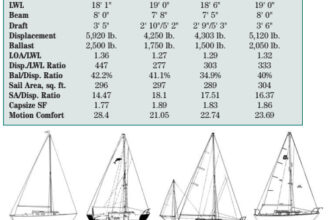
In comparing the “around the buoys” performance of these three boats, I’d have to give the edge to the Pearson with her longer waterline length and lighter displacement. These give her a substantially lower displacement/length ratio of 284 compared to those of the Irwin and the Tartan at 329 and 320, respectively. This would be of particular advantage running and reaching in any sort of breeze. However, the larger sailplan of the Tartan, which results in a sail area/displacement ratio of 16.8 compared to 16 for the Pearson and a low 15.6 for the Irwin, gives the Tartan the edge in lighter air where waterline length is not as important as increased sail area. Her higher-aspect-ratio sailplan will also be an advantage in these conditions. All of the boats’ capsize numbers are under 2 and thus quite conservative and safe, and their comfort ratios are similar. The Irwin has a small advantage in both due to her slightly narrower beam.
All of these boats are pretty to the eye, with pleasing sheerlines, moderate CCA-type overhangs, and good balance between freeboard and house height. The Irwin, however, has an ever-so-slightly rounder stem profile, while the Tartan and Pearson extend the bow line in a straighter profile. All are fine examples of boats designed to exploit the best features of the CCA Rule in its later years.
Rob Mazza is a Good Old Boat contributing editor who, in his long career with C&C and in other design offices, has contributed enormously to the enjoyment of those who sail and own good old boats.
Thank you to Sailrite Enterprises, Inc., for providing free access to back issues of Good Old Boat through intellectual property rights. Sailrite.com