. . . meets a precursor and a follower
Issue 110: Sept/Oct 2016
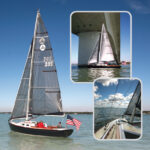
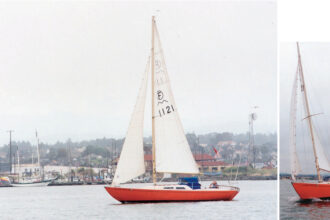
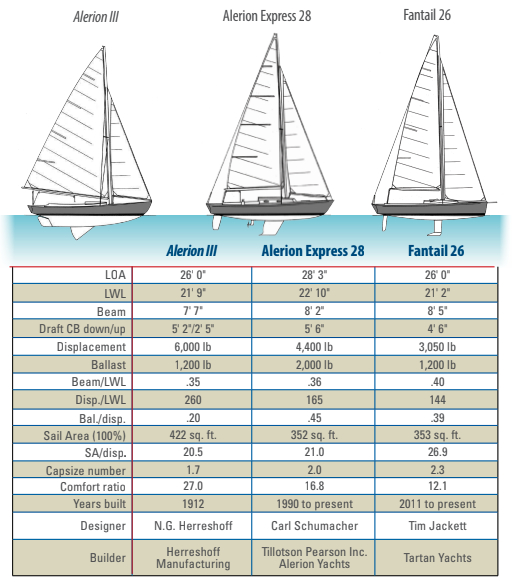
As Bill Jacobs notes in his article on page 10, the design of the Alerion Express 28 was inspired by Alerion III, the boat Nat Herreshoff designed and had built in 1912 for his winter use in Bermuda. Given my fascination with the evolution of yacht design over time, I could not resist comparing Alerion III, essentially a 19th-century design, to one from the late 20th century to see how the “gentleman’s daysailer” has developed over the last 100 years.
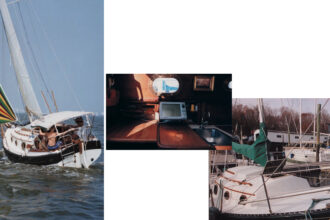
The third boat I have chosen for this comparison is the Fantail 26 designed by my old friend Tim Jackett and built by Tartan Marine. The Fantail 26 again embodies the same combination of elegance and performance that is the hallmark of many a daysailer.
Alerion III has a centerboard, which in some ways matches the fin-keel configurations of the other two boats by introducing a distinct and separate lifting surface, although the ballast center of gravity would be considerably higher. Note also that the modern-day Express 28 and Fantail 26 have the counter stern, moderate overhangs, fractional rig, self-tacking jib, and attractive sheerline that reflect the design aesthetic of 100 years ago. All three of these boats embody the large cockpit and minimal interior amenities of a daysailer but, in a lot of respects, the layout of the Fantail 26 with its cuddy cabin more closely matches that of Alerion III.
The Alerion Express 28 is the largest of these three boats by a little more than two feet. It is about a foot longer on the LWL than Alerion III and about a foot and a half longer than the smaller Fantail 26. However, the Fantail has the widest beam at 8 feet 5 inches, giving it a beam/LWL ratio of .4 against .35 for Alerion III and .36 for the Alerion Express. Also note that Alerion III, at 6,000 pounds is, not surprisingly, the heaviest of the three, with the Alerion Express being about two thirds her weight and the smaller Fantail about half. This produces a displacement/ length ratio of a conservative (but not heavy) 260 for Alerion III, compared to a competitive 165 for the Alerion Express and a sprightly 144 for the much lighter Fantail.
In spite of her heavier displacement, with her larger 422 sqare feet of sail, Alerion III has a sail area/displacement (SA/D) ratio of a competitive 20.4, almost equal to the Alerion Express with its smaller sail area of 352 square feet. However, the Fantail, which has almost exactly the same sail area as the Alerion Express 28 on a displacement lighter by 1,400 pounds, earns a very performance-rated SA/D ratio of almost 27.
So, around a racecourse in light air, you would have to put your money on the Fantail 26 with so much moresail area for its light displacement. As the wind builds, the wider beam of the Fantail will contribute to better form stability and better crew-induced righting moment, so that even in moderate breezes she would be a threat. As the wind builds and boat speed increases, the longer LWL of the Alerion Express will start to allow a higher hull speed. Once they turn more off the wind, the Fantail will certainly start to surf, if not plane, as the wind builds, especially when powered by the large asymmetrical chute on its short bowsprit. Close reaching in heavier air, Alerion III will come into her own with her heavier displacement generating stability even though her lower ballast/displacement ratio means she has a higher center of gravity. (I have had to take an educated guess at the ballast weight of Alerion III as I could not find it in any of the published literature. The construction plan for the boat indicates there wasn’t a lot of it!)
With regard to comfort and safety, the heavier displacement of Alerion III, combined with her narrower beam, produces an easier motion with a comfort ratio of 27, and a very safe capsize number of 1.7. The Fantail’s wider beam and lightest displacement produces the least desirable comfort ratio of 12.2 and an unhealthy capsize number of 2.3. However, since these boats were not designed to venture far from shore, one should not put too much emphasis on these numbers.
So, what great leaps forward do we see in the Alerion 28 and the Fantail 26 compared to Herreshoff’s Alerion III? The biggest difference, of course, is lighter displacement as a result of modern building methods and materials, as well as reduced wetted surface from eliminating the full keel and its attached rudder. On the other hand, the rigs and design aesthetics are very similar. Nat Herreshoff might feel right at home in any of these three boats.
Rob Mazza is a Good Old Boat contributing editor. He is very familiar with the nature of good old boats because, during his long career as a yacht designer, he put a lot of thought and energy into creating good new boats.
Thank you to Sailrite Enterprises, Inc., for providing free access to back issues of Good Old Boat through intellectual property rights. Sailrite.com