Canadian sailors broaden their boating skills on England’s canals
Issue 109 : Jul/Aug 2016
Here we were, four freshwater sailors maneuvering a 65-foot steel narrowboat in pitch darkness through a damp and cold mile-long tunnel at “tick over” speed. How did it come to this?
Over drinks, of course. My wife, Za, and I were kicking back with our friends John and Maureen Vickers in the cockpit of their Catalina 34 when someone suggested we should take a vacation together. John and Maureen proposed a European bus tour. That didn’t appeal to us, so we countered with a Virgin Island charter, but they had already done that.
Za and I later determined that if we were going to plan a dream vacation, free of work-related conferences and trade shows, then a return to Za’s childhood haunts in Devon, England, with side trips to prominent British marine museums and cathedrals, was well past due. With southern England as the focus, we zeroed in on the possibility of doing a one-week canal boat cruise with the Vickers.
Our knowledge of canal cruises was limited to tales told by friends who had taken them long ago, but friends who had been to England more recently encouraged us immensely. Besides, Za’s father had been an engineer on the Gloucester and Sharpness Canal and then the Kennet and Avon Canal, before moving to Canada in the 1950s to take a job with the Welland Canal in southern Ontario. Obviously, canals were in Za’s DNA.
We suggested a canal trip to John and Maureen. I can’t say the initial response was enthusiastic, especially when we said we would be traveling on a 65-foot boat that was only 7 feet wide. Together we measured off, with some incredulity, what we thought would be the 6-foot interior width. But with faith and good humor, John and Maureen declared themselves “in.”
And that’s how we found ourselves in Gayton, Northumberland, pushing our steel leviathan off the dock at 5 p.m. after 20 minutes of instruction. We launched ourselves into the murky waters of the Northampton Canal, heading for a hard right turn into the Grand Union Canal on our way to our first stop for the night, the little town of Bugbrooke.
Internet of canals
England is crisscrossed with canals. John described the canal system of the British Isles as looking “like somebody flung a handful of spaghetti at a map.” Many of the canals were built in the early Industrial Revolution, when the burgeoning number of factories required large amounts of coal to fire their steam-driven machines. The coal fields were a long way from the factories, and the most economical means of transporting heavy and bulky cargo was by water, most notably rivers. With the construction of locks, tunnels, and aqueducts, canals could be made to traverse hills and valleys going up and down, over and through the landscape.
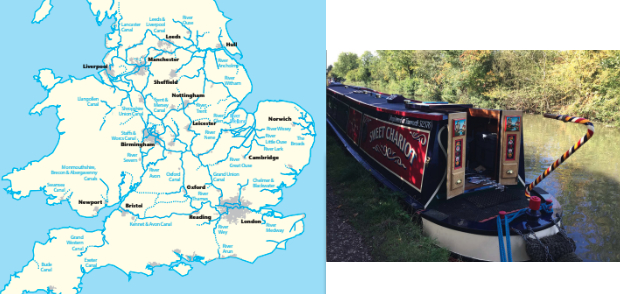
By the mid-19th century, a network of canals crisscrossed the country, connecting seaports to inland towns and to seaports on opposite coasts. The canal concept soon found its way to North America. The Erie Canal of 1825 was a direct result of the success of the British and French canal systems.
On the older canals, the locks used to raise and lower boats to the next water level were built to accommodate 7-foot by 70-foot horse-drawn barges, and every canal was bordered by a towpath for the horses. It’s not surprising that these barges became known as narrowboats. Horses were eventually replaced by engines, first steam and then gas and diesel, and one motorized boat often towed a second or third non-motorized boat known as a “butty.”
By the end of World War II, narrowboats could no longer compete with both the railroads and growing truck traffic on improved roads. The number of boats decreased and canals and locks fell into disrepair. In the 1950s and ’60s, volunteer organizations began their repair and restoration, and enthusiasm for recreational narrowboating grew. Early fans refitted commercial boats, and it wasn’t long before an industry was born building brand-new all-steel narrowboats for ownership or charter. This led to the formation of companies that rented boats to tourists and the development of inland marinas to accommodate the growing fleet.
A boat of a different color
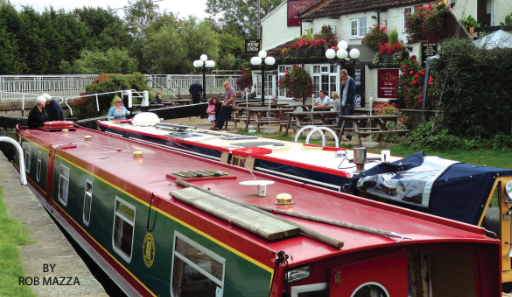
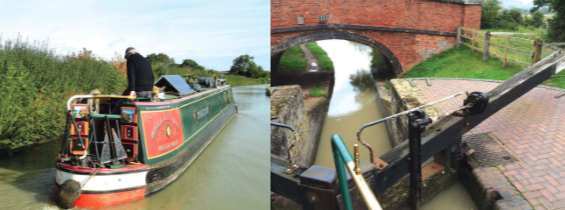
Because narrowboats carried cargoes throughout the country at a walking pace, it was practical and economical for their owners and operators to live on board with their families. They took pride in their floating homes and painted them in flamboyant colors, a tradition that continues to this day.
The first narrowboats were built of wood. Some later boats combined iron (and then steel) sides with wooden bottoms. Today, they are constructed of welded steel to withstand contact with stone locks and with each other when passing in tight quarters.
Almost all narrowboats are steered by tiller. There are three basic cockpit styles. In the traditional or “trad” layout, the helmsman steers while standing in the companionway. The “cruiser” style provides a more open aft deck for the helmsman, who can either stand or sit on curved narrow benches on each side. The “semi-trad” has built-in benches on each side of an enclosed cockpit. We were advised to take the semi-trad style, and that worked out well for the four of us.
We learned that these boats still maintain the walking pace they did when pulled by a canal horse: about 3 miles per hour. As the scenery moved by at a leisurely pace, it was not uncommon for the more energetic hikers on the towpath to outpace us. Wide open, the boats can do about 4 miles per hour, but that was discouraged because of the increased wake. We were advised to reduce speed to idle or “tick over” — about 1 mile per hour — when passing other narrowboats moored on the side of the canal.
Needless to say, our boat did not turn on a dime. We had to watch how much the stern swung during a turn, even during small adjustments in course. This was particularly true in tight turns in the canal, where, either by design or a century of use, the bend had been cut out to accommodate swinging sterns. Steel walls protect the banks from the inevitable contact with boats trying to negotiate these turns.
The towpath goes under the bridges, reducing the width of the canal to the breadth of one boat. Going under a bridge felt like threading a needle, as we took careful aim for the gap between bridge and towpath with little more than a foot to spare on each side.
Navigation
The canal routes are covered in a series of cruising guides. The best-known of these are the Nicholson Waterway Guides. On a generous scale of 2 inches to the mile, the maps show the route of the canal and the locations of locks, tunnels, and “winding holes,” where narrowboats can turn around to go in the opposite direction. They also note towns and villages along the way, with recommendations on pubs, grocery shopping, marinas, watering points, and pumpout stations.
Each mile is marked on the map. The way to estimate the number of hours from one point on the “chart” to the next is to add up the number of miles as marked on the route map, add to that the number of locks on the route, then divide that total by 3. That estimate assumes a speed of 3 miles per hour and 20 minutes per lock and proved to be quite accurate.
Learning to lock
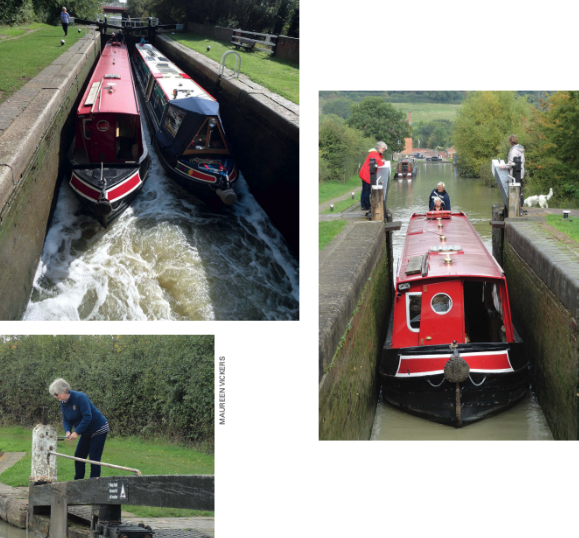
On the English canal systems, the vast majority of locks are operated by the boat crew, not lockmasters. Every boat carries crank handles for operating the mechanisms for raising and lowering the paddles that allow water to enter or exit the locks.
We encountered our first lock on our second day. It was on the Grand Union Canal, which was built later than most, and this lock accommodated two boats side by side. As we approached the lock, Za and I stepped ashore to operate the gates and paddles. This was an upbound lock, meaning water enters the lock to lift the boat to the next higher level. Fortunately, the English couple on the boat sharing our lock helped the Canadian newbies.
Once we had entered the lock, tutored by our co-lockers, we closed the gates behind us. We then opened the ground paddles at the higher level half way, allowing water to flow from the upper level into the bottom of the lock. This created a good deal of turbulence. As the boats started to rise, we opened the paddles all the way. When the water level was halfway up the upper gates, we opened the gate paddles, allowing a further rush of water into the lock. While water is entering the lock, the helmsman must maintain the boat in the center of the lock, away from the gates, by applying forward and reverse as needed.
If the gate paddles are fully opened before the lock is at least half full, water from these higher paddles might flood the forward section of a boat, potentially sinking it in the lock. Once the level in the lock is equal to the higher water level, the upper gates can be opened and the boats powered out of the lock. When the boat is clear of the lock, the crews of the departing boats close all the paddles and the gates behind them.
Locks are most often grouped close together, so one of the crew would walk along the towpath to the next lock in the series, or flight. The other member of the lock crew ensured all the paddles on the previous lock were closed and, if no downbound boat was in sight, closed the gates before joining the other lock crew at the next lock.
If an upbound boat comes to a lock that is full of water, a downbound boat has priority to enter the lock first so the water in the lock is not wasted. Our first flight consisted of seven locks, and by the end of the flight we were pretty well practiced in the art of handling upbound locks.
Going down
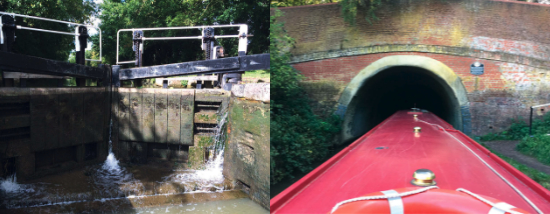
We next ran into a series of downbound locks that presented another challenge. It’s important to make sure the boat is well clear of the lock cill, the portion of the lock that forms the platform for the bottom of the upper gates and projects about 2 to 3 feet into the lock. It is possible for the rudder to hang up on the cill while the bow continues to drop, flooding the forward part of the boat and jamming the boat in the lock. This will incapacitate the lock until the boat can be removed by crane.
On our second day, we encountered the mile-long Braunston Tunnel. We had been warned that, although the tunnel looked perfectly straight, the side walls do undulate, so you have to steer carefully to avoid contact with the brick walls. Fortunately, we did not encounter any boats coming the other way. The light at the end of the tunnel was indeed the end of the tunnel and not a headlight.
Narrow living
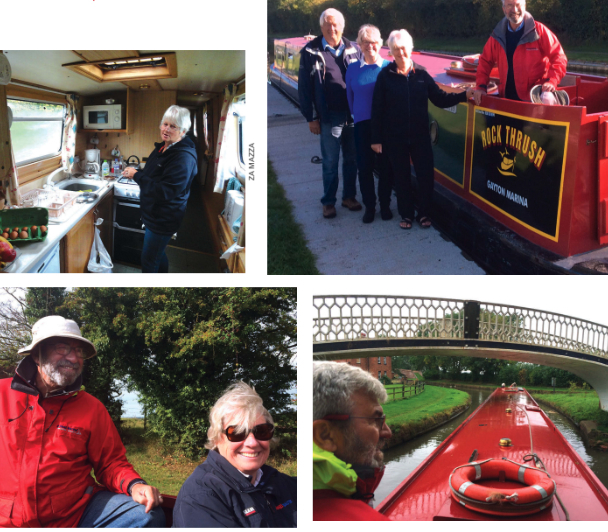
The interior of a 7-foot wide boat is not unlike a railway car, only narrower. There was one cabin aft with a double berth and its own head, a second cabin with a double berth and head amidships, and a galley and dinette forward. Traveling from the aft cockpit to the forward cockpit along either the cabintop or the narrow sidedecks is strongly discouraged. Any route forward or aft by necessity passes through both cabins via a narrow passage beside each head.
The cabin locations also determined the division of onboard responsibilities for the week. Since Za and I occupied the aft cabin, adjacent to the aft cockpit, it was our responsibility to get up each morning to lift a steel plate and reach down into the cold murky water to clear any debris that may have entangled itself on the propeller. We then pumped the bilge, turned on the diesel cabin heater to dispel the morning chill below, and started the engine to generate the extra power required for the microwave, coffee maker, and toaster (only one of which could be operated at a time, even with the engine running). John and Maureen, by virtue of occupying the cabin adjacent to the galley, assumed responsibility for cooking a full English breakfast each morning.
With its dinette that converts to adouble berth, a 65-foot narrowboat accommodates three couples. Shorter boats are available, but we chose this size for the two separate cabins with two heads.
Before picking up the boat, we loaded up on provisions at the local superstore but, since we were usually within easy walking distance of a pub, we ate most of our dinners ashore. While the quality and availability of the food served at the pubs varied greatly, the beer was always good.
A working vacation
We had anticipated a relaxing cruise through the English countryside, but piloting a 65-foot torpedo, even at a slow 3 miles per hour, demands full concentration at the helm and close monitoring of the maps. The whole crew is involved when locking up or down. However, we did develop a system that only required one couple to be “on watch” at the helm when the way was clear, allowing the off-duty couple to sit back.
Ahead of the cruise, our primary concern had been whether the Mazzas and the Vickers would still be talking to each other after a week together in accommodations that measured little more than 5 feet across. To our great relief we were. We still are enthusiastic about the whole experience. Would we do it again? Absolutely! I’ve heard there are canals in France too.
Rob Mazza is a Good Old Boat contributing editor. He is very familiar with the nature of good old boats because, during his long career as a yacht designer, he put a lot of thought and energy into creating good new boats.
Thank you to Sailrite Enterprises, Inc., for providing free access to back issues of Good Old Boat through intellectual property rights. Sailrite.com