. . . and two very different daysailers
Issue 107 : Mar/Apr 2016
Carl Alberg established his reputation as a designer with the Pearson Triton in 1958, the same year he designed the Sea Sprite 23. He used the same design concept in the equally successful Elektra and Ensign, as well as the Alberg 35 for Pearson and the Alberg 30 and 37 built by Whitby Boatworks. He also had a long and successful design relationship with Cape Dory. Over his long career, he didn’t change his design “model” at all. His boats all had full keels, moderate draft, heavier displacement, narrow beam, and attractive sheers with moderate overhangs.
What exactly constitutes a “great” yacht designer . . . or great artist for that matter? Is it doing one thing well over and over again, or is it evolving, innovating, and constantly reinventing oneself and expanding the envelope? The recent biography of C. Raymond Hunt, A Genius at His Trade, indicates the latter, but Carl Alberg undeniably left his mark on the sport of sailing, albeit a similar mark each time.
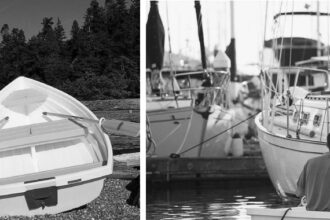
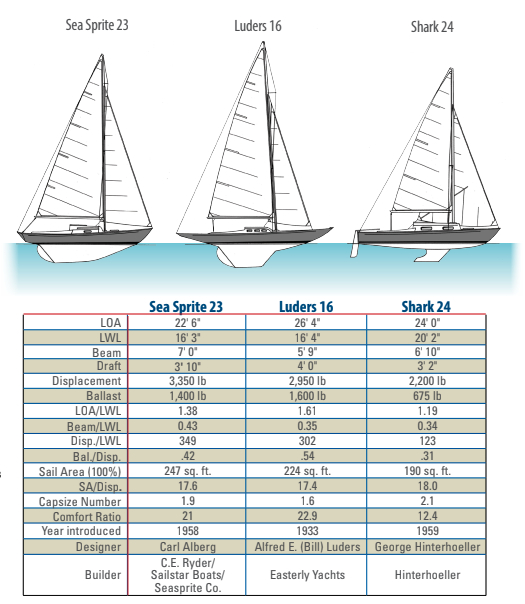
While thinking of “innovation,” let’s look at two boats that bridge the Sea Sprite 23 in time and concept. The first is the exceptionally beautiful Luders 16 (26 feet 4 inches) that dates back to 1933 but made the transition to fiberglass in the 1960s. The “16” relates to the LWL rather than the LOA used today to designate boat models. I remember as a child seeing a Luders 16 at Queen City Yacht Club in Toronto and thinking then, as I still do, that it was one of the prettiest boats I had ever seen. Its exceptionally long overhangs and narrow beam hark back to another era.
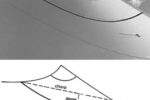
The second comparison boat is the Shark 24, designed and built by George Hinterhoeller. Although introduced only a year after the Sea Sprite, it represented a quantum shift in design thinking and heralded a new era of yacht design. The underwater configurations in the three drawings appear to show, from left to right, a logical transition in the development of a separate keel . . . until you realize that the second boat, the Luders 16, predates the Sea Sprite 23 by 25 years!
When we look at the numbers, we see that the waterline lengths of the more “traditional” Luders and Sea Sprite are almost identical at 16 feet 4 inches and 16 feet 3 inches,respectively. However, the displacement of the “newer” Sea Sprite is 400 pounds greater, while its ballast is 200 pounds lighter. This results in a pretty hefty displacement/length (D/L) ratio of 349 for the Sea Sprite and a more moderate 302 for the Luders, as well as a respectable 42 percent ballast ratio for the Sea Sprite and a substantial 54 percent for the Luders. The sail areas for each of these two boats are also similar at 247 and 224, resulting in almost identical sail area/ displacement (SA/D) ratios of 17.6 and 17.4. So the 25 years separating these designs have not produced any marked improvements. If anything, the older Luders has the more competitive D/L ratio and the higher ballast ratio, which it needs to make up for its narrower beam.
With the Shark, George Hinterhoeller introduced a whole new concept of light-displacement yacht design. The waterline on the 24-foot Shark is 20 feet, almost 4 feet longer than the “older” boats, while it displaces 750 pounds less than the Luders. Yet at 2,200 pounds, it is a full 1,150 pounds lighter than the “newer” Sea Sprite. Granted, the majority of this reduction in displacement is due to the ballast being 1,000 pounds lighter, resulting in a low 31 percent ballast ratio. The triangular bulb on the keel would go a long way to lowering the ballast CG, but probably not enough to completely make up for a 10-inch-shallower draft.
This longer waterline and lighter displacement results in a very performance-oriented D/L ratio of 123 and a slightly higher SA/D ratio of 18, despite the sail area being only 190 square feet. What the Shark could do was get up and plane, something it did very well on reaches and runs, often outsailing 50-footers boat for boat. Neither of the “older” boats could do that!
While the Sea Sprite 23 represents a pretty, but “conservative” design, new materials and design concepts were about to make sailing a lot more exciting, as exemplified by the Shark. Keep in mind that a couple and their 2-year-old sailed a Shark from Canada to Australia, so the seakeeping abilities weren’t bad either, despite the capsize number creeping just above 2. This is due to the light displacement but is partially compensated for by the narrow beam. The Shark’s lighter displacement results in a comfort ratio of 12.4, indicating the rapid motion you’d expect with light weight.
Rob Mazza is a Good Old Boat contributing editor who, in his long career with C&C and in other design offices, designed many boats that are now good and old. He has thus contributed enormously to the enjoyment of those who sail and own them today.
Thank you to Sailrite Enterprises, Inc., for providing free access to back issues of Good Old Boat through intellectual property rights. Sailrite.com