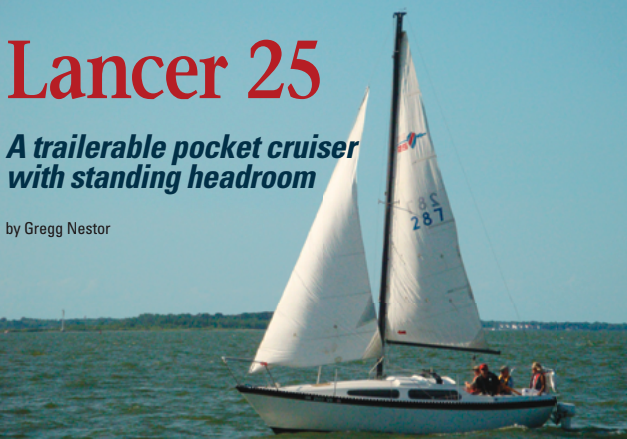
A trailerable pocket cruiser with standing headroom
Issue 76 : Jan/Feb 2011
Richard Valdes founded Columbia Yachts in 1958. Under his presidency, the company became the world’s largest manufacturer of fiberglass sailboats with sales approaching $300 million by the early 1970s. Following his departure from Columbia in 1974, he established the Lancer Yacht Corporation in Irvine, California. The company soon had manufacturing facilities on both coasts, in Fountain Valley, California, and Largo, Florida.
Lancer’s 14-model product line ranged from 25 to 65 feet and included motorsailers as well as sailboats. The motorsailers were designed by Herb David and were unique in that they were available with single or twin diesel engines. They performed tolerably well under sail but really stood out under power — their high-horsepower engines produced speeds in excess of 15 knots.
While the design team from C&C Yachts was contracted to draw the lines for the bulk of Lancer’s sailboats, W. Shad Turner — a young naval architect noted for his custom and production racing designs, including six Santana models for the W.D. Schock Corporation — was commissioned to design the company’s trailerable sailboats, including the Lancer 25.
In 1983, Lancer Yacht Corporation was purchased by a company called Bally. Production of sailboats and motorsailers continued for three more years until 1986 when the company ceased operations.
Design
Shad Turner drew the Lancer 25 with a fine entry, low freeboard, a fairly flat sheer, and a pinched stern favored by the International Offshore Rule (IOR) that was popular at the time. Under the water, he gave it a long, shallow-draft fixed keel with a spade rudder.
The design feature that most distinguishes this 25-foot trailersailer is standing headroom. By recessing the inside of the keel and locating the ballast along its bottom, Shad created a keel sump 6 feet long and 16 inches deep. What would ordinarily be 54 inches of sitting headroom without the sump became 70 inches of standing headroom.
Introduced in 1975, the Lancer 25 remained in production until 1984. In that time, at least three variations or upgrades were made, most involving equipment or cabin layout.
Construction
The Lancer 25 is stoutly built. Its hull is constructed of hand-laid solid fiberglass and the cabintop, deck, cockpit, and transom are fiberglass reinforced with a plywood core. The hull-to-deck joint appears to be an inward fl ange and lid joint that has been fastened together with screws on 6-inch centers, glassed over on the inside, capped with a slotted toerail, and covered with a vinyl rubrail. All the deck hardware is through-bolted and mounted with proper backing plates.
Drawing only 2 feet 4 inches, the Lancer 25’s keel is often described as a shoal-draft fin. However, with a root chord of nearly 14 feet and a tip chord of 8 feet, a more appropriate description would be a cut-away full keel or a long cruising fin. It is molded as an integral part of the hull and has 1,200 pounds of lead ballast bonded to its lowest point.
Interior construction consists of a fiberglass pan that’s bonded to the hull, a series of padded fabric hull panels, and a foam-backed vinyl headliner. These components successfully cover any raw fiberglass and make for easy access to deck-hardware fasteners, wiring, and other fittings. They also impart a degree of insulation and noise suppression. The single bulkhead is teak-veneered plywood and all doors and miscellaneous trim pieces are solid teak.
Deck features
The Lancer 25’s most notable above-the-water feature is the long, low, cambered coachroof that slopes steeply toward the bow and disappears into the foredeck. A pair of long, low, tapered portlights on each side of the cabin emphasize this streamlining effect. Combined with the boat’s sharp entry, these design elements give an impression of speed even when the boat’s at rest. Unfortunately, this styling results in a loss of interior volume and foredeck area.
The deck and coachroof are relatively obstruction-free. Forward, there’s a pair of chocks, a deck pipe, a single mooring cleat, and a cowl vent. There is no anchor locker. On the coachroof there’s a translucent fiberglass forward hatch, a proper sea hood over the companionway sliding hatch, and a molded-in coaming that allows for the easy installation of a dodger or the optional “special windshield.” All horizontal surfaces are finished with a fairly aggressive non-skid pattern. Stainless-steel bow and stern pulpits, plus a single lifeline on 24-inch stanchions, provide some security, but there are no handrails or handholds. Going forward safely in anything but the most benign seas would be very difficult.
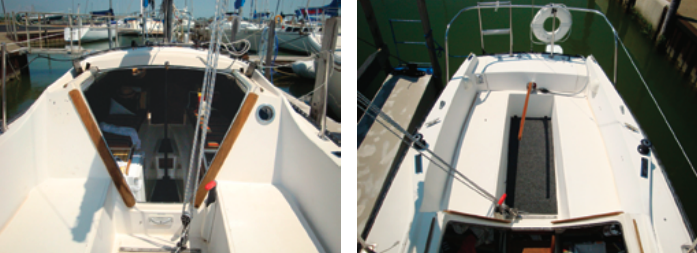
The cockpit is reasonably sized and features 66-inch-long seats with seatbacks averaging 13 inches high. The foot well is narrow enough to offer good bracing and the high coamings provide comfortable back support. The lazarette affords stowage for the outboard motor’s 6-gallon fuel tank. Originally, it gave access to the outboard motor, which was transom-mounted on the boat’s centerline. On our review boat, Bump-A-Noggin, owned by Rodney and Kathleen Scott, the original cutout transom had been glassed over and the outboard motor mounted to port on an adjustable bracket.
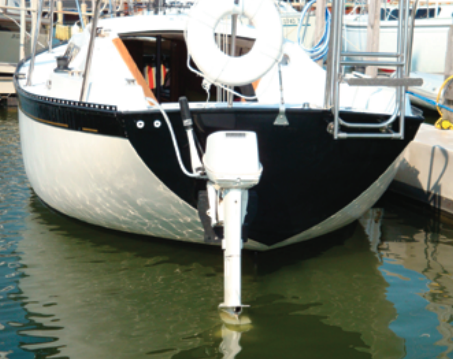
To starboard is a transom-mounted folding swim ladder. A pair of 1 3/4-inch drains keeps the cockpit dry. However, there’s no bridge deck and, together with the generously large companionway opening, these drains may not be sufficient to keep water out of the cabin in rough weather. While under sail in large seas, it would be prudent to keep at least the lower hatchboard in place.
Belowdecks
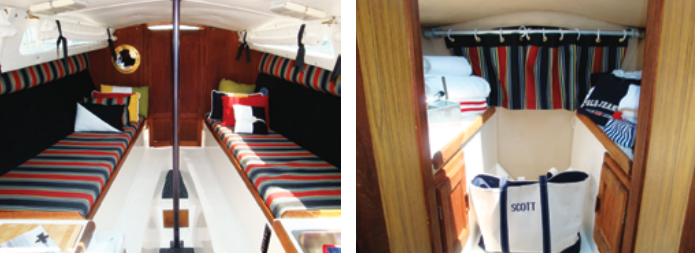
The Lancer 25 cabin is divided into two compartments, with the forward one being further divided into roughly two areas. In the forepeak, there’s a space to store the anchor rode plus a large sail locker.
Immediately aft of the forepeak is the head compartment. It has port and starboard vanities with space between them for a portable toilet or an optional marine head. A stainless-steel sink with manual cold water is fitted in the starboard vanity.
A V-berth conversion also was available as an option, giving this 25-foot trailerable boat a six-berth layout! The forward hatch and cowl vent provide light and ventilation. Unfortunately, the cowl vent lacks a Dorade box to help keep water out and has the potential to make things awfully wet below. When conditions warrant, it should be plugged. The teak-faced bulkhead and solid teak doors give privacy and separate this forward compartment from the main cabin.
The saloon is traditional with port and starboard opposing settees. As berths, the 6-foot 4-inch settees are long enough but are a bit too narrow. A “super bunk” option was available that converts the settees into a full-width berth.
At the boat’s widest beam, and separating the settees from their respective quarter berths, are port and starboard galley units. Originally, the port unit featured a two-burner alcohol cooktop, stowage, and counter space, while a stainless-steel sink with manual cold water and a top-loading icebox were housed in the starboard unit. Bump-A-Noggin’s alcohol stove has been replaced with a microwave and the under-counter stowage now houses a 110-volt refrigerator. Surprisingly, Lancer did not provide a table as standard equipment; a teak folding table that mounts to the compression post was available as an option.
Four fixed tinted portlights illuminate the saloon while the companionway hatch contributes fresh air. The sole is low-maintenance fiberglass and, thanks to the hollow keel sump, headroom is 5 feet 10 inches. There are no handholds at counter level, shoulder level, or overhead.
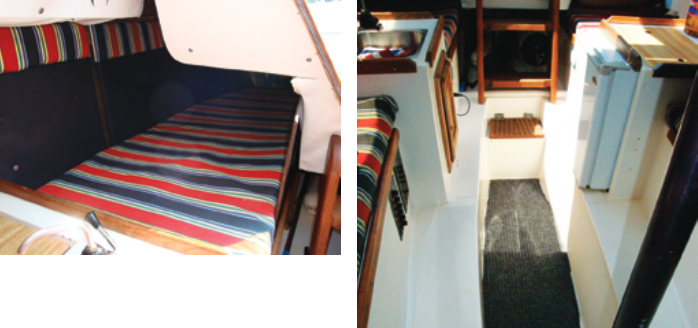
Aft and beneath each of the cockpit seats is a quarter berth. Measuring 6 feet 4 inches long and 30 inches wide, these are roomier than the saloon settees. Above the foot of each quarter berth is a clamshell vent opening to the cockpit. Battery stowage is beneath the starboard quarter berth.
Between the quarter berths and aft of the companionway ladder is a large open stowage area perfect for stowing bulky items such as fenders, boathooks, and life jackets. Beneath this area is a molded-in 15-gallon water tank, with its fill pipe inside the boat. The bottom companionway step is hinged and allows access to the electric bilge pump.
In addition to the lazarette, forepeak, and galley, the Lancer 25 has eight separate stowage lockers. The two bins beneath the quarter berths are molded into the liner pan and could be used as auxiliary ice chests.
The rig
True to its vintage, this masthead sloop was rigged for a favorable rating under the IOR, which, among other things, encouraged large headsails and small mainsails. Standing rigging consists of a forestay, a single pair of spreaders, cap and lower shrouds, and a single backstay. The chainplates are outboard and glassed to the hull. They also appear to be mechanically fastened to the hull with the screws used to secure the hull-to-deck joint. The mast is stepped on deck and supported below by a compression post.
The halyards are wire-to-rope and run through external sheaves. A single Lewmar #7 winch is mounted on the mast. Two more #7s are mounted on the cockpit coamings. There are no headsail tracks but an almost unlimited number of headsail sheeting angles is possible by using the slotted toerail and a snatch block. The mainsail is sheeted nearly mid-boom and connected to a traveler mounted on the cockpit sole.
The standard sails are a 5-ounce Dacron main and a lapper jib. These combine for a sail area of 248 square feet. A 150 percent genoa and a spinnaker with gear were optional. Tiller steering was standard.
Under way
To fully understand how and why the Lancer 25 sails the way it does, an understanding of the IOR is helpful. Under the rule, bottoms tended to be flatter, especially forward. This resulted in a sharp, deep entry and had a negative effect on steering. Shapes tended to be finer or pinched in the bow and stern, which made boats difficult to steer downwind, especially under a spinnaker. The larger headsail and smaller mainsail takes more effort when tacking and may make these boats less attractive as family cruisers. Add to this the Lancer’s long, fat, and shallow keel, and you have a boat that requires constant attention to the helm, is a bit tricky to tack or jibe, and makes noticeable leeway.
The few Lancer 25s that are raced have PHRF ratings of 264. By comparison, the popular Cal 25 outboard model, of which there are large fleets, rates mostly 222 seconds per mile, as does the shoal-keel Catalina 25.

Things to check out
The simplicity of the boat makes for a short list of things to check out. Besides age-related issues, there’s always the potential for a wet and delaminated core. Sound carefully for leaks around deck fittings, especially stanchions. There have been reports of leaking portlights, but this is an easy fix. Remove the interior side panels and examine the hull-to-deck joint, which could be damaged in a hard docking. The boat originally came with wire-to-rope halyards. If they have been replaced with all-rope halyards, make sure that the masthead sheaves were also replaced.
Conclusion
Taken overall, the construction of the Lancer 25 is above average, and its rigging and controls are adequate. Its hollowed-out keel gives this trailersailer “space appeal.” At 3,400 pounds displacement, this boat must be towed by an SUV or pickup truck. Its sailing qualities are fair and it is best suited for protected waters, such as inland lakes and reservoirs. Expect to pay $2,500 to $4,000, keeping in mind that condition is everything.
Gregg Nestor, a contributing editor with Good Old Boat, has had a lifelong interest in all things aquatic. Gregg has written several books, including The Trailer Sailer Owner’s Manual: Buy-Outfit-Trail-Maintain. Last June, he and his wife, Joyce, took delivery of a 1994 Caliber 35 and spent the next two months refitting and addressing some neglected maintenance issues so they could go sailing.
Thank you to Sailrite Enterprises, Inc., for providing free access to back issues of Good Old Boat through intellectual property rights. Sailrite.com