Standout boats from outstanding designers
Issue 76 : Jan/Feb 2011
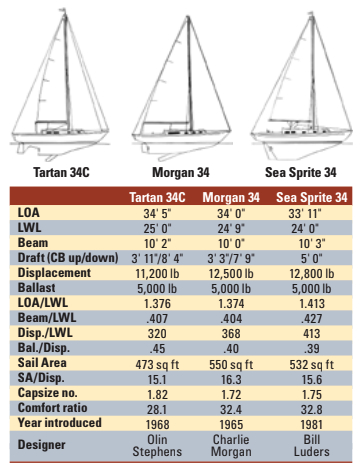
The Tartan 34C is a very handsome design by Olin Stephens, one of the most gifted designers of the past century. In finding yachts to compare with it, I came up with two other classics: Charlie Morgan’s keel/centerboard 34 and Bill Luders’ lovely Sea Sprite 34 which, although a full-keel hull and designed years later, is still reminiscent of the classic, long-ended, sweet-sheered CCA yachts of the 1950s and ’60s with their moderate beam and husky displacement. These designs are quite dated by today’s standards but I knew and admired all three of their designers . . . so I guess that dates me too!
The Morgan 34 is the earliest of the three and appears to be a smaller version of the famous, race-winning 1961 design, Paper Tiger, that was certainly inspired by Olin Stephens’ famous 1954, 38-foot 6-inch Finisterre, the winner of three Bermuda Races. The CCA rating rule favored the beamier, shoal-draft, keel/centerboard hull to quite a degree, so boats like Finisterre and Paper Tiger (sailed by some great skippers) won more than their share of races. While most of the earlier keel/centerboard yachts had typical V-shaped boards, Charlie Morgan fitted a much more efficient, narrow, and deep high-aspect-ratio board to the Morgan 34, similar to the board on Paper Tiger.
Not only did Sparkman & Stephens give the Tartan 34C a high-aspect-ratio board, they also cut away the lateral plane aft to greatly reduce wetted surface and improve the efficiency of the fin. This would definitely give the 34C an edge over earlier keel/centerboarders in light to medium air. The first 34Cs had 526 square feet of sail, with a 13-foot-long mainsail foot, not unlike the sail plan of the Morgan 34. However, within a few years, the 34C’s mainsail foot was shortened to 10.5 feet, possibly to reduce weather helm but also to lower the IOR rating. The result, a 473-square-foot sail area with a high-aspect-ratio main, did not seem to hurt performance greatly, except perhaps downwind.
The Sea Sprite 34 appears to be a later development of the very successful Luders 33 with the same waterline, draft, and displacement but with 500 pounds more ballast and 3 inches greater beam. With over a foot more draft than the others, she should be the stiffest of the three and could undoubtedly prove her mettle on a long breezy windward slog. The Tartan 34C and Morgan 34, with their shoal draft and ballast carried high, would be quite comparable in stability and, like most centerboarders, initially tender when compared to a deep-keel hull. Their strong suit is when reaching and running, rather than a hard thrash to windward. In any case, the Tartan has the better PHRF rating, 168 to 174, compared to the Morgan’s 189, and this would seem reasonable. Downwind, the Morgan’s greater sail area will be in her favor, but I still expect the 34C to outperform her under most conditions. In any case, this short waterline trio will simply not keep up with the modern, long-waterline lightweights in most conditions.
Nevertheless, they still have advantages for the cruising sailor. All three have reassuring capsize numbers, indicating they are capable offshore cruisers. Indeed, one 34C has made a solo circumnavigation while many others have made notable ocean voyages, both cruising and racing. The very-shoal-draft Morgan 34 might be the choice for the Chesapeake, Bahamas, and Gulf waters, while a Luders 34, in good hands, would seem capable of Cape Horn. When it comes to motion comfort, the three also show very well for their size, thanks to their combination of good displacement, moderate beam, and short waterlines.
The accommodations of these yachts may seem sparse and tight alongside modern designs. Many experienced sailors will tell you today’s beamy, long-waterline boats just give you more room to get thrown around in when the seas start to stand straight up. Despite the snug accommodations, the graceful and beautifully balanced overhangs and the sweet sheer-lines of these three old-timers will get nods of approval in any port they enter.
Ted Brewer is a contributing editor with Good Old Boat and, in common with the designers he mentions in this article, he has designed a great number and variety of sailing yachts that were good in their day and are still good today.
Thank you to Sailrite Enterprises, Inc., for providing free access to back issues of Good Old Boat through intellectual property rights. Sailrite.com