All-season sailing in the Pacific Northwest
Issue 76 : Jan/Feb 2011
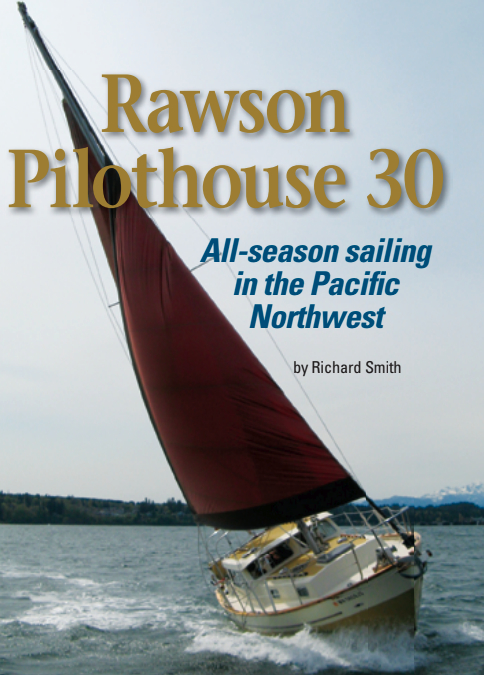
On a cold and windy day in early March, I climbed aboard the Rawson 30, Alcyone (Al-sy-uh-nee), and met her owner, Devon Blankenship. The sun was shining but the outside temperature was only in the middle 40s. It was blowing 15 knots. Ducking through the cabin door, I stepped down into the pilothouse. We took seats on either side of the dining table (that converts to a double berth) with steaming mugs of coffee. Within minutes, we felt the greenhouse effect and relaxed in surprisingly comfortable surroundings for a 30-foot sailboat.
Design
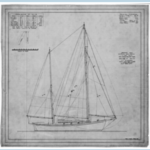
Ron Rawson established his reputation building commercial boats: gillnetters, long liners, and other working craft that fish the West Coast waters from California to Alaska. When he decided to build pleasure boats, he sought out William Garden, one of the Pacific Northwest’s leading naval architects, to design a boat that would bring the Rawson tradition of seaworthiness, strong construction, and reliability to cruising sailboats. The Rawson 30 is distinguished by bluff bows that keep it from diving into big head seas — and create more space in the forward cabin. It found a ready following among sailors who wanted a robust boat that sailed well in rough conditions and provided good accommodations.
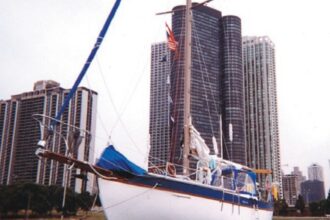
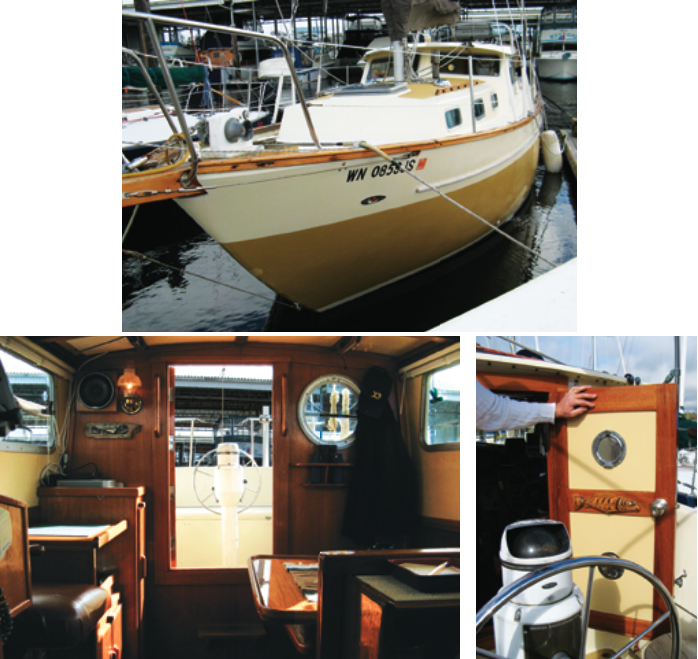
In time, Ron asked Kingston, Washington, naval architect John Anderson to design a pilothouse version for the Pacific Northwest, where one can sail nearly year-round but often in damp, cool weather. This pilothouse does not look like an afterthought but is thoroughly integrated with the original design. The height and profile seem just right. Although the windows are large, they do not distract from the three port-lights in the lower cabin sides. The visor over the windshield extends the line of the pilothouse coachroof, keeping it in proportion with the original design.
On deck
By most standards, the cockpit is small, but it’s adequate for two. The side benches and helmsman’s seat are too short to stretch out on. Under them is a minimal amount of storage for items such as the propane tank. The small 20-inch diameter wheel allows for fairly easy movement through the cockpit. It and the pilothouse helm control the rudder through a hydraulic steering system. The mainsheet traveler is atop the after end of the pilothouse and the two-speed sheet winches and cleats are substantial and well located.
Earlier models of the Rawson 30 were built without a bowsprit, but the sailplan evolved to move the center of effort forward as a check against weather helm. Alcyone’s hefty bowsprit — a short and stocky spar complete with bobstay and whisker stays — supports the forestay and roller-furling gear and provides a substantial base for a large manual windlass and a Herreshoff mooring cleat. Alcyone carries a 35-pound Bruce anchor on a roller at the end of the bowsprit. Its rode of 50 feet of 1/2 -inch chain and 200 feet of 1/2 -inch nylon is led through a hinged deck pipe to the chain locker below.
Bulwarks that are 6 inches high at the bowsprit and gradually diminish to about 3 inches at the stern, together with the exceptionally wide beam forward, provide security for work on the foredeck. Though the 12-inch sidedecks are on the narrow side, hand- rails mounted on top of the pilothouse make movement fore and aft more secure. The chainplates are installed outboard at the rail.
Another pair of handrails, a low-profile acrylic hatch, a couple of solar vents, and the stove’s chimney cap, are fitted on the coachroof over the galley and forward cabin. Devon usually tows his 9-foot dinghy but occasionally lifts it on deck with a spare halyard and stores it between the mast and bowsprit.
Construction
Rawson built 288 30s, of which 36 were pilothouse models, between 1959 and 1985. They were offered with or without a bowsprit and rigged as sloops, ketches, and cutters. By 1969, seven Rawson 30s had been sailed from the West Coast to Hawaii, two had gone on to Tahiti, and one to Australia. Three completed circumnavigations. All of this attests to the boat’s seakeeping qualities as well as its solid construction and sturdy equipment.
The hull is hand-laid solid fiberglass and the deck is of fiberglass and balsa sandwich construction for stiffness, compression strength, and lightness. I didn’t detect any flexing. The vertical hull and deck flanges, bedded and through-bolted, trimmed with teak on both sides, and topped with a teak caprail, form the stout bulwark. A non-skid pattern is molded into the sidedecks and lower coachroof.
The Rawson is ballasted with 5,000 pounds of concrete mixed with “boiler punchings” encapsulated within the keel. Around Seattle, there’s a saying that you can drop a Rawson from the top of the Space Needle and sail it away.
The long keel also helps the boat sit upright in the yard, or on its bottom if an accidental grounding should occur. You could careen it against a seawall to change zincs, scrape barnacles from the propeller and shaft, inspect through-hulls, or sand and paint the bottom.
Down below
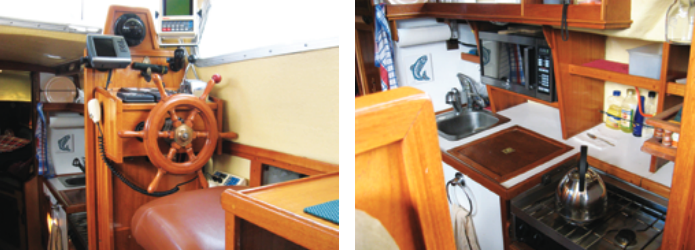
In the forward starboard corner of the pilothouse, behind a sloping windshield complete with wipers, a compact arrangement of compass, GPS, VHF, radar, depth sounder, and engine-monitoring instruments make up the nav station around the single helm seat. A small table and storage spaces are located between the helmsman’s seat and the cockpit bulkhead, handy to the wheel and also to the dining table.
A large circular opening window in the bulkhead looks out into the cockpit and additional ventilation is provided by a portlight and a butterfly vent in the pilothouse door. The overhead is covered with a foam-padded vinyl liner and the cabin sole is teak-and-holly plywood.
Down a couple of steps in the galley, a deep icebox is situated between a two-burner propane stovetop and a deep sink. Devon has installed a microwave and a 1,000-watt inverter. Windows and portlights are tempered glass. Alcyone has pressurized cold and hot water with the heater located under the cockpit sole. There are a few shelves and little more. This is a small galley for a 30-footer.
Opposite to port is a High Seas diesel heating stove just forward of a snug 6 1/2 -foot bench that extends under the pilothouse to form a sort of quarter berth.
There’s a little over 6 feet of headroom in the pilothouse and the galley area and you can walk all the way to the forward cabin without ducking, which is unusual on a 30-footer. The Rawson carries its beam well forward and high up, taking full advantage of its high freeboard. There’s no scrunching down and backing into the V-berths; Devon and his wife, Penny, sleep with their heads forward. The berths are 6 feet 6 inches long with plenty of shoulder room for two. The head is small but contains a sink, shower, and storage.
The accommodations of the Rawson 30 are interestingly laid out with spaces of differing sizes and at different levels: the cockpit is small, the pilothouse large; the galley and head are small, the forward cabin unexpectedly large. The engine room is generous in the extreme. While each space has its particular quality and purpose, they are all interconnected to become a unified whole, and the overall effect is one of openness both within the boat and, through the pilothouse windows, with the outside.
The rig
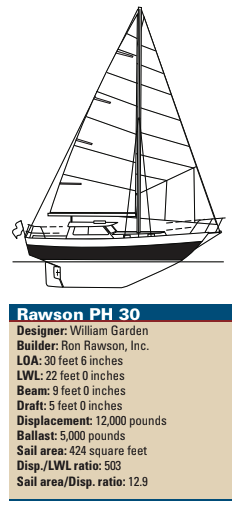
The Rawson PH 30 is a masthead sloop with a 225-square-foot mainsail. Alycone has a 150 percent genoa on a Furlex roller. The single-spreader aluminum mast is deck-stepped with the compression post unobtrusively integrated into the bulkhead between the galley and the head. Standing rigging is conventional, with two lowers and one upper shroud, headstay, and backstay.
The main and foresail halyards are cleated at the mast. The Cunningham and vang lines are led aft to the cockpit.
The engine
Devon and Penny have owned Alcyone since 2003. She was a liveaboard before that and in sorry shape. As part of a stem-to-stern refit, Devon replaced the old Volvo MD11 raw-water-cooled engine with a new four-cylinder, 33-hp, freshwater-cooled Vetus diesel fitted with a 14 x 13 three-bladed fixed propeller. He’s very pleased with the conversion, most of which he did himself.
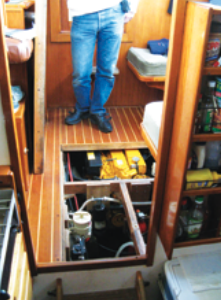
Engine access is excellent, if a bit unusual: first you remove the table, then lift a floor hatch in the after end of the pilothouse sole. This exposes most of the engine. That done, you can slide a floor hatch aft to get at the flywheel, automatic fire extinguisher, bilge pump, fuel filters, and various ventilation hoses. The engine room has very good access for routine servicing and maintaining sundry mechanical and electrical equipment. A hatch in the cockpit sole provides access to the stuffing box.
Performance
Alcyone, having a full keel with the propeller aperture taken entirely out of the rudder, backed with predictable imprecision. The right-handed prop wanted to back us to the left, rather than to the right where we would have liked, but once Devon had some steerage way, he put her in neutral and she went where he wanted her to.
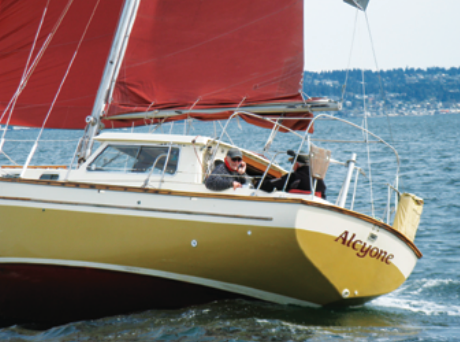
It was a blustery day on Puget Sound with winds 15 to 20 knots, gusting to 25 around the headlands. We took a reef in the main and rolled the genoa in about halfway as we began to work to windward on a close reach. Under the conditions, it took a little while to settle down but, once both sails were full and drawing, we quickly approached hull speed. With a whopping displacement/length ratio of 503 and a small rig, she is not fast. The clinometer would lurch over to 30 degrees and stay there for a spell. The added weight and windage of the pilothouse no doubt contributes to her tenderness. She’d lean over in a hurry but then harden up as we got the rail down. Alcyone is well balanced on the wind or reaching. We didn’t take any water over the bow or rail.
On the way home, I tried out the pilothouse steering station. Rolling and pitching, as we were, I was pressed down to leeward against the wheel and the pilothouse side, but the relative quiet and warmth were welcome.
Conclusion
There’s a lot to be said for a pilothouse on a good sailboat, particularly in areas where the sailing season can be extended. The higher cockpit bulkhead offers considerable shelter even without a dodger and, if the weather deteriorates, the helmsman and crew can move inside and keep going. Considering the amount of time a cruising sailboat spends in the marina or on moorings, to say nothing of cruising in cold and inclement weather during the spring and fall, the advantage is clear. Devon often singlehands Alcyone, racing and cruising about the islands.
True, the Rawson PH 30 isn’t as nimble or swift as a racer/cruiser. She’s a cruiser with a capital C. That said, Devon enjoys racing his boat regularly, taking full advantage of his considerable handicap; Alcyone has a PHRF rating of 333. It’s hard to find a boat with comparable performance. Even the hefty 20-foot Flicka rates around 300 or less.
Anyone interested in the Rawson PH 30 should take a look at the very similar Gulf 32. Owners’ comments and lively discussions comparing the two William Garden designs can be found on the Internet.
Used boat prices are apt to vary greatly, depending on the boat’s condition and even its location. Inexpensive examples in need of extensive refits are available but a well-found Rawson PH 30, such as Alcyone, can run as much as $25,000 to $30,000 or more. Rawsons seem to come up for sale rarely.
Richard Smith is a contributing editor with Good Old Boat. In addition to sailing and writing about boats, he’s an architect, and he designs and builds very small houses. He and his wife, Beth, live in a house with a 16-foot beam and an LOA just a few feet shorter than their Ericson Cruising 31, Kuma, which they sail on the reaches of Puget Sound.
Thank you to Sailrite Enterprises, Inc., for providing free access to back issues of Good Old Boat through intellectual property rights. Sailrite.com