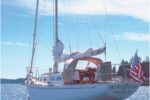
An object of doubtless devotion, Sin Sal sparkles
Issue 76 : Jan/Feb 2011
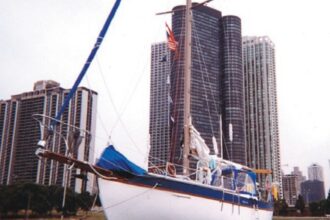
When he suggested that we feature the Tartan 34C owned by Max Guzman and Donna Delahanty, Tom Wells described this boat as “nothing less than a jewel case on the water.” After we’d seen her, Jerry Powlas observed that this vessel, built in 1976, “looks as good — inside and out — as any of the brand-new boats at the boat show.”
Jerry and I own a 1976 sailboat that — in spite of our diligent efforts to keep her young — continues to show her age. That Sin Sal remains a showcase 35 years after she slipped down the ways is a testament to the attention she’s received while in Max and Donna’s care.
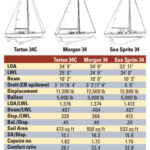
In addition to having conscientious owners, Sin Sal has been blessed with excellent credentials. She and her sisters were designed by Olin Stephens in 1967. The 34C was the third boat built in the Tartan line, following the Tartan 27 and the Blackwatch 37.
Tartan produced approximately 525 of the 34Cs between 1967 and 1978. While there was no 34 already in the Tartan family, the suffix “C” was added from the beginning. I’ve heard it referred to as “C for classic,” but how can a boat become a classic right out of the mold? This design is clearly a classic now, but I go with those who say the “C” stands for “cruising.” Number 377, Sin Sal, has been thriving due to the ministrations of Max and Donna since 1997.
Donna was already a sailor when she met Max. She and her previous husband thought sailing seemed like a nice thing to try. So, while she was in Florida for other reasons, Donna signed up for the Annapolis Sailing School course in St. Petersburg.
“I went by myself,” she recalls. “It was a two-day course. My fi rst big revelation was that you can’t sail straight into the wind. That was in 1982. I’ve been sailing ever since.”
By the time Donna and Max became an item, both were “re-singled,” as the term has it, and Donna was the owner of a Cape Dory 25. They were both engineers with Bell System companies — Donna in Cincinnati, Ohio, and Max in Richmond, Virginia — and their paths had crossed a couple of times over the years at seminars and conferences. Eventually, they began what became a long-distance courtship that lasted five years until Max, who was due to be transferred to Baltimore, found a job with Cincinnati Bell instead.
Max becomes a sailor
Donna sailed Wind Song, her Cape Dory, out of Port Clinton, east of Toledo on Lake Erie, a four-hour drive from Cincinnati. The woman who stole his heart was a sailor, ergo Max was going to have to become a sailor. They laugh as they describe one of their early cruises aboard Wind Song.
Conditions caused them to move the boat from one anchorage to another approximately five miles away in the dark. Donna had sailed into this anchorage at night several times before, knew the landmarks well, and her approach was serious, conscientious, and safe . . . but not as strongly confident as Max, a newcomer to sailing, would have liked. Because it was dark, and perhaps because he had to put his safety in the hands of someone else, he recalls, “It was rather scary.” Still, they arrived without incident, and Max could put a check mark in the box next to “Has experienced night sailing.” These days, the two switch roles aboard effortlessly. There are no pink or blue jobs aboard Sin Sal.
Their sailing skills grew and the two were soon looking for a larger boat. They admired a Tartan 34C just down the dock from their Cape Dory. It was owned by close friends of theirs. So when they found a sister ship that had everything they wanted (a key feature was its new Yanmar with just 38 hours), they were hooked. Still, the purchase of a sailboat is one of life’s major investments. They deliberated for a week. Apparently they deliberated about one hour too long. When they walked into the broker’s office to make their offer, they learned that the man who had just walked out had purchased their Tartan! Devastated, they went back to the drawing board. But, a month later, they learned the sale had fallen through after a survey showed a soft deck. The deck was fixed for $3,000 and the boat became theirs after all.
New-name conundrum
She was Second Wind when they bought her. With one of her previous owners, this boat had been to Bermuda. In spite of the boat’s having a nice history as Second Wind, the name didn’t suit Max and Donna, and their Tartan remained unnamed for a season and a half while they considered their options. Since Max’s 100-year-old father had immigrated from Mexico, they focused on Spanish names. As it turns out, one of Max’s specialties is mixing a mean margarita. His version has been dubbed a maxarita. But Max doesn’t like the salty rim. After considering that their boat is sailed on a lake without salt and that they prefer their margaritas without salt, the two agreed on the name Sin Sal (without salt).
Their passion for Spanish names has also crossed over to their two blue point Siamese cats. Jesus (pronounced the Spanish way) got his name quickly. But they deliberated over a name for his brother, Julio (also pronounced the Spanish way). Seeing a church (“iglesia” in Spanish) on a visit to Texas, they got a good laugh by the inspiration that came to them to name him Julio (as in Julio Iglesias, the popular singer). The cats are affectionate lap cats and contented sailors most of the time (although Jesus does tend to get seasick on rough passages).
Once they retired from their communications jobs, in 2004 and 2007, Max and Donna and their two feline crew-members began spending a lot more time aboard at Herl’s Harbor Marina in Port Clinton and sharing time with sailing friends in the nearby U.S. and Canadian islands. The southwest end of Lake Erie is a beautiful sailing area with a little something for everyone, from remote anchorages to tourist towns with tall ships, T-shirts, and taffy.
But wanderlust grows as your time allows and as your larger cruising vessel makes it possible. Max and Donna have cruised Sin Sal as far west as the North Channel of Lake Huron and as far east as the Thousand Islands, where Lake Ontario meets the St. Lawrence Seaway. So far, the North Channel has been their favorite destination. Perhaps they’ll finish off their Great Lakes exploration with a season in Lake Michigan and another in Lake Superior. It wouldn’t be out of the question for this cruiser that Tartan built.
A sensible sailer
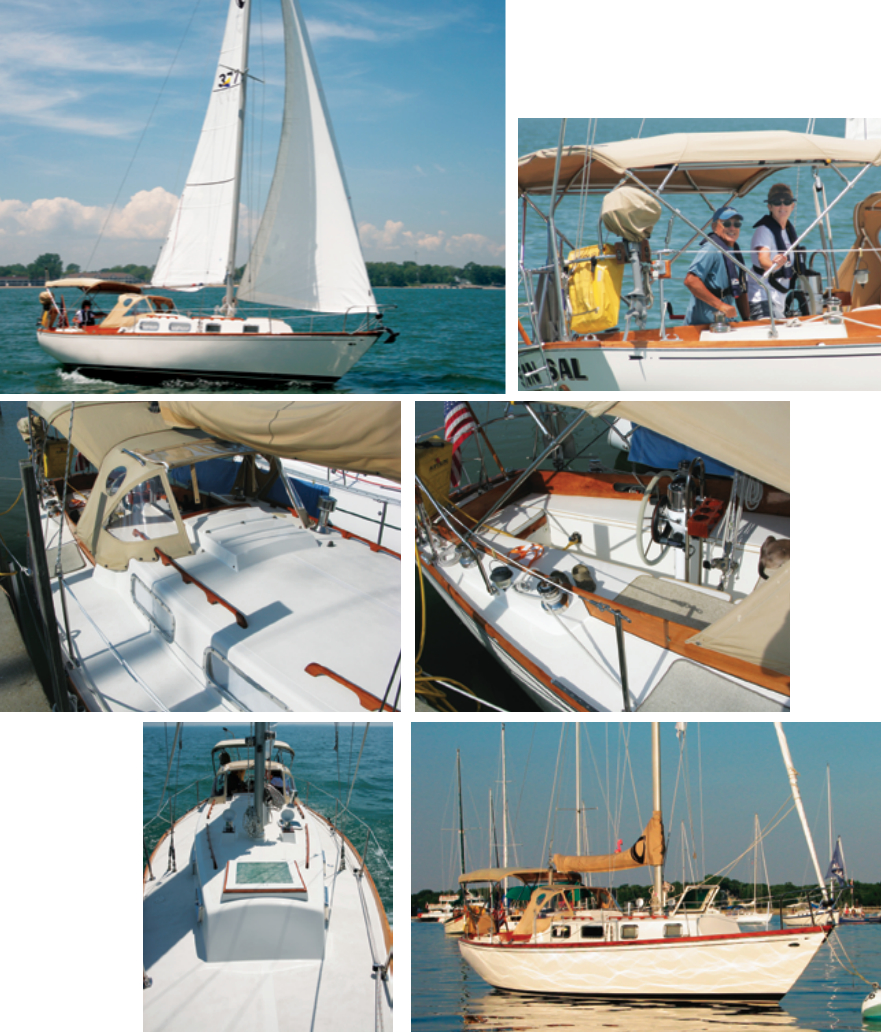
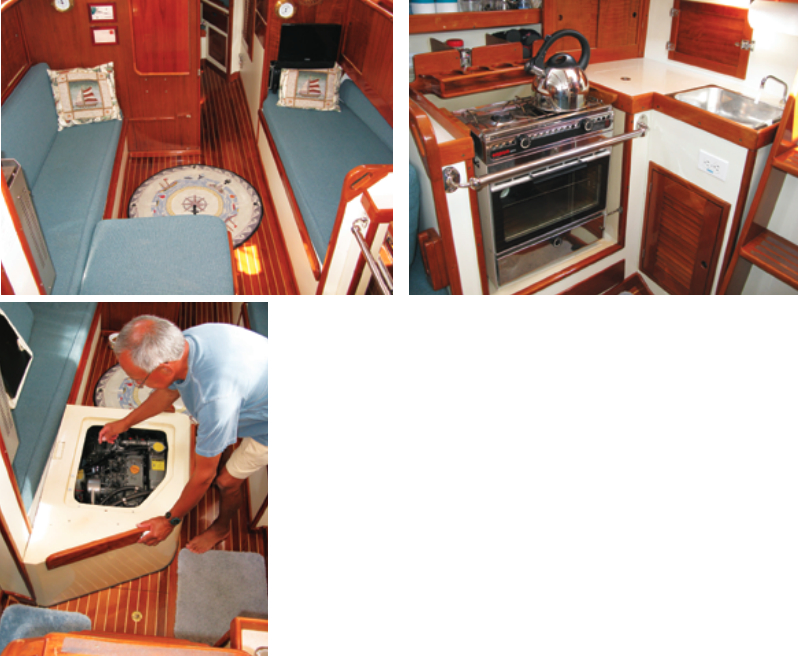
As a keel/centerboard boat in the Olin Stephens tradition, Sin Sal has a fairly shoal draft. Max and Donna sail her almost exclusively with the board up on shallow Lake Erie but will lower the board to help point higher or to reduce weather helm. Her shallow draft is 4 feet, versus 8 feet with the board down. Of course, the Tartan 34C also has that lovely CCA profile with her graceful sheer and overhangs. Our sense, after cruising aboard for two days, is that she’s a good sailer as well. She has roomy decks and a keel-stepped mast. Donna says one of this boat’s biggest assets is the amazing amount of stowage belowdecks. We were impressed that it offers headroom throughout for a 6-footer.
The Tartan 34C has a sensible interior. Some would say she has legendary engine access with the engine box built into the cabin rather than under the companionway ladder. Her other magic feature is the access to the icebox from the cockpit and from the galley. Few boats at the time were designed with this innovation. The cabin also has lots of light from her many ports. Sin Sal’s opening ports are not original, but they can make a big difference when the weather is hot on the south shore of Lake Erie. The drop-down table hangs on the bulkhead and can do an instant vanishing act, increasing the size of the cabin when it’s not needed.
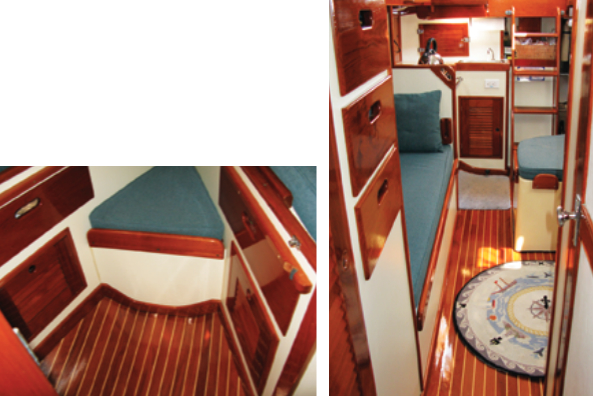
Some would say this boat has too much teak. But not Donna. She has become known around the marina as the Varnish Queen. She has varnished every spot of wood inside and outside the boat. She used a combination of gloss and satin finishes on the interior teak to add a distinctive flair and textural interest to the cabinet and bulkhead surfaces. Donna first used a polyurethane varnish on the interior for its durability and a two-part polymer finish for the exterior. She says the real advantage of the two-part polymer finish was its fast buildup, and she used it for eight years until it was no longer manufactured. At that point, she stripped the exterior teak and applied seven coats of UV-protected polyurethane varnish. Each spring, she sands the teak lightly and applies a couple of coats of fresh varnish. All the work, she points out, is really in the preparation. No matter what product one uses, the preparation is pretty much the same.
Sin Sal wasn’t in showcase condition when she came into the Guzman/Delahanty family. That part came later. She had her original cushions. Her teak sole was stained. She had plastic portlights and archaic instruments for depth and speed. But the very first repair these two took on after purchasing Sin Sal, was the water intrusion at the chainplates. Max says this is a weak spot on the Tartan 34C.
Gilding the jewel case
Max and Donna added stainless-steel opening ports and another overhead opening hatch, a teak-and-holly sole, a cork sole in the head, and new electronic instruments. They installed an automatic bilge pump and another pump in the head. They put Corian countertops in the galley and head, added a shelf for pots and pans under the galley sink, replaced the Formica table in the cabin with a new teak one, and had a cockpit table built to their own design and specifications.
They added an anchor roller, a new steering wheel, an omni-directional TV antenna on the masthead, a diesel heater, an outboard motor lift, new main and jib halyards, a new continuous reefing line for the roller furler, and refrigeration. They replaced the cockpit sole and fitted stainless-steel Dorades in place of the originals. They added an Autohelm, full cockpit canvas with a Bimini and dodger, and cockpit cushions. They Awlgripped the hull and deck using a roll and tip method. And the Varnish Queen varnished, and varnished, and varnished.
Sin Sal is indeed a jewel case on the water. She turns heads wherever she goes.
Karen Larson and her husband, Jerry Powlas, founded Good Old Boat to connect people who share their passion for sailing and making boats, old or not so old, better. They spent three months last summer cruising Lake Superior in their C&C 30, Mystic.
Thank you to Sailrite Enterprises, Inc., for providing free access to back issues of Good Old Boat through intellectual property rights. Sailrite.com