All you need to know about ropes for your boat
Issue 42 : May/Jun 2005
A few years ago, after carefully inspecting my running rigging, I decided it was time to replace much of it. I identified each line and recorded its diameter, length, and color. (Regarding color: long ago, I found it a lot easier to tell a non-sailor, eager to help, to release the yellow line rather than the boom vang.) With my list in one hand and checkbook in the other, I arrived at the local marine store. I was soon standing speechless in front of a wall of spools of rope. Just about every color of the rainbow was represented, as well as a variety of diameters and materials of construction. I was amazed at the selection of cordage available. While I was comfortable with the basics — nylon, Dacron, three-stranded twist, and double-braid — I was at a loss when it came to the newer high-modulus fibers. I decided that, before I opened my checkbook, a bit of research was in order.
Types and construction
All rope (other than wire rope) begins as individual fibers. In the manufacturing process these fibers are first twisted into yarn. Following the formation of yarn, a number of yarns are then twisted into strands or plaits (braids). Finally, the strands or plaits are combined to form rope, either by being twisted or braided.
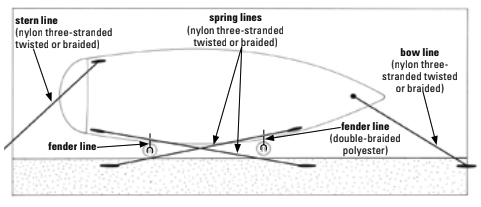
The most common of ropes is the three-stranded twist. Three-stranded twist rope maintains its form because it’s always under self-tension. This self-tension results from the alternate twisting of the individual fibers, yarns, and strands. This creates internal friction among the components and, as they work in concert with each other, forms the rope. Three-stranded twist is inexpensive and easy to splice. It can become difficult to knot and coil properly, especially when it stiffens with age. Its twisted form of construction makes it the ideal candidate for docking and mooring lines as well as anchor rodes. In these applications, stretch and shock absorption are valued attributes.
Like three-stranded twisted rope, braided rope is also made up of fibers, yarns, and strands; however, they are laid out differently and are not under self-tension. Single-braid is braided with 12 strands. Half of the strands revolve to the right and half to the left. In the case of double-braid, the cover can comprise 16, 20, 24, or 32 strands with half revolving to the right and the other half to the left. A rope constructed from 8 strands is called plaited rope. While braided rope is round, plaited rope is flat. Polypropylene ropes are often plaited.
Easier to coil
Single-braid exhibits less stretch than three-stranded twisted, is easier to coil and store, works better in self-tailing winches, and is kinder on the hands. However, it can be difficult to splice, is more expensive to produce, and has limited popularity.
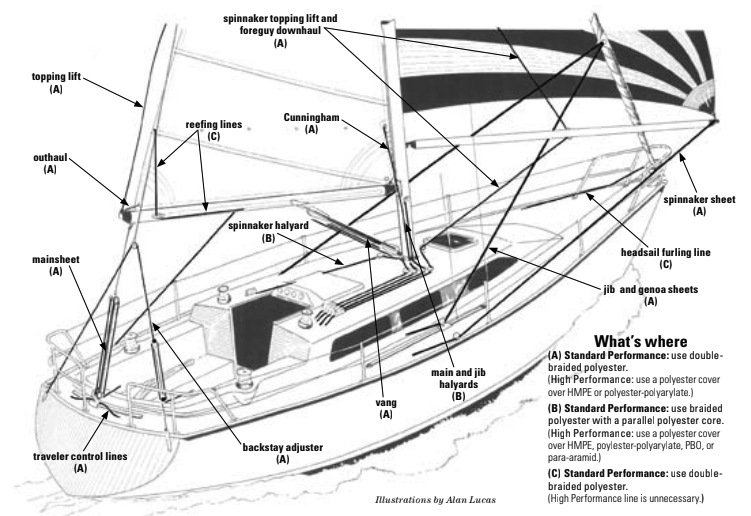
Double-braid, which is a hollow braided cover over a braided core, makes up the bulk of all running rigging used aboard contemporary sailboats. This construction method produces a softer and more flexible rope that exhibits greater strength and less stretch. The core and cover share the load equally, assuming that the materials of construction are the same. Or the core can be composed of a host of different materials to take advantage of differing properties. A high-strength core material can carry 90 percent of the load.
The core can also be woven at low angles or even laid-up as parallel fibers to further reduce stretch and increase strength. There are ropes with low-twist three-stranded cores that are claimed to be 40 percent stronger than double-braid and with only half as much stretch. Double-braids are the easiest on the hands, afford excellent grip, and can be woven in a multitude of colors for quick identification. The cover of double-braided rope also can be finished as smooth or fuzzy. Fuzzy ropes won’t be as strong as smooth ones, though they are easier to handle and work better in rope clutches and jam cleats. Double-braided rope is a bit more expensive to manufacture than three-strand, and splicing takes some practice.
Construction materials
Rope used to be made of natural fibers. These included such materials as cotton, flax, sisal, hemp, and manila. These days, synthetics rule the high seas.
The evolution from natural fibers to synthetics started in the late 1950s with the application of three-stranded twisted nylon as halyards and sheets. For halyards and sheets, nylon was soon replaced by polyester. Nearly half a century later, advancements in synthetic-fiber technology continue to put new cordage aboard sailboats. While none can equal the durability of polyester, when it comes to ultraviolet and saltwater exposure, these new breeds of synthetics have each found a niche in this complex arena of sailboat rigging.
Nylon
Nylon can be chemically described as a polyamide (a polymer of amines). Its basic ingredients are coal and water. Nylon was developed by E. I. du Pont de Nemours and Co. Inc., in the 1930s and has the honor of being the very first synthetic fiber. The name became instantly generic; DuPont declined to register it as a trademark. Nylon is strong, affordable, and offers excellent resistance to abrasion, rot, and flexural fatigue. Nylon is prone to stretch. Three-stranded nylon will stretch 16 percent of its loaded length at 15 percent of its breaking strength. This stretchiness can be useful when it comes to absorbing shock loads imposed on mooring lines and anchor rodes. Nylon is susceptible to UV-degradation and readily absorbs water. This latter tendency can reduce the rope’s strength by as much as 10 to 15 percent. Also, when soaked, the individual nylon fibers swell, and the rope temporarily shrinks a little in length.
Another downside to nylon’s absorbent nature is that, over time, impurities are drawn into the rope. This results in discoloration and a progressive stiffening of the rope. Nylon has a specific gravity of 1.14 (meaning it weighs 1.14 times the weight of fresh water) and, when dry, is lighter than polyester. Nylon is not recommended for running rigging. It makes great docklines and anchor rodes. When protected from ultraviolet rays by means of a polyester cover (Polyon), it makes the ideal mooring pendant.
Polyester
Dacron is the U.S. trade name for polyester fiber, another synthetic created in the DuPont laboratories. While nylon has become a generic term, Dacron has not; it is a registered trademark. It is not as strong as nylon, but polyester performs very well in high-stress applications, such as running rigging. It is resistant to rot, abrasion, and flexural fatigue. Unlike nylon, polyester is UV-stable, does not absorb water, and stretches much less. Even greater stretch-resistance can be achieved by pre-stretching the rope to its elastic limit and heat-setting it. However, this leaves the rope markedly stiffer and more difficult to splice.
Polyester takes to coloring very well and is ideal for color-coding lines, making them instantly identifiable. While polyester has a specific gravity of 1.38, making it a heavy material, it is usually the first and most economical choice for virtually all running rigging. Pre-stretched polyester ropes or ropes made from a low-twist or parallel polyester filament core with a braided polyester cover are ideal for halyards.
Rigging your boat can be as simple as making sheets and control lines from polyester double-braid and halyards from a braided polyester cover with a polyester parallel filament bundle core. Use nylon for your ground tackle and mooring lines.
Polypropylene
Polypropylene is an inexpensive, hardwearing fiber that is weaker than both nylon and polyester. It is stiff, slippery,brittle, and hard to knot. Polypropylene is heat-sensitive and can melt if run rapidly over a winch or through a block. It exhibits poor UV-stability and is very susceptible to fading. Its low resistance to weathering further prevents it from being widely used. However, polypropylene has stretch characteristics approaching those of polyester. It doesn’t absorb water, and it has a specific gravity of less than 1.0. Polypropylene’s claim to fame is that it’s extremely light . . . it floats. This makes it an excellent candidate for rescue lines and dinghy painters.
HMPE
High modulus (high-strength) polyethylene is more commonly known by the trade names Dyneema and Spectra. It is a high-strength, low-stretch synthetic fiber that resists weathering and abrasion much better than polyester. Coated HMPE exhibits reasonable resistance to UV-degradation. However for the long term, a polyester cover works best. It is expensive and second only in strength to PBO (polybenzoxazole). In addition to its cost, HMPE tends to creep (elongate) under sustained loads. With a specific gravity of 0.97, it is a much lighter fiber, one more reason that it’s often found aboard racing yachts. For example, a 7⁄16-inch halyard comprising an HMPE core with a polyester cover is not only stronger than a 1⁄2-inch double-braided polyester line but, due to its inherent lightness and smaller diameter, is 40 percent lighter. In light air HMPE spinnaker sheets might allow the sail to fly when heavier polyester ones could lead to the sail’s collapse.
Para-aramids
This family of high-modulus synthetic fibers consists of Kevlar and its sister fibers, Twaron and Technora. Para-aramids are said to be stronger than steel by weight. While these fibers are quite vulnerable to UV and abrasion, they are exceptionally stretch-resistant. Para-aramids are brittle, do not bend well, and are difficult to splice. They tend to break down when flexed over small-radius blocks. Technora is the exception and can handle turns better than Kevlar and Twaron. Also, as a core material, para-aramids tend to cut through polyester covers. On high-tech racing boats, these fibers are usually sheathed in shrink-on black plastic. Even though these synthetics display outstanding strength-to-weight properties, their many drawbacks and high cost make them less practical for cruising boats.
Polyester-polyarylate
Vectran is the only brand of polyester-polyarylate high-modulus fiber used in the construction of marine rope. Its high-strength, extremely low-stretch, and little or no creep characteristics are similar to those of the para-aramids. Like the para-aramids, Vectran is degraded by UV and has a limited flex life. However, it displays much better abrasion-resistance and, therefore, will last longer when turning around sheaves. Like all the newer high-modulus fibers, Vectran is expensive. But, unlike most, when covered with polyester, it can perform most running rigging tasks aboard high-tech racing boats.
PBO
Poly-para-phenylene-2 6-benzobisoxazole (or polybenzoxazole for short) is the strongest of the synthetic high-modulus fibers. In fact, it’s 20 percent stronger than its nearest competitor, HMPE. It displays exceptional stretch-resistance and very low creep. However, it is susceptible to UV-degradation, needs chafe protection, and has a limited flex life. On high-performance ocean racers, PBO, covered in shrink-on black plastic, is used as standing rigging, where it is substantially lighter than stainless-steel rod rigging. However, considering its cost and maintenance, PBO is best relegated to boats where the pockets are as deep as the water sailed.
The bottom line
While there may be some high-tech racers rigged entirely with HMPE or polyester-polyarylate, the majority ofcruisers coming off the assembly line are rigged mainly with double-braided polyester, although a few manufacturers are beginning to offer HMPE halyards.
Since most good old boats didn’t come off the manufacturing line recently, they probably sport this mixture of fibers: halyards and sheets of double-braided polyester, docking and anchor lines of three-stranded twisted nylon, and heaving lines and dinghy towing bridles of plaited polypropylene.
While high-modulus fiber ropes are slowly making their way to cruising boats, they’re pricey. Once the economics of scale kick in, price will probably come down.
For now, at least, most cruising sailors will be content with good performance double-braided polyester, while banking the difference between it and those high performance, cutting-edge fibers.
Thank you to Sailrite Enterprises, Inc., for providing free access to back issues of Good Old Boat through intellectual property rights. Sailrite.com