A short lesson on surveying the surveyors

Issue 42 : May/Jun 2005
You usually get a sailboat surveyed because someone, most likely an insurance or finance company, has told you to or because, as a potential buyer, you want one to establish her value. Surveys do not come cheap, $14 to $15 a foot is the going rate for a survey in the upstate New York area where I cruise.
Assuming you really do have to get a survey, you want it to meet your needs. This is not a given. There are competent and not-so-competent practicing surveyors, all of whom willingly accept your hard-earned dollars, so the whole process is a bit of a crapshoot. However, you can tilt the odds in your favor with a little preparation and a few questions before the survey takes place.
The quality of a survey depends largely on the experience and background of the person doing it. Some surveyors are accredited by groups, such as SAMS (Society of Accredited Marine Surveyors) and NAMS (National Association of Marine Surveyors) who may nevertheless overlook glaring faults and deficiencies during your boat’s checkup. And there are experienced and knowledgeable old salts with nary an initial appended to their names who can give you a thorough and completely adequate assessment of the vessel in question. Be forewarned however: some insurance companies require the surveyor to belong to one of the professional accreditation agencies. Others say that as long as they receive a written report including the surveyor’s actual “narrative description” of what they inspected on the boat (not just a standard checklist form) and accompanying photos, they’ll accept it. If you are getting the survey for insurance purposes, check the company’s requirements first.
Part-time businesses
I’ve paid for two insurance surveys. Both men doing them had worked beside experienced surveyors for a number of years before starting their own part-time businesses dealing mostly with fiberglass yachts. Both had extensive boating experience, and one had done a number of boat restorations. One was affiliated with SAMS, the other was not. Both men generated reports consisting of checklists, a market value based on data from the Internet and other sources, and several paragraphs of narrative description.
The professional surveyor organizations have attempted to impose standards on the essentially unregulated business by requiring that an accredited surveyor have a certain amount of actual field experience and follow guidelines of the Coast Guard, the American Boat and Yacht Council (ABYC), and the National Fire Protection Association (NFPA) for construction equipment and other safety-related matters on board the boat.
The SAMS group also requires its members to take an exam and to submit examples of past surveys for review. It allows less-experienced surveyors to join as associates and affiliates. By working with experienced surveyors, they can then upgrade their skills over time to become full-fledged surveyors. These associations also have different areas of surveyor specialization for various commercial craft or yachts. Both SAMS and NAMS require their members to attend meetings and programs to keep them up-to-date on regulation changes, marine industry problems, marine insurance, and other pertinent information.
Geographical listings
These two organizations maintain websites with geographical listings of members so you can find a surveyor near you. SAMS is the larger of the two associations and, because of its lower entry barriers and graduated levels of affiliation, you’re probably more likely to find a SAMS-accredited surveyor in an area where marine activity is pursued for pleasure.
There are two categories of survey, the pre-purchase evaluation of a boat being sold and the so-called insurance or condition-and-value survey, done at the request of a bank or insurance company. Both are intended to establish the value of your boat. They may differ some in what they include.
The condition-and-value survey tends to be a bit more standardized, thanks to the requirements of the financial institutions requiring it for an appraisal. It consists of an out-of-the-water survey, where the boat’s overall condition and its accompanying equipment are evaluated and appraised. A lot of it consists of compiling and describing inventories. It rarely involves a sea trial. The surveyor should find and note any conditions considered hazardous or a safety threat.
As part of the process, at least for insurance surveys, the surveyor may also survey the boatowner. Insurance companies want to know how the boat will be used, if she is appropriate for the waters she operates on, and whether the operator has had any safety courses or other documented education or proficiency, such as a certificate from the U.S. Power Squadron or a Coast Guard captain’s license.
Sea trial and haulout
Pre-purchase surveys done for buyers will include the appraisal and inventory information and may also involve a sea trial and/or a haulout as well. In both types, the surveyor will be seeking flaws and potential problems or safety issues. How many he or she finds will depend in part on the level of experience with other boats similar to the one you have. So before you hire surveyors ask about their past surveying experience, areas of expertise, and what types of boats they’re most familiar with. Also ask them for a sample of their work on a past survey. Most reputable surveyors will provide an example with the client-identifying information blacked out.
You won’t have much problem finding surveyors with experience in evaluating fiberglass hulls, but if you have a wooden or steel-hulled boat and live in an area of limited commercial marine activity, it may be harder to find a competent surveyor. Evaluating steel hulls requires special gear such as steel-thickness meters, pricey pieces of equipment not owned by many part-time surveyors.
Wooden hulls are an art unto themselves, and I’ll say no more about them except that if you have owned a wooden boat in a region where most people sail fiberglass boats, and if you’ve pulled your share of garboard fasteners and dug away at the rot pockets for a few years, you’ll probably be better able to evaluate one than most of the local surveyors. If you are not an experienced wooden-boat owner and are thinking of buying a woodie in an area where they are few and far between, you might do better to try to find a knowledgeable owner and/or boat-repairer to look her over with you, rather than hiring a surveyor.
Avoiding a survey
You might be able to avoid the expense of a pre-purchase survey if you pay cash (or use a credit card) to buy your boat and if you can insure her through your homeowner’s policy. Sometimes boats under 26 feet can be added to homeowners’ policies, and you may be able to get at least liability insurance on a bigger older boat as part of an “umbrella policy.”
A pre-purchase survey can turn out to be a good investment for a buyer, however, providing him or her with useful bargaining chips with which to drive the price down. If the surveyor uncovers a serious defect, such as an area of bad deck core, you may be able to renegotiate the price down several times over the cost of the survey. And even if you’ve owned your boat for a while and think you know her well, getting her resurveyed because of insurance requirements can be an interesting experience. Old problems you’d ignored or perhaps a new one or two you weren’t aware of may come to your attention as a result. You may be glad you got a checkup for her.
One surveyor I spoke to told of a pre-purchase survey he’d done on a powerboat. In the dark bowels of the yacht in a small inaccessible area forward of the cockpit, he found a plugged hose attached to a through-hull. The hose, possibly once connected to a bait well and subject to years of vibration, had a deep crack around much of the base where it was bent over sharply. “It was a 1 3⁄4 inch hose, and if that had let go, it would have caused all kinds of commotion,” the surveyor told me.
Do it yourself
If you’ve been using and fixing boats for a while, and you aren’t required to get a survey for financing or insurance on a boat you want to buy, you might be able to do a pre-purchase survey yourself. If you find something you aren’t sure of, some surveyors will come in and do a little consulting at a per-hour cost considerably less than a full-blown survey. Be clear on what you want; don’t ask them for or expect a full survey or written report. Limit your questions to a specific area or two. Because a surveyor could also be held liable by insurance companies for an overlooked safety issue, some may refuse to do a partial survey.
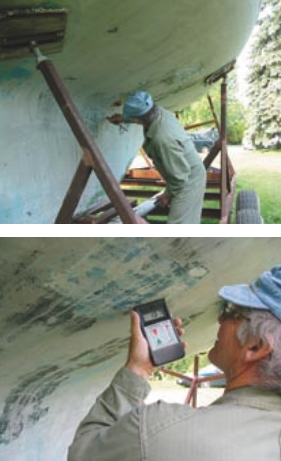
A typical condition-and-value survey on a fiberglass boat hauled out will probably take three to five hours depending on her size and how many complicated systems are on the boat. It consists of an examination of the hull, decks, shaft, prop, and rudder. The surveyor will look for blistering below the waterline and soggy core in the decks. He or she will probably use a moisture meter to detect and measure the water content of the laminate. The surveyor will also probably sound the hull, tapping on it at various points above and under the water as meters may be unreliable on wet and painted surfaces. Bruce Sodervick, a surveyor in upstate New York, believes extra time spent on hull soundings on the outside of the boat saves time on the inside, as these tappings provide information on the key structural elements of the boat.
“Sounding the hull will tell you how far inside the glass laminate the bracing and inside stringers are. You’ll hear bulkheads, attachments, patches . . . you’ll already know a lot about the boat before you look inside her,” he says. Moisture meters used in conjunction with sounding and visual inspection of the hull and decks can provide a quick check on how serious a possible flaw, such as a stress crack, may be.
Problem areas
On older sailboats, spade rudders and their associated attachments are a common problem area as are worn Cutless bearings. After checking out the hull and keel, the surveyor will probably climb aboard and check over the deck using a moisture meter and visual observation to find stress cracks, delamination, soft spots, and squishy areas. Deck cores around bolted through-fittings, chainplates, mast steps, and other stress points are suspect. Soggy deck cores can be repaired, but it’s usually a nasty, time-consuming job. Therefore, mushy decks can lower the price of a prospective boat by several thousand dollars. Other details on deck of interest to the surveyor will be things like hatch construction, hinges and latches, and handholds. The rig, if on deck, will be studied for condition of the spreaders, stained or cracked swages, and other signs of corrosion. If the mast is standing you may have to negotiate with the surveyor on this item. He may not want to go aloft to look things over without additional compensation. The mast step should also be examined closely.
The surveyor will undoubtedly spend a fair amount of time belowdecks on your boat’s fuel and exhaust system, as well as on the installation and location of the bilge pump or pumps. More time will be spent on the engine itself and its ventilation and required safety gear such as flame arresters on the carburetor for gas engines. Fuel systems, fuel tanks, and their installation, and the condition and installation of the exhaust system, risers, and mufflers should be evaluated and described on the survey along with the type and condition of all seacocks, hoses, and connecting lines. During my boat’s survey, the surveyor explained that he liked to see deckfills clearly labeled, citing a recent incident near my homeport where a powerboat took on 200 gallons of fuel through the pumpout fitting. Battery installations not up to ABYC standard are another fairly common area of deficiency.

A second look
Obviously an out-of-water survey and one done afloat cover different aspects of the boat. You can’t easily check a stuffing box or run the engine if the boat is laid up. So if the survey involves both a haulout and a sea trial, the surveyor may have to return to areas previously reviewed for a second look.
The whole process of giving a sailboat a physical is a bit of a Sherlock Holmes exercise. Often when the surveyor follows up on one area, he’ll spot several other potential problems. Bruce recalls tracing an electrical circuit through the bilge when he noticed the bilge water was flowing. He discovered, in short order, a poorly bedded seacock and a defective bilge pump. He concluded, “This boat is going down. I wonder how fast I can finish this survey.” Needless to say, he made a couple of quick phone calls before that boat’s physical was completed.
Bruce, like many surveyors, looks for clues, starting with obvious maintenance and upkeep. If he sees a lot of clutter and dirt, he immediately wonders about deferred maintenance and neglect. As your surveyor follows the trail, crawling hither and yon throughout your boat, he may be distracted and knocked off the scent by a multitude of questions. Some surveyors prefer to work without someone hanging over their shoulders with a constant stream of questions. Show up on time, unlock things, then stay with the surveyor for a little bit to see that he really knows what he’s doing. Then leave the surveyor alone.
Others, however like to show and explain things verbally to the client. If in doubt, ask your surveyor whether he or she would prefer to be alone or to have you there.
Thorough inspection
Your surveyor will need to get into lockers, corners, and odd places in your boat. He’ll need to check each seacock and its hose below the waterline, and he’ll want to examine water tanks, holding tanks, and bulkhead attachments. Gear must be cleared out of the way if this is to happen. Although this seems fairly obvious, many potential buyers and owners leave lockers and cabins full of clutter. On the outside, the surveyor needs a good eye as he scrutinizes the exterior of the hull for fairness and suggestions of bulkhead shifting or past patches and repairs. Adequate lighting inside the boat and outside, if she’s in a building, is crucial.
The two surveyors I consulted, both experienced surveyors familiar with older fiberglass sailboats, were generally complimentary to the 1960s and ’70s yachts with solid fiberglass hulls. Many older boats were holding up remarkably well to the relentless stresses of use, they said. After the mid-1970s some builders started to cut corners, perhaps spot-glassing bulkheads in or skimping on the hull-to-deck joint (an area Bruce says is one place where you’ll find the “real identity” of the boat). Cored hulls presented new challenges to graceful aging, they noted.
Good surveyors need to be people of strong moral fiber. They are apt to be pressured by opposing interests and perhaps be urged to be less than frank by a seller who may suggest, “Why don’t we just skip through this part of the boat?” or by a broker who has been giving them referrals. One surveyor told me a boat seller tried to sue him after he valued the boat far below the asking price. Unfortunately yacht buying and selling usually involves large sums of money. And money, especially big chunks of it, can provoke strong emotions and lead to tense situations and rancor. Be respectful of your prospective surveyor’s integrity and competence until proven otherwise. But ask him some questions, too, before you give him the job.
Thank you to Sailrite Enterprises, Inc., for providing free access to back issues of Good Old Boat through intellectual property rights. Sailrite.com