Issue 14: Sept/Oct 2000
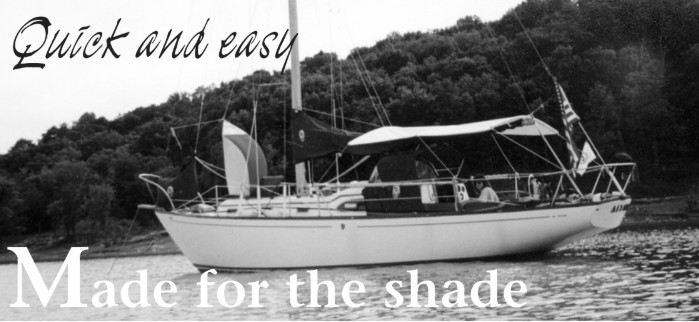
No matter where you sail, one of the things that zaps the energy out of you is the sun. There are many ways to beat the heat. A simple, cost-effective homebuilt cockpit awning that rests on the boom and ties down in the corners could be just what the doctor and pocketbook ordered.
Here’s the plan for one made from old tarp material. It will have three PVC support tubes and be 7 feet long and 6 feet wide. You can decide if you want one longer or shorter and with more or fewer support tubes. You can make this from a myriad of materials: old fabric from a tarp or tent, a bed sheet, or fabric from the store.
Start by orienting yourself with your material. Ours will start out being 6 feet 1 inch across and 7 feet 7 inches long. The extra 1 and 7 inches of cloth will be used to make pockets for the tubing and to provide for hems.
Fold each edge over 1/4 inch — twice — and sew a zigzag stitch down the entire length. If you are using a cloth that might unravel, the zig-zag stitching will prevent that and reinforce the edge.
Go to one of the 6-foot ends and make a 1 1/2-inch wide fold along the edge. After you have that creased it, sew a simple straight stitch down the edge of the fold, making a pocket for a PVC tube. Repeat that step at the opposite end, giving you a second PVC tube pocket at the other end.
Now fold your awning in half so both of your PVC pockets are lined up. Go to the center, crease it, and draw a parallel line 1 1/2 inches from the crease.
Leaving the awning neatly folded, sew a simple straight-line stitch, through both halves, down the line you just drew. This makes your middle PVC pocket.
Cut three pieces of 3/4-inch outside diameter PVC 6 feet 2 inches long, and insert them into the pockets you’ve created. There should be an extra inch of tubing sticking out of each end.
Drill a small hole through each end of the tubing and attach 36 to 48 inches of inexpensive line to each end. Center your awning over your boom so that the PVC pieces are at right angles to the boom.
Tie down the corners so the awning is somewhat bowed and under a little tension. This will see to it that it stays put. Relax. Now’s the time to appreciate your work and to enjoy the shade.
Helpful hints – You can add holes in the center of the end pieces of PVC and tie them off to either end of the boom to help stretch the awning out more, and you can put a hole in the center PVC piece and use the main halyard to elevate it for better rain drainage or to provide more headroom under your new creation. I added a piece of cloth with grommets in it along the aft edge of our cockpit awning and made a separate piece that can be draped off the end of the boom and awning to keep the setting sun from blinding us. This made evening dining a more pleasant experience. Use your imagination, and you will come up with a custom-made awning perfect for your boat and your needs and worthy of pride. Happy sails!
Brian and his wife, Kelly, own Sails and Sew On, a sail loft and canvas house in Perry, Kansas. Of course there’s water there, Dorothy (Lake Perry), but their business comes from all over via the Net: www.sailsandsewon.com.
Thank you to Sailrite Enterprises, Inc., for providing free access to back issues of Good Old Boat through intellectual property rights. Sailrite.com