Issue 14: Sept/Oct 2000
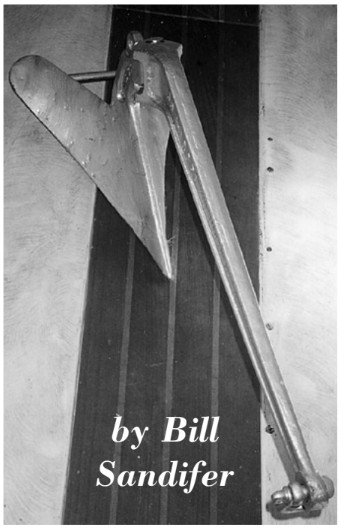
The 35-pound CQR anchor that was with my boat when I purchased her was a mass of rust. Large sections of rust were easily chipped off. In some places rust had eaten through the anchor flukes. I was loath to throw the anchor out, as a new 35-pound CQR is not cheap. I went so far as to ship the anchor to Simpson-Lawrence, since they advertise a lifetime warranty. A representative at Simpson-Lawrence explained the warranty was against breakage, not deterioration.
What to do? Being persistent (my wife says cheap), I decided to save the anchor and recondition it to serve another day. I tried chipping the rust off followed by several coats of Naval Jelly. This was of limited success and did not give me any confidence in the surfaces so treated. Cost $8.
The next step was to take the anchor to a local shop that specialized in sandblasting for industry and home. They sandblasted the fluke part of the anchor, top and bottom, for $20. The shank was in good condition.
These CQR anchors are galvanized, so I did not want to destroy any of the still good galvanizing if I could avoid it. The anchor came back with a silver sandblasted surface. I put it in our air-conditioned living room (I have a very understanding wife) until the weekend. I knew I would have a light coating of rust on it if I kept it out in the shop. We basically live in a swamp in Coastal Mississippi and Louisiana.
When the weekend arrived, I purchased a 14-oz can of Marine-Tex in gray. Cost: $20. The gray is stronger that the white. Marine-Tex bonds to all metals, handles like putty and hardens like steel. It is unaffected by temperatures from -600°F to +3000°F, oils, gasoline, and other chemicals. It’s a really good product.
As an aside, some years ago my small outboard engine for the dinghy threw a rod through the cylinder sidewall. I rebuilt the sidewall using Marine-Tex to “glue” the pieces together, bought new parts, reassembled the engine, and ran it for another year prior to selling it. It’s still running, I believe. Marine-Tex is amazing stuff.
I coated the anchor with the Marine-Tex, building up the really thin areas. As it was setting, I covered the coated surfaces with clear plastic wrap and massaged the anchor with my hands through the plastic wrap to get the correct shape. I let it set up for two days. The plastic wrap peels off epoxy easily and leaves a relatively smooth surface. A surface sanding followed by Rust-O-Leum steel primer and two coats of aluminum-colored Rust-O-Leum paint completed the job.
For the princely sum of $48 plus some sweat labor, I have a working CQR anchor that looks better than new and would cost $449 to replace. It was definitely worth saving.
Thank you to Sailrite Enterprises, Inc., for providing free access to back issues of Good Old Boat through intellectual property rights. Sailrite.com