Issue 16 : Jan/Feb 2001
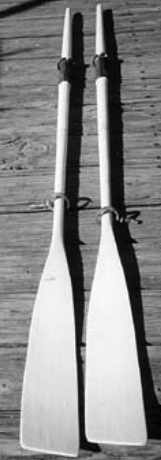
I purchased two sets of new oars more than 30 years ago for use with a beautiful 12-foot Whitehall-type rowing tender built by Jarvis Newman of Southwest Harbor, Maine. The tender and oars served for many years until, in a fit of lunacy, I sold the tender and one set of oars. The other set I kept. These oars had copper on the blades and leather for the rowlock and were varnished. Over the years, I continued using the remaining set with various small boats until I built a 10-foot Nutshell pram from plans published in WoodenBoat magazine.
The oars are 7 feet 6 inches long and fit the pram very well. The increased use of the oars and the soft spruce wood combined to create a pulpy surface in spots on the oars. I tried sanding and re-varnishing, but the wood would never sand smooth. I was afraid to remove too much wood, as I would weaken the oars. Determined to restore the oars, I sanded them of any remaining finish and coated them with epoxy. Once that had cured, I sanded the coating and applied a second coat of epoxy. The epoxy penetrated into the wood and stabilized it, allowing it to be sanded to a smooth surface. There were no more pulpy soft spots.
Epoxy does not like ultraviolet light and will degrade over time if exposed to it, so I used an epoxy primer and a white polyurethane top coat to protect the epoxy from damage. I sealed the blade ends with fiberglass cloth and epoxy and added leathers on the shaft to take the wear of the oarlocks.
The oars are five years beyond the day they were restored and look and work like new. The epoxy is flexible enough to allow for the bending of the oars. There has been no sign of surface crazing or cracking, and a little soap and water keeps them clean and bright.
Since then, I have used epoxy as a coating under varnish for interior wood doors and drawers on the boat, and it creates a new, deep-looking varnish finish. I am careful to use a top coat of varnish with UV inhibitors to protect the epoxy. The mast for the Nutshell was coated with epoxy and wrapped with fiberglass cloth. The epoxy turned the fiberglass cloth invisible and, with several coats of varnish, it looks just like a natural wood varnished mast but it is hard, strong and much tougher than if it were without the cloth and epoxy.
Have a problem with wood? Try epoxy to stabilize it prior to restoration.
Thank you to Sailrite Enterprises, Inc., for providing free access to back issues of Good Old Boat through intellectual property rights. Sailrite.com