Phil Rhodes inspired a generation of yacht designers, including Bob Perry
Issue 76 : Jan/Feb 2011
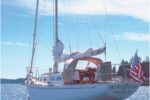
It was about 50 years ago. I was probably 15 years old. I had started sailing and I was studying mechanical drawing in school. I worked in a meat market after school and I would walk home from work and pass a drugstore that had a good supply of magazines by the front door. One afternoon, I picked up a copy of Popular Boating and there on the cover was a photo of the Chesapeake 32. Inside the magazine was a feature story on the Chesapeake 32. I was struck by the beauty of this little cruising boat. To my young eye, the boat just seemed to exude perfection of proportion. It was a fairly simple design but it was powerful enough to convince me that I wanted to design sailing yachts for a living. In this article, we are going to take a look back at the work of Phil Rhodes. His designs range from 12-foot Penguin dinghies to ocean racers, to mega-yacht motorsailers, large power yachts, and commercial vessels. I have tried to pick out a selection of his designs that I think show the Rhodes “eye” at its best.
An impressive life’s work
Philip L. Rhodes was born in 1895 in Ohio and did not come from a yachting background. He spent some of his early years living by the Ohio River, where he was first exposed to the large paddle-wheelers and other vessels that worked the river. Phil soon started sketching and carving boats. While in high school, he designed and built a single-step hydroplane called Dusty. By the time he graduated from high school, he had had two articles published in Motor Boating magazine.
While attending Denison University in Ohio, Phil made the decision to become a naval architect and, in 1916, transferred to MIT. After working for several other designers, Phil opened his own office in New York City in either 1924 or ’25. It was a small “hole in the wall” office with just enough room for Phil and one assistant. At one time, that assistant was a young Olin Stephens.
When the Depression hit, work was slim, and Phil began working with the large firm of Cox & Stevens, concentrating on large commercial vessels but keeping his hand in with yachts working at home. He quickly rose to an administrative position. Phil was considered an excellent draftsman, and that was back in the day when you drew with a drafting pen with ink on cloth. It was a demanding art.
In 1947, Cox & Stevens was dissolved and the firm’s name was changed to Philip L. Rhodes, Naval Architects and Marine Engineers. Rhodes designs were being built all over the world and the Rhodes office was one of the first to explore the use of fiberglass in series- or “production-” built boats. The Rhodes Bounty II was the first large sailboat built of fiberglass. I learned to sail in a 12-foot Rhodes Penguin dinghy.
Phil Rhodes, a tall, handsome, kind-looking man was usually photographed smoking a pipe. He died in 1974 at the age of 79. The list of designers who got their start in the Rhodes office is long and includes Bill Tripp, Al Mason, Francis Kinney, Winthrop Warner, James McCurdy, Olin Stephens, Bob Wallstrom, and Charles Wittholz.
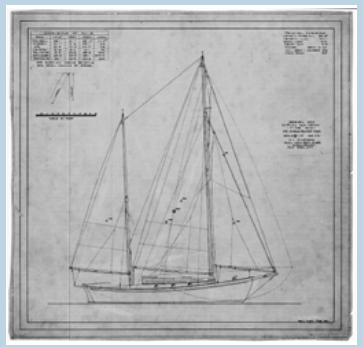
Tide Rip/Dog Star
Phil liked double-enders and designed several of them, starting in 1926 with Caribe. My favorite Rhodes double-ender is Dog Star, also known as Tide Rip. I could be wrong, but I think one modestly successful Taiwan double-ender was based on this parent set of lines. A GRP version of Dog Star, called the Traveler 32, was built in the U.S. The Traveler 32 has a much more dramatically cut-away forefoot than did the original Dog Star.
I just love Dog Star. It’s only 30 feet 8 inches LOD, with 10 feet 2 inches beam and 5 feet of draft, but it is as shapely as can be and very salty looking. The waterlines are almost symmetrical fore and aft. In studying the tall, ketch-rig sail, plan you can begin to see the magic of the Rhodes sheerline. In Phil’s era, designers were not afraid to bend that batten and put some strong spring in their sheers. Phil was extremely good at it and I think his sheers convey a proud strength.
I don’t know what the displacement of Dog Star is but I would estimate a D/L of around 330. Note on the sail plan how the main backstay is dead-ended on the mizzenmast about 5 feet above the gooseneck. You don’t see that detail anymore. The working jib is club-footed. Also note how low the main and mizzen booms are. Back in those days, you learned to duck when you tacked. A designer could not get away with that today. “What do you mean, I have to duck?” I have never sailed this design but I would bet you a beer that the helm balance was impeccable.
Dog Star’s layout below was very simple. The galley is forward, as was the style in the old days, just aft of the V-berth. The mainmast is well forward up in the eye of the V-berth. There is a wood-burning stove. Adjacent to the galley is an enclosed head. Large and comfy-looking settee berths are aft.
I think you can see in Dog Star some of the origins of the love of double-enders that was so strong among so many cruising sailors through the 1990s. I know this design influenced my own work.
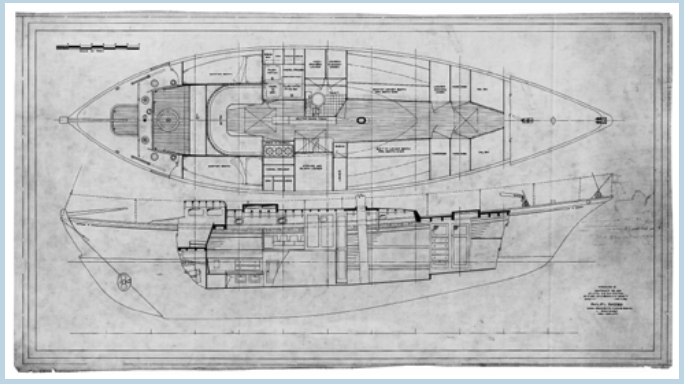
Kirawan II (Hother)
I have a hard time picking my favorite Rhodes design, but Kirawan II, designed for Robert Baruch, is always very near the top. For one it’s a double-ender and for two it has an outboard rudder and tiller steering. The LOA is 46 feet 3 inches and the draft is only 4 feet 9 inches, but a large centerboard at least doubled that draft. I do know that this hull was tank-tested in 1938. They tested a deep-keel version against a centerboard version and found them equally effective. The centerboard was bronze plate over a cast bronze frame with 1,000 pounds of internal lead. Imagine the expense of that today.
The bow of Kirawan II is unusual. You could call it a “modified clipper” bow. Originally, Phil drew the boat with a more conventional, short overhang bow and a bowsprit. But he did not like the look and tried this concave bow profile while giving the forward sections plenty of flare and buoyancy to keep it from burying. It worked. Kirawan II was raced extensively and then bought by Jakob Isbrandtsen who changed the name to Hother. In 1955, Hother was bought by Paul Hoffman and that’s when she really started to clean up on the race course, winning 29 out of 33 races in their first season. This boat certainly was a very distinctive looking CCA racer with her outboard rudder and unusual stem profile.

I think the bow shape is a bit odd, but it just works so well with the rest of the proportions that I can’t criticize it. Note again the strong sweep to the sheer and the way it’s echoed by the cove stripe and thin bootstripe.
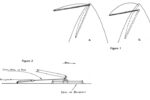
The modern cutter rig has proportions similar to my own Valiant 40. Note the mini boomkin aft to keep the backstay clear of the outboard rudder. You can easily see how Phil used the concave bow profile to pull the stem forward to get the center of pressure of the headsail forward. However, as originally drawn, Kirawan II had too much weather helm and, under Hoffman’s ownership, Phil modified the rudder shape, adding area low on the rudder blade and shortening the boom to give the mainsail a 3:1 aspect ratio. This was the race-winning combination and a harbinger of modern mainsail proportions. To my eye, the mast should have been about 28 inches forward; that would have eased the helm pressure.
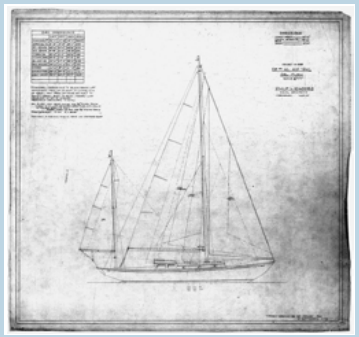
Bounty II
Bounty II, not to be confused with the earlier Rhodes Bounty, may not be one of my favorite Rhodes boats, but in the context of Good Old Boat it is probably the most important Rhodes design. Phil’s son Bodie drew the lines for Bounty II, which has a 28-foot DWL and is a direct reduction of the beautiful sloop Altair, which was 29 feet on the waterline. It is unusual to just mathematically reduce hull lines but, in this case, the reduction was small so it worked well.
What makes Bounty II so important to the Good Old Boat reader is that this is one of the very first large GRP sailing yachts. After WWII, it was getting hard to find skilled wooden boatbuilders and materials. The builder for Bounty II was the Coleman Boat and Plastics Company, later changed to AeroMarine Plastics Corp., in Sausalito, California. Coleman was building the original wooden Bounty before the war, with production-line techniques, but the war brought that project to an end.
In 1956, Coleman decided to produce another “stock” boat and, with Rhodes having some experience in much smaller GRP boats, it was decided the new Bounty II would be GRP. Ironically, engineering data for GRP construction was pretty scarce at the time, so Rhodes collaborated with Bill Garden in Seattle on the engineering of the Bounty II’s construction.
By today’s standards, with its solid glass decks and a massively thick hull laminate, the Bounty II was an icebreaker. We know now that the scantlings were basically guesswork, resulting in an over-built heavy boat. But they did endure, and you can still find Bounty IIs in almost any marina in the U.S.
As you would expect, the sheer is perfection, dipping down around station 8 and kicking up with a strong spring to a very shapely transom. The sections are wineglass-type with thick garboards, which allowed the engine to be placed low in the bilge of the boat. The long overhangs conformed to the CCA rule. The cabin trunk features a raised portion aft.
As a kid, I was not too keen on the look of the Bounty II. All the glamour of the beautiful wood trim and detailing that had made the older Rhodes boats stick out was gone. With no wooden cap rail and no “eyebrow” on the cabin trunk it was all too “jello-moldish” to my eye. But I now realize that this was all part of the early experience in transitioning to GRP construction. Heck, the first boats built to this design came with GRP masts. They were extremely heavy and made the boats quite tender and were soon replaced by aluminum masts. Remember, this was 1956.
In the early 1960s, AeroMarine Plastics Corp. was bought out by Pearson Yachts in Rhode Island. Pearson retained the tooling for the Bounty II class and built it as the Rhodes 41, with some small design changes. The freeboard was raised slightly, the engine was lifted out of the bilge, and the single window in the raised house was replaced by two windows. In 1968, Pearson stopped production of the Rhodes 41 after building nearly 50 boats. Bounty II represents the beginning of production boatbuilding as we know it today.
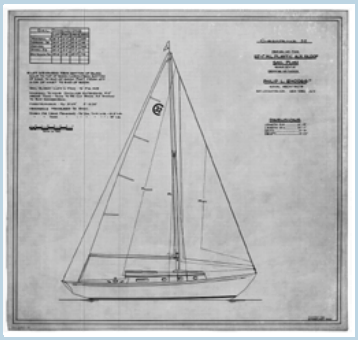
Chesapeake 32
This is the little Rhodes design that got my heart pumping when I was 15. It was designed for the George Walton Company of Annapolis in 1959. It’s a 32-footer with a short DWL of 22 feet 1 inch. The beam of 8 feet 9 inches gives it a length-to-beam ratio of 3.65, indicating what today would be a narrow boat. Draft is just shy of 5 feet. The boats were originally built in Denmark by Danboats, Inc., and the first eight boats were a little “soft” in the shell laminate. Later boats were reinforced with longitudinal stringers. After hull number 25, the builder was Sandersen’s Plastic Boats in Copenhagen and build quality was improved.
I find the proportions of the Chesapeake 32 very appealing. Freeboard is low and I suspect “headroom” is less than 5 feet 11 inches. The “jello mold” look has been avoided by using a wooden cockpit coaming and a teak eyebrow trim on the cabin trunk. You can’t see the underwater profile here, but by this time, Phil was pulling the leading edge of the keel well aft and the keel was starting to almost look like a fin. Yet the rudder stayed attached to the aft end of the keel. The 32 had a reputation for hobbyhorsing, so additional ballast was added amidships and reportedly helped the situation. The narrow beam of the 32 resulted in a smallish layout. But there were V-berths, an enclosed head, settee berths in the main cabin, and a minimal galley and chart table shoved well aft. Today, you could find roomier 26-footers, but certainly not prettier.
Carina
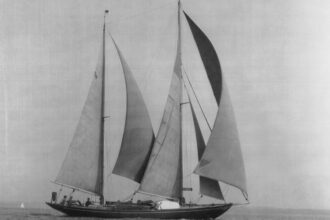
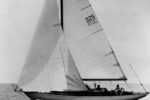
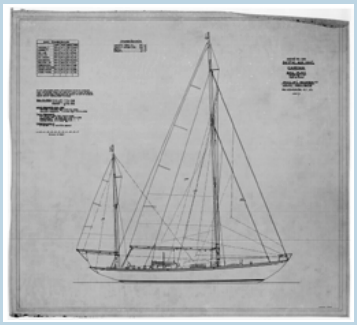
I hardly know what to say about Carina, designed in 1955. I think the drawings speak for themselves. To my eye, this is Phil’s most beautiful design. It’s perfection in yacht design, beautiful, and an ocean-racing rocket of its day. The long overhangs, the sweeping sheerline, the trim little cabin trunk, and the flush deck forward all combine to make this pure eye candy. There is just not an ugly line on this boat. Note the subtle spoon profile to the stem and the hint of hollow in the counter aft. I even think the yawl rig adds an air of interest to the look. Carina was built by H. Heidtman of Hamburg, Germany, in four months, probably a record. Carina went on to earn an impressive race record in the U.S. and in Europe. She won the Transatlantic Race that started 12 days after she was delivered to the U.S. Carina also won the Fastnet Race, the Bermuda Race, three awards at Cowes Week, then won another Transatlantic Race and another Fastnet. You can’t ask much more of a boat. They don’t make them like this anymore.
Robert Perry is a Good Old Boat contributing editor. His own career in yacht design began toward the end of that of Phil Rhodes and he has carried on the tradition of drawing boats that remain good even as they get older.
About the drawings on these pages
The illustrations that accompany this article are reproductions of the original ink-on-cloth drawings made by Philip Rhodes and represent his skill and artistry. These drawings, and hundreds like them, are in the Philip Rhodes collection held by Mystic Seaport.
The Daniel S. Gregory Ships Plans Library at Mystic Seaport preserves, and makes accessible, the documentary history of American naval architecture from the 19th and 20th centuries. The library actively collects plans from all areas of the U.S. In this specialized archive of approximately 100,000 naval architectural drawings, yacht plans and small-boat plans sit side by side with drawings of fishing draggers and lighthouses.
For information and to research and order plans, visit http://library.mysticseaport.org
Thank you to Sailrite Enterprises, Inc., for providing free access to back issues of Good Old Boat through intellectual property rights. Sailrite.com