As fast as physics allows
Issue 76 : Jan/Feb 2011
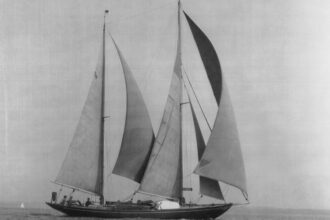
Although it’s somewhat of a misnomer, the term “displacement hull” is used in reference to a boat whose displacement at speed is the same as its displacement at rest. All hulls displace their own weight at rest (see “Buoyancy and Displacement 101,” September), but some hulls, when driven fast enough, are able to climb up and plane on the surface of the water. These hulls, called planing hulls, displace considerably less water when at speed than at rest. The loss in buoyancy is made up for by dynamic lift. Most large monohull sailboats have displacement hulls.
Making waves
When a boat travels through the water, it creates a wave that moves at the same speed as the boat. There is a direct relationship between the speed of a wave and the length of that wave. (In fluids, the length of a wave, its wavelength, is usually, but not necessarily, measured from crest to crest.) The faster the speed of a wave, the longer its length. As an example, a tsunami wave often will travel in the open ocean at speeds of hundreds of miles per hour. The wavelength (from crest to crest) is also very long — 20 miles or more — which explains why boats in open water don’t notice when a tsunami wave passes beneath them. (For the purposes of this discussion we will ignore how very shallow water and variations in the density of water affect the behavior of waves.)
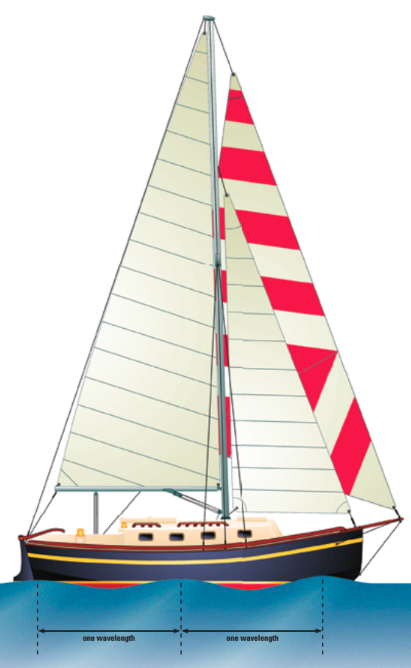
A boat moving slowly creates a slow-moving wave with a short wavelength. In calm seas, the resulting series of waves can be seen along the hull.
Speed limit
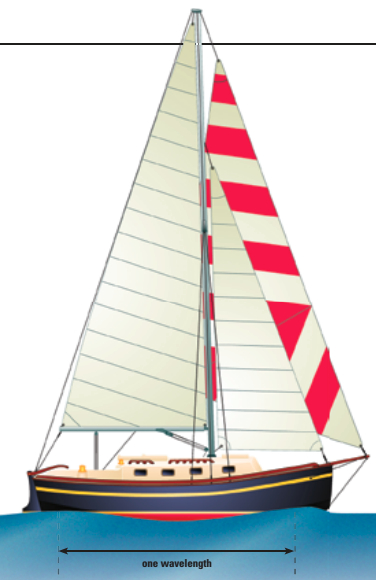
Because the length of a wave is proportional to its speed, as the boat moves faster, the wavelength becomes longer until the point arrives where the length of the wave that the boat is creating is the same as the length of the boat’s waterline. If the boat tries to go faster than this, the wave it creates will be longer than the waterline of the boat.
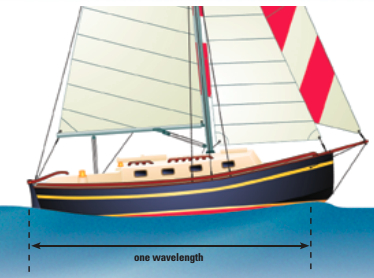
We’ve all experienced the phenomenon when a boat “squats down” in the stern. This happens because the hull is in the trough of the wave it’s creating while the bow is on the crest. The boat is now attempting to go uphill on the face of the wave it’s creating. This holds true for all displacement hulls, whether they are a 30-foot sailboat or the QE2.
To make a heavy boat go uphill takes a tremendous amount of power — more than most displacement hulls have available — and to attempt to do so would be extremely wasteful of fuel for a negligible result. So effectively, the top speed of a displacement hull, often referred to as its “hull speed,” is limited by the length of its waterline or, in other words, by the length of the wave it’s creating.
Many of us have seen this condition when towing a dinghy. When the towing speed exceeds the dinghy’s displacement hull speed, we see the dinghy squat down at the stern as its bow rises on the face of the wave it’s creating. This puts great tension on the towline and considerably reduces the speed of the towing vessel.
Calculating hull speed
For most good old boats, hull speed can be calculated using the formula S = 1.34√L, where S is the hull speed in knots and L is the waterline length in feet. The number 1.34 is a constant. The number 1.4 would more accurately represent the speed of a wave whose length was L, but many naval architects use the lower number because the effects of achieving maximum hull speed are usually observed before the wavelength reaches L.
As the formula shows, maximum hull speed is proportional to the square root of the waterline length, which explains why a boat with a 40-foot waterline doesn’t sail twice as fast as a boat with a 20-foot waterline.
Rule breakers
Waterline length is not the speed-limiting factor for all hulls. Long slender hulls, such as those of multihulls, incur relatively low wave drag (drag due to creating waves) compared to the wetted-surface drag, or viscous drag. The notion of limited hull speed does not apply to these hulls.
Don Launer, a Good Old Boat contributing editor, built his two-masted schooner, Delphinus, from a bare hull and has held a USCG captain’s license for more than 34 years. He has written several books, including Navigation Through the Ages and The Galley: How Things Work, and frequently gives talks on the history of navigation.
Thank you to Sailrite Enterprises, Inc., for providing free access to back issues of Good Old Boat through intellectual property rights. Sailrite.com