A schooner’s crew won’t be dock-bound by a defunct engine
Issue 76 : Jan/Feb 2011
Sailing a heavy fixed-keel boat without an engine could be viewed as a challenge and a good opportunity to improve one’s skills. Or it might be just plain dumb.
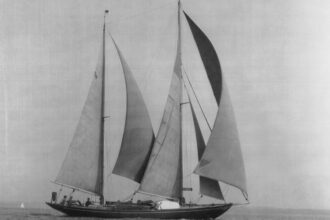
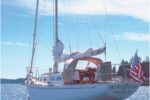
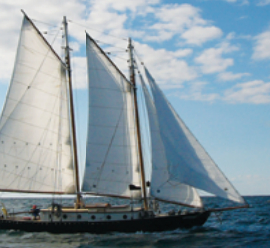
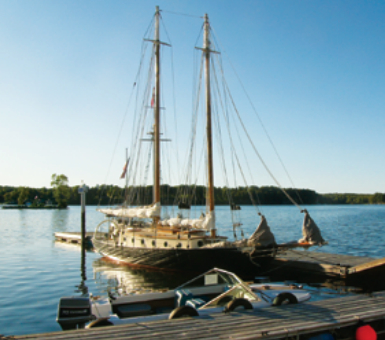
Our good ship Sara B, a “true-to-type” Tancook schooner yacht, was built as an apprentice shop training project in the 1950s in Nova Scotia. When her engine, Lake Ontario’s oldest living Thornycroft diesel, suffered a midseason transmission failure, we were dismayed and disheartened. The offending part was extracted and sent off to a friendly machine shop, which began what turned out to be a lengthy repair process for the British-made antique. As weeks became months and the season dwindled, we watched the spiders rig their webs on every part of our boat. Summer faded into September and we missed the old girl. “I wish she was still on a mooring,” I sighed. “We could sail her without a motor then.”
We pondered getting Sara B out and back into her dock in the weedy shallows by sailing, line handing, grapples, bolting an outboard onto her, using sweeps or a push pole, or some other technique. Our unwieldy vessel’s long keel, gaff rig, and projections at both ends gave us pause. With 12 tons behind that bowsprit and no brakes, things could get ugly. Yet we knew engineless schooners far larger than our little 47-footer were (and still are) routinely maneuvered in close quarters using sails, tugs, and yawl boats. And skill. The old-timers did it — all we needed was a little shove in and out of the dock.
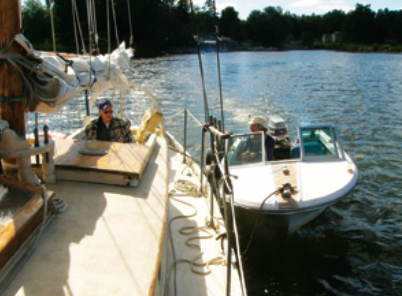
While gazing upon our old yacht one evening during happy hour, my spouse proposed that, since we were a little short in the skills department, we go buy a tug for her. A check of craigslist the next morning revealed a wealth of cheap old runabouts and, two days later, we owned a 15-foot 1972 Mark Twain runabout with a 70-hp outboard. We equipped Tug with a half dozen oversized ash cleats and four Geo tires, launched her that weekend, and motored to the dock. The plan: lash her alongside, use reverse to pull out, then swing around and head for open water. What could go wrong? Actually, quite a lot, as it turns out.
An uneventful maiden outing
As we prepared to cast off, the schooner crew asked the tug driver what’s next. “I have no idea,” he replied. “I’m making this up as I go.”
Surprisingly, the fi rst outing went quite well. Our departure from the dock on a day of light wind was uneventful. We anchored Tug and raised sail on Sara B without mishap (though at least 30 spiders fell from the rigging). Our old boat slipped off with a whisper of her bow wave and a few quiet creaks of leather and wood from the gaff rig. We were sailing again. It felt grand!
When it was time to head back, we sailed alongside Tug as if she were a mooring and picked up a line buoyed off to the anchor. We then lashed up and pushed back to the dock. In the calm of the bay, the process went without a hitch and the crew of the Sara B was considerably emboldened: “We’ve gotta’ try this again!”
Sailing without an engine requires a different mindset. You can’t hurry when the winds are light. If you have an appointment at 2 p.m., allow for being becalmed. You had better know your vessel’s turning radius under sail if the outboard refuses to start and you have to sail onto the dock while towing your tug. Leave extra room on a shifty day near shore lest you get caught aback or miss stays. And have at least one, if not two, backup plans.
Anticipation and vigilance are essential for engineless sailing as are good basic sailing skills. Quick thinking and improvisation help. Having a cell phone along is probably a good idea. We got cocky after a couple of light-air excursions within the protected bay and made a couple of forays into the open lake. They proved humbling.
A test of mettle
The following Sunday was a day of sapphire blue water, 10- to 12-knot steady sweet onshore wind and perfect sailing. A dozen white-winged sloops were tacking up the bay as we trooped out on the dock with picnic lunch and gear. Three sailors plus two guests and a dog climbed aboard and we made a smooth exit from the dock. It seemed to me we were leaving the dock with more aplomb than we had managed with some of our “normal departures” aided by the diesel. A few wakes bounced Tug around on Sara B’s quarter as we pushed up the bay, but the lash-up survived. We pushed through the channel and entered the wide blue lake. At last — freedom.
It took several tries to anchor on the rocky bottom. We taped a note, “Be back soon,” on Tug, cast off, and hoped she would be there when we returned. If someone hijacked her or she dragged, we figured we’d at least be able to sail ourselves back into the bay with the onshore breeze. We wondered momentarily whether it had been smart to leave the key in the ignition.
Sara B romped off with real enthusiasm and pointed her bowsprit for Canada. The lonely little white runabout festooned with Geo tires bobbing around in the open lake quickly dwindled to a white speck and then was gone. It was wonderful to really sail again. Sara B put her rail down and stepped along smooth and easy. In no time, we were 5 miles offshore. Sure was nice to sail in a straight line for more than 10 minutes. We broke out the crackers and lemonade and celebrated.
The brief fall afternoon spun away astern and daylight dwindled. We noted the sun was getting low and the thought occurred that we really should go in before the wind died. We reluctantly turned Sara B homeward. She surged along on a broad reach and, as we approached Tug, we remarked that the lake had kicked up and the wind sure hadn’t dropped any: “Man, this is really getting bouncy — look at that little boat jumping around! How is the driver going to get in there?” A collision at sea and a sunken runabout seemed like real possibilities.
Our first pass at the buoyed-off pickup line missed by 75 feet. The second and third passes also missed. “Four is my lucky number,” announced the helmsman as we approached the buoyed line once again. This time we snagged it, though in the ensuing melee, the flogging jibsheet sent my eyeglasses overboard. As Tug danced alongside with real vigor, the driver belatedly donned a life jacket and waited his chance to get aboard while we tried with the boathook to keep her from bashing Sara B. The tug driver finally disembarked and the motor started immediately. We cast Tug off and turned to weighing anchor . . . no simple task in my new myopic state. Thank goodness for the good old hand windlass!
That one was a little more exciting than we had bargained for. But we were game to try again. It sure was fun to sail the old girl, and the novelty of trying to use our brains as we attempted to get Sara B from point A to point B without her engine had not yet worn off. Still, after the latest outing, I was beginning to appreciate just how sharp those old-timers were as they managed their unwieldy ships. They used every trick in the book, including grapples and heaving lines, raffee sails, kedging, and sweeps . . . plus others I don’t know about.
A little too testing
On the next Sunday, the weatherman predicted 10- to 13-mph winds from the south. Perfect mild weather, flat water, nice easy sailing. “Let’s go!” We took along two experienced crewmembers for this one and expected a sweet gentle September sail. We hoped to make a day of it and arranged to meet at the dock at 9 a.m. When we assembled, we noted the wind stirring the treetops looked a tad stronger than 10 mph. Maybe more like 20. “Well, that’s OK. We’ll just reef the main as a precaution. We can always shake it out.”
This time, I was Tug’s driver. The plan was for me to push Sara B out of the dock and follow her out into the lake where she would anchor. I would then come alongside to shift the anchor to Tug. We’d be under the lee of the land with nice flat water this time so it should be dead simple. Piece of cake.
In the open bay, with a puffy brisk wind, Sara B’s crew raised just the reefed main and staysail. She took off like a racehorse and broad reached down the bay at hull speed. I followed in Tug and marveled at the way she ran — she flowed over the water with effortless grace. Other people have told me she looks magnifi cent under sail. They weren’t exaggerating. She was splendid even under shortened canvas. She left no tracks that day; I heard at least one gull weep with envy.
But out in the lake and hard on the wind, progress was not effortless. She put her rail down and slogged. Under the lee of the land, the crew opted to tie in a second reef. With Tug well anchored in a nice 10-foot mud patch, we raised sail again and fell off on a reach. Sara B stepped along smartly under a scrap of sail as little whitecaps blossomed on the green water around us. In minutes, we were a half mile offshore and well on our way to Oswego.
“Maybe,” we thought, “we ought to go the other way close-hauled just to see what it’s like.” We tacked around and headed back. Now suddenly feeling the full weight of the wind and hearing it whistle through her rig, we said, “You know, it’s kinda’ brisk out here. Let’s bag it. Let’s just see if we can even get back into the bay!”
We beat our way upwind to Tug and lashed alongside uneventfully in the calm water. Then we headed for the channel. As we turned upwind against gusts of 25 knots and higher, Tug bounced and plunged through the chop and strained hard to shove 12 tons of wood and gaff-rigged windage up the channel.
We crawled along, barely maintaining steerageway. The bow tried to fall off, but we were able to crab her around again and keep moving. I watched the homemade cleats and tight-stretched springlines closely. Everything held, although one tire popped out of place repeatedly. They made good sturdy fiberglass motorboat decks in those days.
It was slow going, though, and Tug sucked up fuel doing it. About halfway in, the driver hefted the tank and found it alarmingly light. “Wow! Hope we don’t run out of gas. We started out with at least 4 gallons!” We decided that, once in the bay, we would drop Tug so she would be free to go get some more gas. Meanwhile, Sara B would tack toward the dock. We plunged down the bay under short canvas and hooked up with the refueled Tug for an uneventful tow to the dock. There we declared that was just about as interesting as we wanted to make it.
To sail is better than not to sail
I suspect there are a few folks (maybe quite a few) who would think this whole sailing sans engine business was ridiculous, if not downright hazardous. Sensible people would simply haul their old wooden boat early if they couldn’t use it and maybe get to work on fixing some dry rot.
But it had been a strange, and at times disturbing, summer for us. Life, they say, is like a roll of toilet paper. When you get to the end, it goes fast. We’d heard of far too many folks who had been caught short by the toilet paper roll of mortality over the last few months. Though we seek, perhaps unwisely, to make permanent the impermanent, we know Sara B’s days with us, like our own, are numbered. She needed to go sailing again! And so she did.
Susan Peterson Gateley has written a half dozen books on sailing and Lake Ontario, including one that features Sara B. Visit www.silverwaters.com for excerpts and more stories.
Thank you to Sailrite Enterprises, Inc., for providing free access to back issues of Good Old Boat through intellectual property rights. Sailrite.com