She’s a 20-foot trailersailer with a large cockpit and a lot of names
Issue 36 : May/Jun 2004
Back in the 1930s, a couple of teenage brothers enjoyed being out on Lake Wawasee, located near their hometown of Syracuse, Indiana. Their enjoyment was made even more special since the boats they used were ones they had built themselves. They soon began selling their home-built boats; then, in 1945, Lewis Rinker, with help from his brother, John, founded Rinkerbuilt Boats.
Their first offerings were simple fishing boats. However, over the years their product line developed into runabouts, cuddies, and cruisers … all of them powerboats. In 1981, they expanded into the trailerable sailboat market, with the formation of Gale Force, a wholly owned subsidiary housed in a separate facility across the road from the parent, Rinkerbuilt Boats. That year, Gale Force introduced two sailboat models, the 16-foot Lil’ Pirate and the 20-foot Wild Wind.
Production of the sailboat line lasted only two years. A catastrophic fire at the Gale Force facility destroyed everything. The fire, combined with soft sales and the tough economy of the early 1980s, sealed the fate of Gale Force. Rinkerbuilt Boats decided to concentrate once again on powerboats. At that time, they also shortened their name to Rinker Boats. This family-owned company is still in business today.
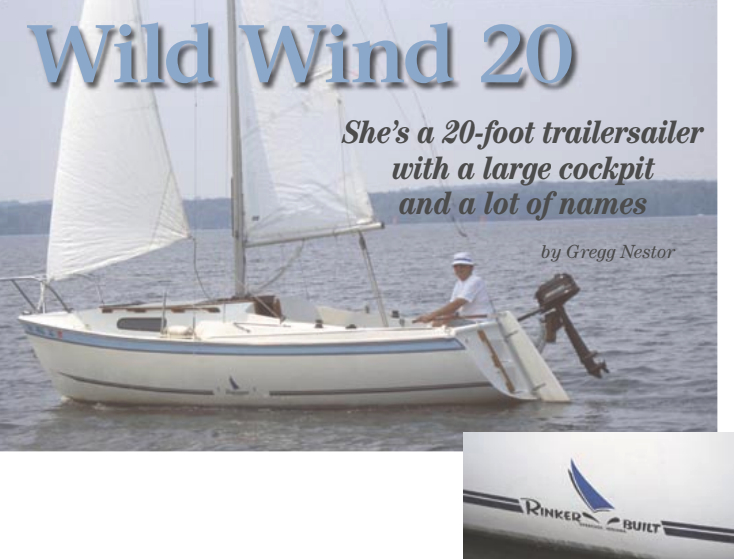
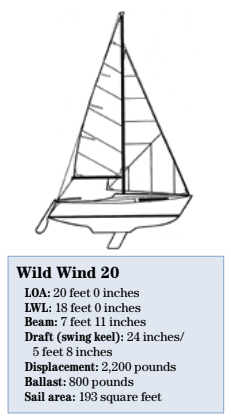
With such a short history it’s interesting to note that the Wild Wind 20 is also known as the Gale Force 20, the Rinker 20, and the Rinkerbuilt 20. Some of the confusion may have come from the fact that the decal on the boat’s hull was changed from Gale Force to Rinkerbuilt, once the supply of Gale Force decals was depleted. Even though it may have several names, the Wild Wind 20 is a novel mini-cruiser. It has an overall length of 20 feet, a waterline length of 18 feet, and a beam of 7 feet 11 inches. It displaces 2,200 pounds, with 800 pounds of ballast.
Design and construction
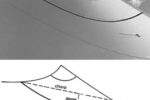
The Wild Wind 20 profile displays a flatter-than-traditional sheer, a straight bow, and a reverse transom. The cabin is a holdover style from the late ’70s, exhibiting a wedge-shaped deck that gives the interior lots of volume, if no headroom, and creates a large uncluttered foredeck. In doing so, the cabin possesses a flatter curve than the sheerline, and the entire structure is aimed at the tip of the stem. Combined with generous coamings beginning at the cabin’s bulkhead and gradually diminishing aft, this confluence of lines harmonizes well with the hull.
Both the hull and deck are fiberglass. While the hull is a solid handlaid laminate, the deck is a sandwich of two layers of fiberglass with a core of marine plywood. This construction provides an extremely stiff deck and also eliminates the need for backing plates for deck hardware. Even though the Wild Wind 20 is of a raised-deck design, it does have short and very narrow sidedecks: 7 feet long and 7 inches wide at the widest part. These token areas are more for aesthetics and added structural rigidity. They also offer a place to mount a stanchion. The hull-to-deck joint is lapped, sealed, mechanically fastened, and covered with a two-piece (aluminum and vinyl) gunwale.
The Wild Wind 20 is shoal draft with a weighted swing keel providing 800 pounds of cast-iron ballast. With the keel fully retracted, the boat draws only 24 inches, compared to 5 feet 8 inches when it is fully extended. The raising and lowering of the swing keel is accomplished by means of a winch in the cockpit, recessed into the sole and hidden beneath a trap door.
On deck
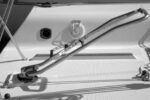
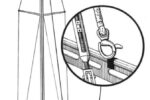
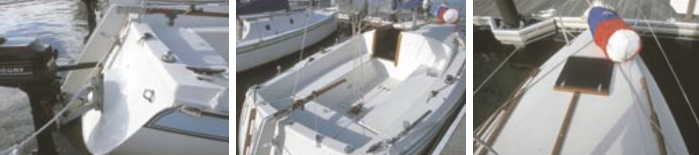
All horizontal areas — including the deck, cabintop, cockpit seats, and sole — have molded-in non-skid surfaces. A solitary mooring cleat is the only hardware to interrupt the otherwise clean and uncluttered foredeck. A couple of feet aft of the cleat, centered over the cabin, is a nearly flush and quite stout, tinted hatch. Aft of the forward hatch and 9 feet from the bow is the tabernacle for the deck-stepped mast. Off-center and to port is the narrow (18-inch-wide) companionway.
Even though the shrouds are located outboard and there are 5 feet of handrail on each side of the cabintop, crawling forward would be more prudent than walking forward. Once there, the bow pulpit does offer a degree of security, but the single, 19-inch-high lifelines are more for looks than function. Brightwork is limited to hatch trim, handrails, swim ladder treads, and tiller. The hatchboards are not of wood but of thick, tinted plastic, similar to the forward hatch material.
The boat is divided exactly in half, with 10 feet devoted to the cabin and another 10 to the cockpit. The beam is widest at the boat’s midpoint and tapers to 5 feet 11 inches at the transom, adding to its tenderness. The more-than-generous cockpit, including the 31-inch-wide footwell, would be envied by many daysailors. There is no bridge deck; any water that finds its way into the cockpit is drained through the pipe used by the swing keel’s pendant. The coamings are high (14 inches at the cabin bulkhead and gradually sloping to 8 1⁄2 inches at the transom) and provide very good back support. While the winch for the swing keel is recessed beneath the cockpit sole so as not to be an obstruction, the mainsheet is cleated directly to the cockpit sole, 6 1⁄2 feet aft of the cabin and a foot in front of the tiller, cluttering things up a bit.
Access to a spacious lazarette is through a hatch located across the transom. The lazarette is also the home for the battery and gas tank. To port there’s a small, insulated cockpit cooler. There is a fixed spade rudder mounted to the reverse transom, which also features molded-in swimladder steps and a base for mounting an outboard motor bracket. There are two stern mooring cleats. The majority of the hardware, especially hinges and hasps, is above-average quality.
Below deck
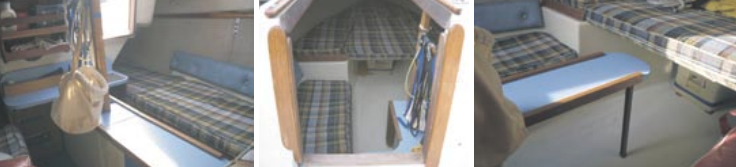
Upon entering the companionway, one takes two steps down to go below. The first step is 10 inches to an extension of the tabletop, and the next is 19 inches to the cabin sole. Like many boats of this size and category, the Wild Wind 20 uses a fiberglass pan for additional structural integrity and to designate the location of interior features. The cabin is 10 feet long and completely open. There are no bulkheads. Two tinted, non-opening, oval ports, along with the forward hatch, provide good cabin illumination. Forward and companionway hatches provide ventilation. Forward is a V-berth that is 6 feet 7 inches long and 66 inches wide at its widest. Centered beneath the V-berth and forward (two insert cushions forward) is a Porta Potti.
There are port and starboard settee berths, which blend into their respective quarterberths, making them each 9 feet 6 inches long. From sole to cabintop measures 49 inches, and sitting headroom is 34 inches. The wooden compression post is incorporated into a wooden, T-shaped, drop-leaf snack table. This combines with the companionway steps to hide the forward portion of the centerboard trunk. Also beneath the table and to starboard is the fuse panel. There are storage bins under all berths and settees.
Beneath portions of the pan, mostly in the bow and stern areas, there is positive foam flotation. While the overhead fiberglass is painted down to the deck-to-hull joint, a foam-backed fabric hull liner is employed from the joint to the settee base, giving the cabin’s interior a more finished look. There is neither a sink nor an icebox in the cabin and therefore no through-hulls.
The rig
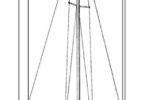
The Wild Wind 20 is a sloop with a 25-foot 11-inch mast stepped on deck in a hinged tabernacle. Both spars are made of anodized aluminum. The mast is a single-spreader rig with upper and lower shrouds and a single backstay. It is a fractional rig with a total sail area of 193 square feet, comprising a 110-percent jib of 114 square feet and a 79-square-foot mainsail. All halyards are double-braid polyester, external, and cleated at the base of the mast. Since the mast is almost amidships, raising or lowering the sails can be done easily from the cockpit, the deck, or even the cabin (by simply standing up in the companionway).
The mainsail has three battens and comes with a single row of reef points and jiffy reefing. End-boom sheeting is cleated to the cockpit sole. There is no traveler. A Barlow #14 sheet winch, along with a clam cleat, is located on each cockpit coaming. Outboard and forward of each winch is a 24-inch track and jib-sheet lead. Other sail controls include a downhaul, topping lift, and a 4:1 vang.
Under way
The Wild Wind 20 is a good “big daysailer” or “mini-cruiser” (weekender at most). It is perfectly at home in protected waters and gives satisfactory performance with stock sails and controls. It’s a tender boat. As it heels it seems to stiffen up, however, responding well to occupants who serve as movable ballast. With its standard sails, the Wild Wind 20 is a bit under-canvassed and possibly could benefit from a larger headsail. In light air, a drifter enables it to glide while on its feet. When the wind pipes up, however, a larger headsail would need to be reduced, making the Wild Wind 20 a good candidate for roller furling. Other options to help things along might be to have the mainsail cut with more roach or even to swap the 7-foot 6-inch boom for an 8- or 9-footer and a mainsail to match. A traveler might be another nice addition.
Things to check out
Any Wild Wind 20 on the market will be at least 21 years old. Some will show their age, while others that have been cared for won’t.
Sound out the deck for signs of water migration through the plywood core. Striking the deck with a plastic hammer or the handle of a screwdriver should yield a ringing sound, not one that is dull and hollow. Take special care around fittings and chainplates. There have been reports of the hull flexing or “oil canning.” This condition, if present, can be aggravated by the use of a trailer with improperly adjusted rollers. Check for cracks. Inspect beneath the tabernacle for compression damage, including the compression post. Inspect the swing-keel pendant and attachment and swivel points for wear. Look over the swing keel itself; it’s made of cast iron and subject to corrosion. That swing keel is heavy; make certain that the winch works properly. A new winch of that quality is expensive, if not near-impossible, to replace. Also look at the rudder, pintles, and gudgeons for damage.
In summary
As designed, the Wild Wind 20 is a good large daysailer or small cruiser. It truly is a weekender at most and should be sailed in protected waters. As a daysailer, its cockpit can’t be improved. As a weekender, it has berths for four average adults (forget privacy) but is better suited for two or possibly two adults and two children. Its overall construction is sound, and the hardware, for the most part, is above average. Being under-canvassed is a mixed blessing. For daysailing, so what? However, if you’re intent on performance, save your money and look elsewhere. None of this boat’s shortcomings are glaring, and most can be associated with age or the quality of care the boat has received.
Expect to pay around $2,500 to $4,500 depending upon condition. This includes boat, motor, and trailer.
Rinker Boats is still in business offering powerboats from 19 to 39 feet. However, according to Randy Rinker, when the Gale Force subsidiary that produced the Wild Wind 20 burned to the ground in the early 1980s, everything was lost. There are no known Wild Wind 20 support groups, discussion groups, or associations . . . here’s your chance.
Thank you to Sailrite Enterprises, Inc., for providing free access to back issues of Good Old Boat through intellectual property rights. Sailrite.com