Issue 7 : Jul/Aug 1999
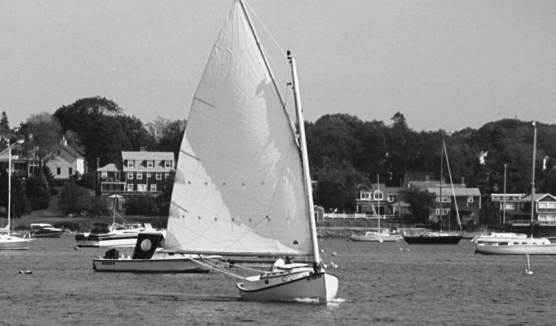
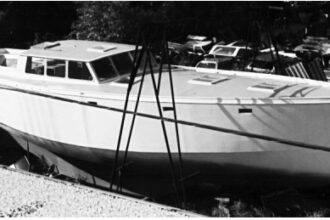
I’m not rich. I’m not poor, but I’m definitely not rich. In fact, in the great chasm that separates the two extremes, I’m somewhere near the bottom trying to claw my way up a little at a time. This has not prevented me from sailing. I’ve sailed with friends and rented boats for daysailing and recently, when I came into a little money, I bought a 30-year-old catboat in a state of disrepair with the idea of fixing her up myself.
There were several things wrong with the boat: someone had installed handrails in the cored section of the deck without bedding the self-tapping screws they used, spoiling the core; a trim piece had come away, leaving behind a difficult-to-remove band of adhesive; and the entire boat was beaten, nicked, scratched, and holed. The ports leaked badly every time it rained. In short, the boat was sound of hull but everything above the waterline needed repairing, repainting, or replacing. The worst thing about the boat, however, was the rig.
She was rigged with a Marconi sail set on an aluminum mast that had been broken and repaired, and an aluminum boom that was so pitted and dented as to be too ugly to keep. I have always thought a catboat should have a gaff rig, and when I regarded the boat at her mooring, the Marconi rig looked ridiculous. The rig also gave her an almost neutral helm in strong winds but an unnerving lee helm in light air. Charles Whitholz, the designer, had said somewhere that he considered the Marconi version of this boat perfectly balanced, so I suspect there was some tinkering done on the rig by a previous owner. The boom seemed a little short when compared to the drawing. At any rate, I decided to re-rig the boat with a gaff sail.
I designed the rig myself after obtaining drawings of the gaff-rigged version of the boat from the previous owner. The drawings, which included the center of area of the sail, gave me the general proportions to shoot for in drawing the new rig. I put the new center of area slightly aft of the Marconi version’s. Because, as I said before, I’m not rich, I decided to build the rig myself.
As I look back on it, the whole project cost me roughly $2,000, which is about what a new aluminum rig would have cost without hardware or paint. That’s mainly because I had to buy several tools for the project. I look at this little investment as money well spent because I intend to build a small cruiser someday, and the tools I have acquired will come in handy. Still, the economy of using my own labor did not save me a whole heck of a lot of money. It did, however, give me control of how and with what the spars were built. The peace of mind that brought was priceless.
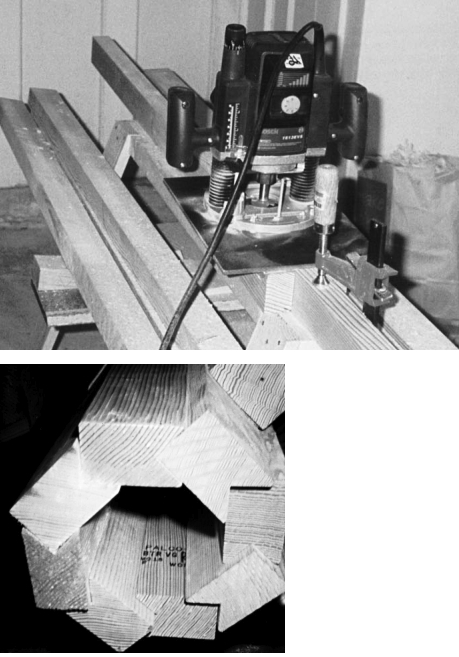
All of the spars were built of Douglas fir. The mast is hollow, and the boom and gaff are solid. I swiped the idea for building the hollow mast from a letter I had seen in Boatbuilder magazine. The plan called for eight full-length staves, notched on one edge so each stave would fit into the notch on its neighbor at a 45-degree angle, creating a large octagonal cylinder. The taper for the top of the mast was planed into the flat edge of each stave and the whole thing clamped with Spanish windlasses for gluing. Lacking the room in my basement to pass the 24-foot staves through the table saw, I made up a jig for my half-inch router and bought a 90-degree V-groove bit to cut the notches in the staves. It took several passes per stave, but the results were satisfactory.
The gaff and boom were built up of laminated stock and rounded in the conventional manner. I did not use a spar gauge to mark the cuts on the beams that would become the rounded spars. Instead, I measured in from the edge of each side (and from the pencil line at the tapers) 3.5 twelfths of the width of each face to get the octagonal cross section I wanted. I then cut along these lines at a 45-degree angle with a circular saw. From there, I planed the spars by eye and found no difficulty in turning out a set of straight, well-rounded spars.
The mast presented a small challenge in that the cables for the navigation light and the radio antenna had to ascend to the mast truck inside, to avoid fouling the mast hoops that would secure the sail to the mast. This problem was solved by simply leaving two opposing notches in the staves unglued, allowing me to separate the halves of the mast after curing to install cores and cables. I later glued the halves together with the cables inside.
All of the new hardware on the rig is of cast bronze, which is bedded and set on lignum vitae pads backed out to the curvature of the spars. The forestay is wire looped around the mast and dropped into hardwood hounds which were mortised into the mast and then screwed and glued. I originally planned on having shrouds fitted since the original chainplates were still on the boat, but instead opted for reinforcing the foredeck to take the greater lateral load of the heavier new rig. I cut a new hole in the deck and fitted a collar to it to take the wedges that would make the mast’s alignment adjustable. I also installed a new step, built up from eight half-inch layers of marine ply and glassed to the hull.
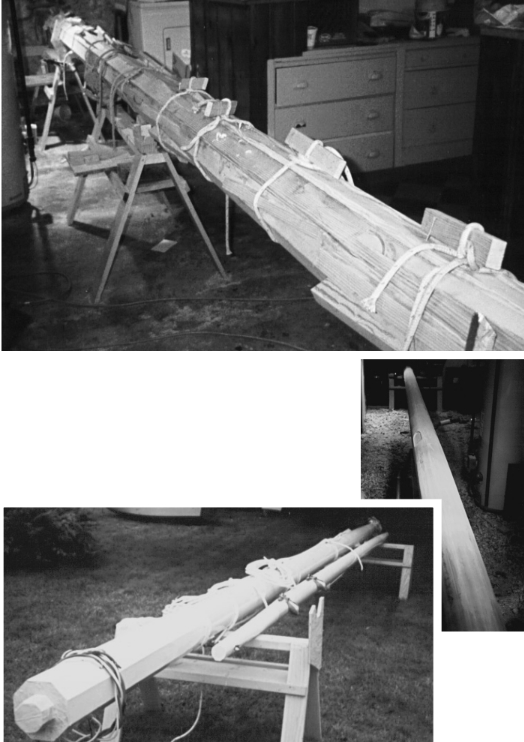
In all, the process took four months from the time I began scarfing the mast staves to the time I was ready to install the rig. In short, it took all winter. I worked part-time and at a leisurely pace. Had I been in a rush and could have worked full-time, I have no doubt that the job could have been done, including installation, in about four weeks.
After I installed the rig on the boat, I noticed an increased period of roll, due to the greater weight of the new mast. The heavier mast had raised the boat’s center of gravity slightly. This meant less stability. To compensate, I dropped almost 400 pounds of lead into the bilge. This seemed to put her back where she was before the new rig, so I ordered the new gaff sail. Later, when I sailed the boat, I found the balance of the new rig to be perfect. Her performance is great. She sails like a witch and looks much better than she did a year ago.
I went to a lot of trouble to build a new rig and to refurbish the boat. For the total investment, I probably could have bought a boat that needed no work and was ready to sail. But what would have happened to this boat? Fiberglass boats don’t rot away. They hang around for decades. There are a lot of great boats out there that, with a little work, could be giving enjoyment for years. I didn’t want to add to the collective trash heap, so I chose to recycle a boat of good design. Many other people have done the same, and the rewards are great. With luck and care, this boat should be around for the next 30 years.
Thank you to Sailrite Enterprises, Inc., for providing free access to back issues of Good Old Boat through intellectual property rights. Sailrite.com