Issue 7 : Jul/Aug 1999
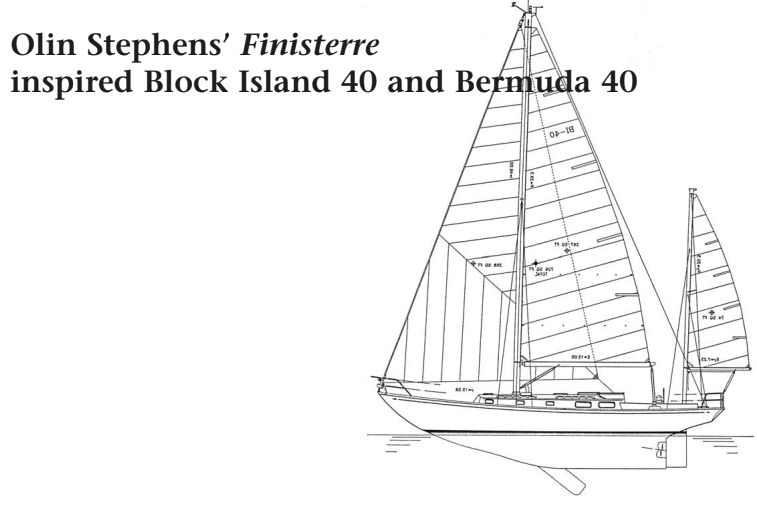
Finisterre, designed by that genius of yacht design, Olin Stephens, was the first of the fleet of cruiser/ racer keel/centerboard yawls that became so popular in the ’50s and ’60s. The reason for the popularity of the type is that Finisterre won almost everything in sight, including the Bermuda Race, three times. Naturally that inspired a number of other designers to come out with their own versions of the winning keel/centerboard yawl formula. These boats ranged in size from Bill Shaw’s delightful little 24-foot MORC racer, Trina, to Charlie Morgan’s very successful Paper Tiger and George Cuthbertson’s beautiful 54-foot Inisfree.
The late Bill Tripp, Jr., also tried his hand at the keel/centerboard yawl, and it is significant that his two creations — the Hinckley Bermuda 40 and the Block Island 40 — are still available today in limited production. That alone says much about the fine qualities of these two very enduring designs The Block Island 40, designed in 1957, was the first of the Tripp keel/centerboarders. In 1959 that design was modified slightly to produce the Bermuda 40. It is truly wonderful that these yachts, masterfully designed more than 40 years ago, are being built today for owners who appreciate and can afford brand-new good old boats.
A comparison of the characteristics of the Tripp designs, along with Finisterre, is very interesting:
| Finisterre | Block Island 40 | Bermuda 40 | |
| LOA | 38′ 6″ | 40′ 8″ | 40′ 9″ |
| LWL | 28′ 11″ | 29′ 2″ | 28′ 10″ |
| Beam | 11′ 3″ | 11′ 10″ | 11′ 9″ |
| Draft, c.b. up | 3′ 11″ | 4′ 2″ | 4′ 3″ |
| Draft, c.b. down | 7′ 7″ | 8′ 10″ | 8′ 9″ |
| Disp. (lb.) | 22,000 | 20,000 | 20,000 |
| Ballast (lb.) | 9,460 | 7,800 | 6,500 |
| Ballast Ratio | 43% | 39% | 32.5% |
| Sail Area (sq.ft.) | 710 | 738 | 776 |
| DISP/L Ratio | 406 | 360 | 372.6 |
| SA/DISP Ratio | 14.47 | 16.03 | 16.85 |
| Motion Comf. | 42.3 | 35 | 35.5 |
The Tripp boats have about the same waterline length as Finisterre but are a bit beamier and a couple of feet longer overall. They also have about 10 percent more draft with the board up, and 16 percent more with the board down. This slightly greater beam and draft may account for the fact that the Tripp designs carry a significantly lower ballast ratio than Finisterre. Indeed, the 32.5 percent ratio of the Bermuda 40 seems unusually low, but I called Hinckley and that is, indeed, the figure they quoted. The Bermuda 40 is a very well-proven design but, still, I would feel better with another 1,000 pounds of lead fitted as low as possible in the boat, if my dreams included extended ocean cruising.
The wooden Finisterre is heavier than the fiberglass 40s but would be closer in displacement if she carried less ballast. However the added ballast will result in a higher capsize angle and the heavier displacement in greater motion comfort, so it is not out of place on a cruiser. Still, the BI 40 and her sister are quite capable of crossing oceans; more than one has circumnavigated the globe and, of course, both yachts have participated in ocean races in every kind of weather and won more than their share.
The sail area/displacement ratio of the Tripp boats is higher than Finisterre’s so I would expect them to be faster in light-medium air, but Finisterre’s smaller rig and greater stability would put her back into the competition when it breezed up. Back in the ’60s when I sailed with Bill Luders on Storm, I raced against a sister of Finisterre, which was skippered by the legendary Arthur Knapp. I recall that we beat her on a long slog to windward in a stiff breeze, but I also recall that it was not easy. We worked very hard for every inch we gained! I’m sure the BI 40 and the B 4O will do every bit as well.
Of course, that was back in the good old days of good old boats and the Cruising Club of America rating rule. Any of these heavy CCA cruiser-racers would be easy meat for a hot contemporary IOR yacht, but that does not take a thing away from the ability of the BI 40 and B 40 to perform as comfortable and able-to-go-anywhere cruising yachts. Their shoal draft capability alone will endear them to many who cruise where the bottom is close to the top. Too, these boats are a solid investment. They may not equal the return on Microsoft stock, but many have repaid their lucky owners with years of service and most, or all, of their initial investment back later when it was time to swallow the anchor. Few of today’s crop of cruising yachts will be able to make that claim!
Thank you to Sailrite Enterprises, Inc., for providing free access to back issues of Good Old Boat through intellectual property rights. Sailrite.com