The obvious question: Why hasn’t someone done this before?
Issue 7 : Jul/Aug 1999
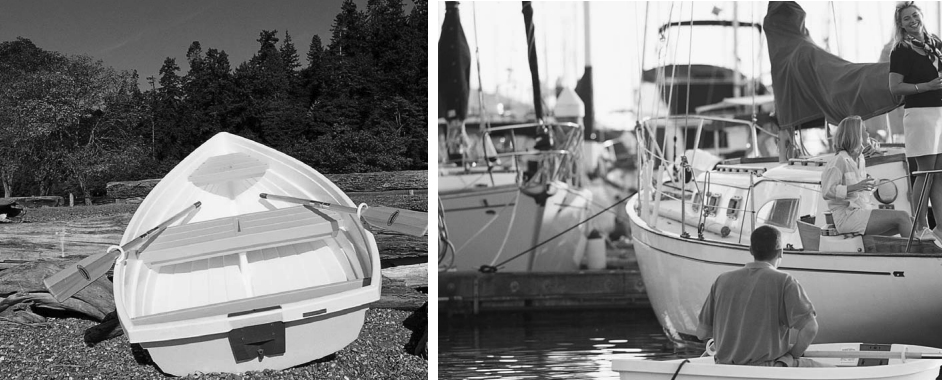
We’re in a warehouse large enough for at least a half-dozen Goodyear blimps, and Jeff Larsen is pointing to endless stacks of plastic 8-foot dinghies fading away into the distance. “We’re selling them all over the world,” he says. “And they’ve already won a prestigious international award.”
This industrial park, only a few miles from Seattle, Wash., is the center of a boating revolution. In the 21st century, this is how small boats will be built, sold, and distributed. We’re looking at the world’s first true “belly-button boat.” If Walker Bay Boats has its way, everyone will have one.
“We’re aiming to get a boat in every home,” says Larsen, president of Walker Bay Boats. And at a selling price of $399 for an 8-foot dinghy, they might just succeed. The Walker Bay 8 is injection-molded from polypropylene plastic — the same stuff that’s in 95 percent of today’s car bumpers. It’s light, it’s cheap, and it’s almost indestructible.
But how do you produce a quality boat for $399? The secret lies in the design of the boat, the manufacturing process, and the arrangements for shipping the finished product. Walker Bay produces hundreds of dinghies at a time from a 6,000-ton press. Each one takes less than three minutes to complete.
The finished hulls nest like dories on an old Cape Cod schooner. Better, in fact. They nest so tidily that each new hull adds only two inches to the height of the stack, so you can fit 192 of them into a regular 18-wheeler truck, and 168 of them will fill a 40-foot sea container. That makes for cheap transportation.
“Human beings have a genetic disposition toward boats,” says Larsen. “It’s something deep inside all of us. You see a river, a bay, a pond — and straight away you want to get out there on a boat. This is the boat that will do it. You can row it, sail it, or motor it.”
So why hasn’t anyone produced a boat like this before? There’s a huge upfront cost,” Larsen explains. “The mold for this 8-footer cost nearly $2 million. It’s not something you recoup in a couple of years. The investment is not for the short term.”
The finely detailed mold weighs 70 tons, and was imported from Italy. “They have a history of fine craftsmanship over there. There is a lot of handwork in these molds.” The boats must be classic, Larsen insists. “They must be good quality. They must last, because a boat that performs badly soon gets a bad reputation. The word gets around. Sales decline.”
But to cover the upfront costs they need to sell a large number of boats. Normally, one of the major expenses for boatbuilders is freightage. Boats take up a lot of room, and are mostly empty inside. So from the outset Walker Bay planned a boat that could be cheaply shipped in volume — 6-packs, 12-packs, truckloads, container loads, whatever. And they recognized the importance of mounting an aggressive sales drive.
When Walker Bay Boats started out a bare two years ago, the idea of injection-molding an 8-foot boat was almost revolutionary. It was a very big deal to mold anything much bigger than a plastic duck for the bathtub. Certainly no boatbuilder in the United States was able to produce an 8-foot injection-molded dinghy. But Walker Bay’s executives figured it could be done — if they were prepared to risk the huge capital outlay for the mold.
Another problem they had to overcome was one of public perception. A cheap polypropylene plastic boat is just what it sounds like, right? Well, no. Not any longer. It’s cheap, all right, but only because it takes moments to make and because the cost of materials is minimal. The quality is actually first-class.
It used to be that polypropylene was adversely affected by sunlight. Ultraviolet rays would react with the plastic and make it brittle. Then it was prone to fracture and puncture under a heavy, localized blow. But now newly developed chemical stabilizers protect the hull from the adverse effects of ultraviolet rays and preserve its flexibility and impact resistance. Walker Bay is confident enough to give the hull a two-year warranty. You can drag this boat over barnacle-covered rocks. You can ram it into submerged stakes. It won’t flinch. You can slam it with a hammer, and it laughs at you.
But when it comes to making one, you need a 6,000-ton press in addition to the 70-ton mold. Luckily for Walker Bay, there happened to be the right kind of press in the city of Yakima, 140 miles south-southeast of Seattle. Yakima lies at the heart of Washington state’s apple-growing country, and the injection molding press was churning out thousands of plastic crates for apple farmers. Now they swap molds every little while and turn out 8-foot dinghies instead of apple crates.
Walker Bay Boats is about two years old, and has been shipping 8-foot dinghies for only about a year. But in that time they have already made a major impact. Official statistics show that the number of boats 11 feet and under produced in the U.S. in 1997-98 totaled 5,922. That is 72 percent more than the number produced the year before. “We think it’s due in no small measure to the Walker Bay 8,” says Larsen.
The boat has already had its share of glory. It won the prestigious 1998 Montell Worldwide Innovation Award for the best new or existing consumer product that uses polypropylene. Walker Bay was commended for its innovative use of design, esthetics, functionality, and marketplace significance. The award was presented in Dusseldorf, Germany, late last year.
The boat is now selling all over the world, from New Zealand at one end to Finland at the other. A shipment even went to Kuwait, in the Persian Gulf. Larsen admits he’s a bit puzzled about why Kuwait would order 8-foot plastic dinghies, but he’s very happy to supply them. They’re going to the Far East as well. Walker Bay 8s are making their mark in Hong Kong, China, Singapore, South Korea, and Malaysia.
Nevertheless, the company is making relentless efforts to improve name recognition. Walker Bay executives attended 20 shows in Europe in the past year and 25 or 30 U.S. shows. Larsen says Walker Bay’s strategy is to target three main markets:
- Yacht owners needing tenders.
- Sail-training programs for kids where the traditional Optimists and other small boats are too expensive.
- The “genetic disposition” market.
The third marketing strategy represents a dramatic departure from traditional methods of selling boats. It presents the Walker Bay 8 as a family boat that panders to the urge within us to get out on the water — any water. And it makes this possible by keeping the price so low that even impulse buyers will be able to afford to buy one, sling it on the car roofrack, and take it home. This market obviously needs work to develop, but once the principle is firmly established the prospects for growth seem almost unlimited all over the world.
Elena Rista, Walker Bay’s marketing manager, describes the dinghy as the first truly “world boat” in the marine industry — one that families around the world could comfortably afford. It is Walker Bay’s unique concept of injection molding, combined with a design intended for cheap transportation, that makes it possible for the company to appeal to the “genetic disposition” of buyers everywhere.
Rista says the privately held company also insisted from the beginning on quality in every phase of manufacturing, marketing, and customer assistance. There’s a lot of documentation with the boat, for instance. Walker Bay provides an illustrated booklet to show buyers how to fit the seats — not just a sheet of uncaptioned diagrams with mysterious arrows and missing symbols. Furthermore, the booklet has been translated into all major languages.
Meanwhile, the company is not resting on its laurels. The revolution continues. There are plans afoot to mold a 9-footer and an 11-footer. Can a 35-footer be far behind?
Honor is satisfied, the dinghy tested
Walker Bay Boats is a different kind of multi-million-dollar company, so it makes sense that Jeff Larsen is a different kind of company president. He’s tall and wiry, a waterskier and boater from way back, and on this bright, but cool, day in early spring he’s dressed for work in jeans and a warm Pacific Northwest shirt.
“You can’t write about it unless you’ve tried it,” he says. He grabs a trolley on castor wheels, heaves a Walker Bay 8 dinghy onto it, and trots off through the parking lot. “Let’s go down to the slough,” he says.
He shoves the boat down a steep bank and holds the painter. “Jump in,” he says. He squats down and watches me intently, coiled up like a watch spring, ready to dive in and save me if I capsize. You can tell this guy takes responsibility seriously.
I row upstream a bit, doing my best fancy stroking, not lifting the blades too high, not pulling too fast. Then I do a couple of fancy spins and twirls. I let her drift back down-stream and ship the port oar. I scull with the starboard oar and get her moving forward, mostly to show off to the president of Walker Bay Boats but also to prove you can get home with one oar in this boat if you know what you’re doing.
The president is not impressed. Or, if he is, he doesn’t say anything. But I suspect he’s impressed deep down inside. As soon as I’ve gone, he’ll probably be back here trying the sculling trick for himself. I nudge the dinghy into the bank, and we pull her up the grassy slope.
Back at the warehouse, the president takes a claw hammer and starts lambasting the boat. Yeah, well. I’ve seen enough wrestling matches on television to recognize pulled punches. He hands me the hammer. “Your turn,” he says. “Do your worst.” Now I don’t want to be the first person to put a hole through this boat and ruin a multi-million dollar advertising campaign, so I take it easy.
“Harder,” says the president. “Give it all you’ve got.” Well, he asked for it. I flex the rippling muscles in my right shoulder and forearm, and I let fly with the hammer. It bounces right off the boat. Not a mark.
“Try the claw side,” says the president. “Try to dig it in.” So I slam the claw side down at lightning speed. It’s like a jet-propelled wrecker’s ball equipped with tiger’s teeth. A tiny sliver of plastic curls off the hull. It’s the thickness of a tissue, and it leaves a shiny smooth patch that seems to improve the look of the hull.
“Well done,” says the president. “Not everybody manages to do that.”
I smile modestly. I have left my mark. Honor is satisfied.
Thank you to Sailrite Enterprises, Inc., for providing free access to back issues of Good Old Boat through intellectual property rights. Sailrite.com