Get maximum value in replacement mains and jibs
Issue 7 : Jul/Aug 1999
Let’s face it, most of us who sail older boats do so, at least in part, because the new ones are so darned expensive. Few sailors are entirely immune to the allure of the latest yachts and their ingenious design features. But when it boils down to an objective assessment of functional value versus dollars expended, good old boats keep coming up the winners.
It’s rare to encounter an “experienced” sailboat with no serviceable sails whatsoever. Boatowners buy new sails to fill gaps in the inventory as their sailing plans become more ambitious or to replace key sails that are gradually wearing out. But there’s a third reason — equally rational and sometimes overlooked — for buying another sail.
Many of our boats were designed 20 or 30 years ago, when rigs and sails were often quite crude by today’s standards. For this reason, the purchase of a new sail (or sails) can be a golden opportunity to take advantage of recent thinking and some genuinely superior technology, which may well enhance the performance of an aging boat so it’s literally better than new.
Racing sailors with long-term experience in one-designs — such as the Thistle, Lightning, and Star — are fully aware of the substantial increases in speed these classes have achieved over the years. Better boathandling techniques have, of course, contributed; but the biggest accelerator has been steady improvements to sails and associated spars and rigging. The same principles apply to larger sailboats. With good planning, improvements can be dramatic.
Performance, for the purposes of this article, means an optimal combination of speed, easy handling, and seaworthiness. By and large, the owners of older, cruising sailboats will fall into one of four camps, each with distinctly different needs when it comes to sails.
Coastal cruiser — The first and largest group are the inland/coastal cruisers — folks who use their boats to travel and explore without ever making open-water passages that put them more than a day or so from a safe harbor. By watching the weather, the risk of getting caught out in Force 6 or worse conditions can be almost eliminated, so dedicated storm sails will ordinarily not be necessary. This sailor’s working sails are unlikely to rack up high hours quickly.
Offshore cruiser — A second and increasingly sizable contingent are the bluewater sailors — those who make offshore passages. These cruises can be anywhere from weeks to years. In every case, offshore sailing puts heavy demands on sails. Chafe problems are greatly exacerbated by the motion of a yacht at sea. UV exposure is generally more prolonged. And sooner or later, there’s sure to be heavy weather. On most of the popular voyaging routes, close-hauled sailing is rare. However, upwind capability in very rough conditions may be essential at times to escape a tight spot.
Cruiser/racer — A third set of sailors are those who mix racing and cruising. In most cases the racing will be fairly casual competition at the club or regional level; but racing is racing, and the aim, as always, is to finish ahead of the other guy. Many older boats can be highly competitive, particularly under PHRF (the Performance Handicap Racing Fleet system). In some regions, the owners of certain popular boats have organized as one-design classes and enjoy good, close racing with restrictions on sail purchases to control costs. More than any other equipment-related factor, sails spell the difference between top finishes and mediocre results. Unfortunately, it’s become very easy to spend a bundle on modern racing sails — perhaps defeating the purpose of buying that “economical” older boat in the first place. Without the protection of one-design class sail restrictions, a casual or occasional racer may find it difficult to achieve competitive speed while keeping sail expenditures at a reasonable level.
Racer — Finally, there are the gung-ho owners of older boats whose primary passion is racing. There is nothing contradictory about this — quite often the most affordable way to achieve fairly lofty racing goals is to “recycle” a retired raceboat and upgrade her sails, gear, foils, and bottom to near-perfect condition. (See Block Island 40 story on Page 44.) New raceboats often depreciate even faster than automobiles, and used ones regularly sell for a small fraction of their original cost. On the other hand, the ongoing expenses of campaigning an older racing machine will likely be about the same as competing with a new boat of comparable size. Suffice it to say, a full-bore program requires state-of-the-art racing sails, and unless a good supply of fairly fresh sails comes as part of the package when a used boat is purchased, they certainly won’t be cheap.
Sailors in each of these groups need to approach the complicated business of sail shopping with their goals and expectations clearly in mind. In general terms, the aim of the first three groups is to achieve acceptable performance across the range of anticipated conditions without buying or carrying more sails than strictly necessary and without spending too much on each sail. Dedicated racers, however, must be prepared to spend more freely but may still be able to achieve some savings through principles outlined in this article.
Stable sail shape
The wind makes no distinction between racing and cruising boats, so for similar sailing conditions, the ideal “flying shape” for any particular sail will be almost identical. The popular notion that cruising sails can be designed with a “wider groove” to better accommodate inexperienced helmsmen is mostly just a sales pitch. In reality, many cruising sails — especially flat-cut headsails made from relatively stretchy cloth — are less forgiving than their more sophisticated racing counterparts (and considerably less efficient to boot).
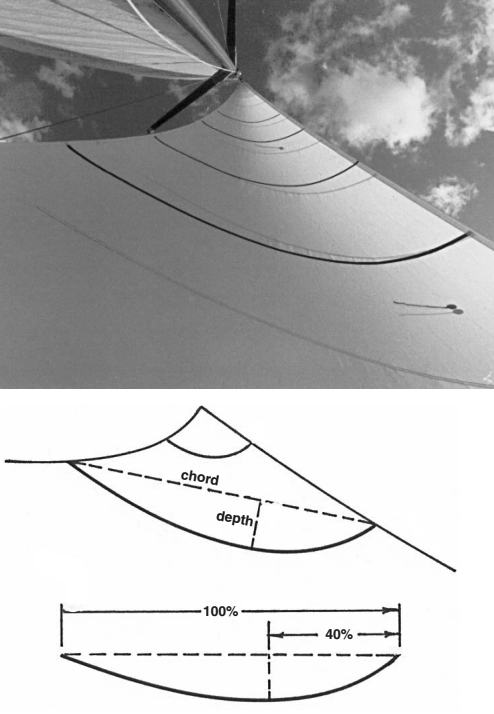
The description of a sail’s flying shape begins with its draft — the depth of its curvature as a percentage of the distance from luff to leech. The difference between a “flat” sail and a “full” one is quite subtle — rarely more than about 4 percent. Efficient upwind headsails are typically between 9 and 12 percent draft, while mains range from 8 to 11 percent. Also very important is the so-called draft location — the position of greatest depth in a sail’s horizontal curvature as viewed from the windward side. For headsails (or cat-rigged mainsails), the draft location should normally be fairly far forward, around 40 percent of the distance from luff to leech. Due to the effect of the jib, the optimal draft location for most mainsails is a little farther aft, around 45 percent, but it should never stray aft of the 50 percent position. In principle, a deeper sail can generate more power, but too much draft leads to flow instability and a dramatic reduction in drive, even when the boat is not overpowered.
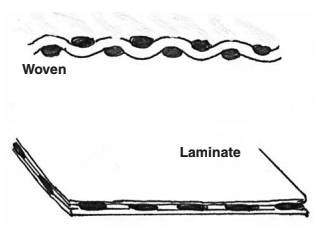
The typical crosscut genoa made of fairly soft, stretchy “cruising cloth” is a serious compromise for allround use — too flat, particularly near the luff, for good light-wind performance, yet prone to becoming excessively full and draft-aft when loaded up in a brisk breeze. To some extent, it’s possible to “drag” the draft forward by winding up halyard tension, but trim adjustments will seldom induce anything close to an optimal shape all the way from head to foot. The real solution is a sail which retains its built-in shape over a wide wind range. This calls for some form of radial construction plus a durable, low-stretch sailcloth that’s compatible with a radial panel layout. More often than not, the most suitable materials are laminates rather than traditional woven Dacron fabrics (see illustration on next page).
Aside from lost boat speed, a stretchy genoa with a “draft-starved” luff and a tight leech will be prone to backwinding the mainsail. When this happens, the crew will tend to oversheet the main which will induce excess weather helm. Another common indication of sub-standard genoa shape is the behavior of the yarn telltales (normally positioned on either side of the headsail luff at various heights, and from 12 to 15 inches behind the luff tape). If your boat goes to windward best with the telltales on the leeward side drooping and the windward ones streaming straight back, it’s a sign that the front quarter of the headsail lacks sufficient curvature.
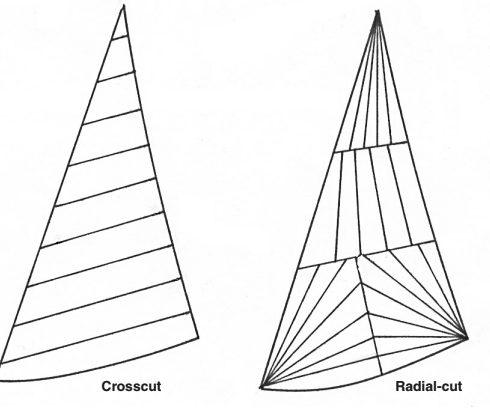
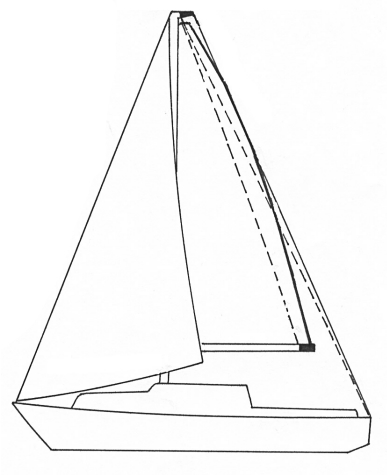
The typical crosscut mainsail handles a wide range of wind speeds more successfully than its headsail counterpart, primarily because its luff is supported by a sturdy mast instead of a sag-prone headstay. Long battens, especially the luff-to-leech variety, also help a great deal by maintaining fair, uniform curvature as the mainsail ages. However, no battens can be expected to overcome the inherent deficiencies of an overly elastic sailcloth.
Whether its worthwhile to add full-length battens (or even just a full-length top batten) to an existing mainsail will naturally depend upon the condition and quality of the sail. The forward ends of full-length batten pockets will suffer heavy wear unless each batten is attached to the mast by a small gooseneck-type fitting. Penny-pinching solutions rarely work out well when it comes to batten hardware. Also, bear in mind that quite a few older boats were designed with mains that, by today’s standards, would be considered significantly undersized. These boats will often speed up with more mainsail area and, surprisingly, it’s often feasible to add to this area without major changes to the rig itself. In many cases, the easiest way to get this extra area is to bite the bullet and buy a new main that employs long battens to support a larger roach.
All-weather inventory
Aerodynamic forces increase exponentially with flow velocity, so even if sail shape could be “cast in stone,” you can expect a fourfold increase in propulsive and heeling forces when the wind speed doubles. The fact that most sails stretch and get fuller as they load up makes these forces escalate even faster. This, of course, is why we reef or change down to smaller, flatter sails. Trim adjustments, such as altering mast bend, headstay sag, luff tension, lead/traveller position, and sheet tension can certainly help a sail function more efficiently across a range of wind conditions. But no advancements in sailmaking will probably ever allow a single sail to perform effectively in everything from a light-air day to a gale. So for most sailors, the challenge is to assemble a modest inventory — typically three to six sails — that can handle all anticipated conditions with competence.
Coastal cruisers should begin by deciding whether sailing efficiently in winds under 8 knots is important enough to justify the cost of specialized light-air sails. If you’d just as soon motor when boatspeed drops below 4 knots (and I don’t mind admitting that I usually do), you can save a bundle by optimizing your sail plan for medium-to-brisk conditions. Many masthead-rigged cruiser/racers from the late ’60s through the mid-’80s were designed with an eye to the IOR (International Offshore Rule) which favored tall, narrow mainsails set on very short booms. The foretriangle of these boats is disproportionately large by today’s standards. If you set a genoa with substantial overlap (greater than 135 percent) in an effort to enhance performance in light air, the big headsail becomes a bear to handle in a breeze, especially when tacking repeatedly.
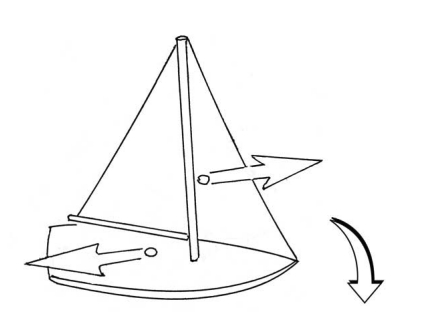
On the other hand, the same older boats with big foretriangles will often perform beautifully in 8 to 10 knots when powered only by a “lapper” of 105 to 110 percent, in combination with a big-roach mainsail for added power and enough extra sail area toward the back of the rig to prevent a lee helm problem from developing when there isn’t enough force in the breeze to heel the boat to her normal sailing lines. Remember, because the typical keelboat is designed to sail upwind at a substantial heel angle, the forward force from the rig will normally be quite far to leeward of the center of resistance for the hull. This creates a couple which tends to pivot the bow into the wind (shown below). Therefore, to compensate for the reduced heeling force associated with a smaller headsail, the center of effort of the entire rig will usually need to be shifted aft — hence the enlarged mainsail roach. Conversely, when the boat begins to heel too much in a stiff breeze, the rule is always to de-power from back to front; readily accomplished in most cases by flattening the main, easing down the main traveler, or putting in a reef as required.
Another key to success with the “smaller jib approach” is getting a lapper with enough built-in draft to set well in moderate air. A #3 heavy-weather jib that’s as flat as a board in anything less than 20 knots true, simply won’t do the trick. What you want is around 10 percent average draft just as soon as there’s enough breeze for the sail to fill. The challenge, of course, is to prevent the narrow lapper from becoming too full once the breeze builds enough to induce appreciable headstay sag. This is where an adjustable backstay and contemporary, low-stretch sail construction will really pay off. A good modern lapper in combination with a big-roach, reefable cruising main will enable most keelboats to sail upwind or close reach with good speed in winds from around 7 knots up to the mid-20s.
Another necessity for good results with the “small jib” approach is a low-drag propeller. Replacing a fixed prop — still the norm on a majority of cruising sailboats — with a folding or feathering model is typically worth at least half a knot in light air and, unlike a big genoa, will pay speed dividends in strong winds as well. In terms of expense, upgrading the prop generally falls in the same ballpark as replacing a genoa.
One caveat: the sailor who races and cruises needs to approach the headsail size decision with extra care. Boats that were sold as racer/cruisers in the ’60s and early ’70s were often designed for monster 170 percent genoas that overlapped almost the entire length of the main boom. It’s difficult to justify carrying a sail of this size. Its effective wind range is too narrow because the mainsail traveler cannot be eased down without choking the slot, and the outsized genoa is laborious to grind in after tacking. Still, traditions die hard in sailing, and the history of big overlap genoas goes back to the CCA (Cruising Club of America) rule which pre-dated the IOR. CCA rule-makers recognized that overlap area is considerably less efficient than headsail area within the open foretriangle, but erred in allowing this overlap area to be almost “free” in handicapping terms. Naturally, when the wind is light, even inefficient sail area will contribute a bit more speed. On the other hand, as soon as there’s a significant rating penalty involved, the benefits of this minor speed gain tend to dim.
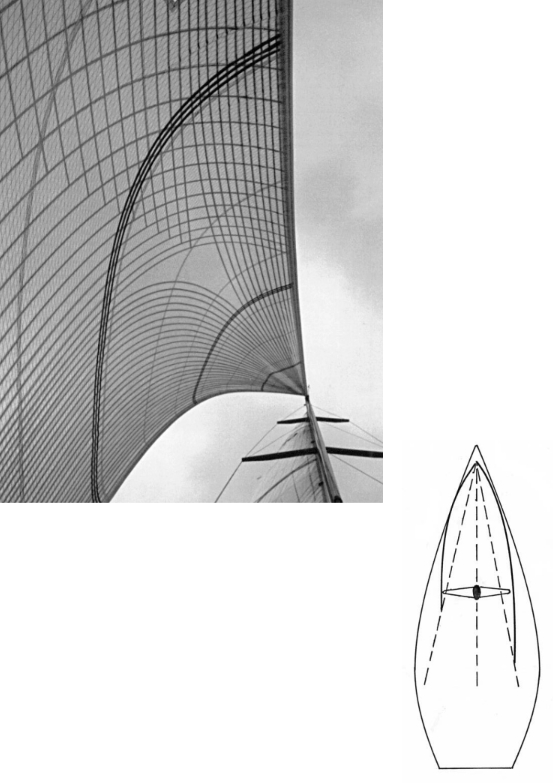
Later, as the IOR gathered steam in the late ’70s, standard genoa size became fixed at 150 percent. Today, most PHRF organizations continue to adhere to this template, although the trend in modern lightweight raceboats is to even smaller overlaps. If you race from time to time, and a 150 percent genoa is the norm in your fleet, then you’ll probably need one, too. In addition to extra area, an advantage of the 150 percent genoa, as opposed to say, a smaller 135 percent sail, is that it wraps around the shrouds to a greater extent and can, therefore, be sheeted to a tighter angle for higher pointing (see illustration at left). However, this extra height (pointing ability) is a subtle thing, and will only be noticeable if the boat also has a clean bottom, efficient foils, and a satisfactory arrangement for inboard sheeting.
Finally, if you routinely sail downwind in “no flying sails” mode (without spinnakers, Gennakers, a-symmetrical spinnakers, and so on), you’ll need to consider the suitability of your big headsail for running, as well as for upwind work. Downwind speed using white sails is mainly determined by the projected area because, when sailing wing-and-wing, the rig functions in a stalled condition. A larger sail can potentially generate more power, but only when propped out by a whisker pole about equal in length to the sail’s LP. A standard spinnaker pole (equal to the length of the foretriangle base or J measurement) is considerably too short to make an efficient whisker pole for a 150 percent genoa, although it works well with a lapper.
Furling sails
A great many cruising boats these days are equipped with headsail furling gear, and sailors who do not already enjoy this convenience will, more often than not, put it high on their wish lists. Mainsail furling has become a popular option for new boats but is rarely considered for old ones, because retrofitting generally involves either a complete new mast or an expensive in-the-boom system.
Most hank-on headsails can be readily converted for furling by cutting off the luff tape and replacing it with a boltrope luff. Depending upon the age and condition of the sail, it may also be worth adding UV-protective strips along the leech and foot. However, this addition is fairly expensive, especially when costly acrylic fabric (such as Sunbrella) is used; and it adds considerable weight to the sail’s leech. Often, it’s better to let the sun do its worst to the old rag for a season or two while saving up for a new sail designed specifically for the furling system.
Roller furling is easier on sails than dropping and bagging them. It also pretty much eliminates the perceived need for soft, flexible sailcloth, because these sails are rarely handled on deck. Unfortunately, many new furling genoas are still being built from soft, relatively stretchy fabrics which are essentially identical to those used 20 years ago, despite the fact that superior materials, such as cruising laminates, are now available.
Roller reefing using headsail furling gear is not without its problems despite numerous attempts to develop an “ideal” system. A partially-rolled headsail typically becomes baggy and distorted because the head and tack areas get wound in a little ahead of the center of the sail, and because there’s no effective way to retain luff tension once the sail is “reefed.” Some high-end furling systems now feature double swivels at the head and tack, so only the aluminum extrusion is linked directly to the furling drum.
Alternatively, some sailmakers will sew tapered foam luff pads or a staggered array of extra bolt ropes just behind the luffs of their furling sails. These approaches can improve the reefed shape of a purpose-built furling headsail, but the results won’t compare to a second, smaller sail designed specifically for brisk winds. On the other hand, cruisers have been known to circumnavigate using just a single furling/reefing 135 percent genoa. I wouldn’t feel comfortable with this choice.
A decade ago, the notion of racing with furling gear was considered almost laughable. This attitude has changed, thanks largely to the near-universal acceptance of this gear for high-profile single-handed events like the Around Alone (former BOC) and the Vendée Globe. True, these are predominantly offwind races that put a premium on simplified sail handling, but the speed losses associated with furling headsails are smaller than you might think. A reduced luff length is unavoidable, but can usually be kept in the neighborhood of 18 to 24 inches, if care is taken to mount the furling drum close to the deck.
Because sewn-on sunstrips are expensive and add extra weight toward the back of the sail, sailcloth manufacturers have developed UV-resistant finishes. This alternative is probably most suitable for seasonal sailors in temperate climates, or as secondary protection for working sails that experience heavy use on offshore passages. Another solution is the sock-type sail cover with a full-length zipper that can be hoisted on a spare halyard after the headsail is furled. This kind of cover will protect any sail you set from the furler now and in the future.
The inevitable gap between the foot of most furling headsails and the deck/cabintop is often cited as a strike against furling sails, but in reality, the importance of an “end-plate effect” is generally overrated. To effectively restrict cross flow beneath the headsail, the front half of the foot needs to literally lie on the deck. Even a six-inch gap eliminates most of the benefit. A low-clewed racing sail will achieve this extra measure of efficiency, but at the cost of poor visibility to leeward and the risk of blowing out the sail from a solid wave impact.
High-clewed sails are also less prone to twist excessively when the sheet is eased off for reaching and are generally less “twitchy” to trim. Just remember that the lead position will be further aft with a high-clewed sail of equal overlap, so be sure that the deck hardware can accommodate this. In most cases, the jib tack should be as close to deck as is feasible, and the clew as high as can be reached conveniently. The old-style furling genoa with a foot that parallels the deck will neither set nor furl as well, but some sailmakers still favor them because they are easy to build using a basic crosscut panel layout.
Dedicated racers often favor twin-groove furling systems, with split drums that can be removed when the boat is in competition mode. With multiple halyards and a twin-groove foil, the crew can perform inside/outside changes to maintain full racing speed at all times. By recutting the luff, a retired racing genoa can often be converted into a satisfactory furling sail for cruising (perhaps freeing up funds for a new racing sail).
Sailcloth and sailmaking
Sails are tensile structures similar to a mesh hammock which supports a person’s weight using a network of strong cords. Even when one edge of a sail is uniformly supported by a stay or mast, the stresses tend to radiate from the corners and are most concentrated near the head and the clew. Sailmakers deal with this concentrated load by adding extra layers of material (corner patches); different fabrics for different parts of a sail; and, in some cases, bands of strong fibers which are applied directly to a lightweight foundation material during sail fabrication.
Hot racing sails these days are reinforced by exotic stuff like Kevlar, Vectran, and PBO (phenylene benzobisoxazok) — super strong, stretch-resistant materials that have pretty much superseded polyester (i.e., Dacron) except where restricted by racing-class rules. These fibers are many times more costly than polyester, and with materials typically representing around 30 percent of the price for even a basic crosscut sail, the use of advanced fibers can lead to rather terrifying price quotations. Too often, club-level racing deteriorates because one or two fleet members are prepared to spend a bundle on high-tech sails, thus buying a major competitive advantage.
On the other hand, there’s now a strong case for building sails out of the more economical polyester laminates as an alternative to traditional woven Dacron. Laminates ordinarily incorporate a layer of Mylar film (polyester in thin sheet form) which forms a stable foundation for the material and greatly enhances resistance to stretch on the bias (i.e., diagonal). Furthermore, in a laminate the principal load-bearing yarns lie flat on the surface of the film in contrast to a woven sailcloth with yarns that zig-zag over and under one other (see above). By eliminating this crimp, the laminate gains superior stretch-resistance, even when similar materials are used. In terms of both cost and performance, there’s less benefit to using high-tech fibers to construct woven sailcloths so, little by little, laminates are gaining favor.
In most racing laminates, the primary reinforcements are flattened fiber bundles sandwiched between two films. In most cases they take the form of an open mesh or scrim, with spaces between the yarns to promote secure adhesive bonding between the outer layers. So-called cruise laminates usually substitute a layer of taffeta — a lightweight woven polyester fabric — for one of the outer films. The taffeta boosts tear resistance, but also increases weight and cost while contributing almost nothing to bias stability. What it does do is create a laminate that more closely resembles conventional sailcloth, and for this reason some cruising laminates have taffeta layers on both outer surfaces, plus at least one Mylar layer inside. From the viewpoint of sail performance, this is not the best way to go, except perhaps for offshore sails that are likely to suffer exceptional chafe and weathering.
Since the early ’80s, computerized design and panel-cutting systems have become important tools for many sailmakers. With a computer-aided design system feeding information to a full-scale plotter or automated cutter, the speed and accuracy of sail production — be it crosscut, bi-radial, or whatever — is significantly improved. On the debit side, this specialized equipment and software is expensive, as well as challenging to use, update, and maintain. Even in the computer age, there remains a niche for the “cottage industry” sailmaker, largely because there’s still demand for basic crosscut Dacron sails which can be built inexpensively using nothing more than some hand tools and a good sewing machine.
Although the majority of the small lofts now use a computer for design work, quite a few have not yet taken the more costly step into automated cutting. Nearly all the heavier woven Dacrons favored for cruising sails are fill-oriented styles with the largest yarns extending across the width of the sailcoth roll. These materials are only suitable for conventional crosscut sails. By and large, if you want the superior shape retention of a bi-radial or tri-radial panel layout, you’ll need to abandon all-woven materials in favor of laminates. These more complex layouts can only be constructed efficiently with the aid of computerized sailmaking tools, and even so there’s greater fabric waste and more assembly time involved. These factors help explain the higher cost of laminate sails, despite the fact that laminating is actually quicker and potentially less expensive than weaving. The price premium ranges from about 25 percent using all-polyester laminates to 50 percent and up when advanced materials become involved.
There is, however, one group of “high-tech” reinforcing material that deserves serious consideration by mainstream owners of larger boats: the ultra-high-modulus polyethylenes, including Spectra, manufactured by Allied-Signal, and Dyneema, made by DMS. These fibers are stronger, pound for pound, than Kevlar and far superior in terms of fatigue, chafe, and UV resistance. Their main shortcoming is a tendency to “creep” or stretch permanently when subjected to high, sustained loads — a real problem for minimum-weight racing sails that are often pushed close to their limits. On the other hand, for a more conservatively-built sail, brief load peaks caused by knockdowns or other mishaps will not cause creep and permanent deformation.
Hard-core racing sails need to be as light as possible so they will fill more easily in zephyrs, and contribute less to speed-sapping weight aloft when the wind pipes up. However, the cruising sailor or casual racer shouldn’t worry much about sail weight — shape stability and robust construction are far more important. There’s no question that Spectra laminate sails offer both superior shape stability and much larger safety margins than polyester sails of similar weight.
Choices
The owners of older sailboats are as diverse as their vessels, making it extremely difficult to generalize about sail needs. Inshore cruiser, bluewater sailor, casual racer, or serious competitor — each must evaluate the existing sail inventory, set priorities, and come up with an affordable schedule of sail replacements. A first-rate modern main or jib has the potential to give good service for 15 to 20 years of seasonal, inshore cruising, so it’s not unreasonable to regard good sails as long-term investments.
Laminate sail materials and radial layouts represent a genuine improvement over traditional cross-cut Dacron sails, but have been slow to gain popularity within the cruising community due to a 20- to 50-percent price premium and nagging concerns about durability and repairability. This is not to say that a conventional Dacron sail will necessarily have a longer useful life, or that a “high-tech” sail will be impossible to repair at sea. However, the first of these “new generation” cruising sails have not yet seen a decade of use, and despite some positive indications from solo marathon racing, the longevity issue has not been settled to the satisfaction of most cruisers. Sailmakers generally sell what their customers want, and many are happy to keep building sails the “old-fashioned way” as long as there’s a call for functional, economical sails and personal service.
At one end of the size spectrum, a small-boat sailor with a microscopic budget will likely have a hard time rationalizing anything but basic Dacron. Boats over 45 feet will nearly always be better served by laminate radials (although offshore voyagers may still elect to play it safe for a few more years). That leaves the owners of the mid-sized good old boats with the difficult decisions . . . but at least we have more, and better, sail options than the original owners ever did.
Thank you to Sailrite Enterprises, Inc., for providing free access to back issues of Good Old Boat through intellectual property rights. Sailrite.com