A boat provides a happy mix of activities and security
Issue 77 : Mar/Apr 2011
Naming a boat is serious business. When we upgraded from a decrepit 1972 Cal 20 to our second boat, a 1976 27-foot O’Day, to accommodate our family of four, none of the names on our list fi t. We decided to ask Harrison, our then 5-year-old son with autism, what he thought. He looked directly at us, put his hands on his hips, and responded, “Olo, o’course.”
My husband, Danny, asked, “What about the dinghy?” This time, Harrison placed his hand outward in a gesture of certainty and said, “Antsy, o’course.”
And so the naming was done. We have no idea what Olo means, but found Antsy to be so insightful for the dinghy. When we purchased our current boat, a 1985 35-foot O’Day, we again consulted Harrison. “Olo 2, o’course,” he responded, clearly wondering why we even had to ask. For a brief moment, Harrison was in our world, making connections.
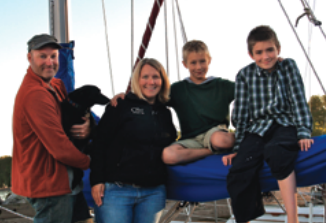
We keep our boat in Lake Superior’s Apostle Islands. Sailing with a family is exciting, fun, challenging, and amazing. When I read articles about other families and ideas others have for interesting crafts, activities, projects, and discussions, I can’t quite connect. One son with autism and a younger son with attention deficit hyperactivity disorder (ADHD) makes for interesting days and nights on our boat, and we wouldn’t change that for the world . . . We have, however, learned several lessons along the way.
Pack carefully
At the end of my 13th year of teaching high school art, I was itching to get out of town. I had made several lists of things to bring on our first one-week trip for the summer. In my haste, I forgot Harrison’s medication.
To help understand what this means, here is a bit about him. He’s 10 years old. At first glance you might not notice how autism affects him. He’s an active, well-spoken, and talented boy with irresistible steely gray eyes and a smile that melts not just his mother’s heart. But it doesn’t take long to notice a collection of obsessive behaviors, such as talking to himself or fixation on a cartoon character. At one moment, his inquisitive and insightful nature stuns us, such as when he named the boat with the voice of a seasoned expert or when he rattles off entire chapters of memorized text from The Mouse and the Motorcycle. The next moment, he is inconsolable over a torn page in a book.
His medication keeps Harrison “even.” He obsesses less, restrains more impulses, and needs fewer repetitive or self-stimulating behaviors (flapping his arms or twiddling his fingers) to calm himself. This all adds up to a more pleasant experience for anyone in his orbit.
Our younger son, Avery, is usually a fine playmate and match for Harrison’s interests. The boys have long bouts of imaginative play. It’s amazing to listen to them construct dramatic situations and challenges for themselves with just a few simple toys. But Avery is challenging in his own ways as he struggles with ADHD. It’s not surprising that Harrison’s unique behaviors are sometimes more than Avery can take, especially as Avery matures and develops skills that surpass Harrison’s. At 8 years old, Avery is starting to notice his brother’s needs and the ways we simply have to treat the boys differently at times in order to be good parents to each. Avery needs more than we can give him in the small quarters of our boat—more activity, more attention, more variety. We do what we can, but sometimes we lack options. He’s not always understanding.
The lack of Harrison’s medication, coupled with bad weather that held us in port all week, would have been intolerable if not for the local community center. Swimming saved us; it got us out of the boat and it entertained Avery. Best of all, it served as just the “medication” Harrison needed; water has such a calming effect on him. In the water, Harrison is a “normal” child, and we felt like an almost-normal family.
Develop a routine
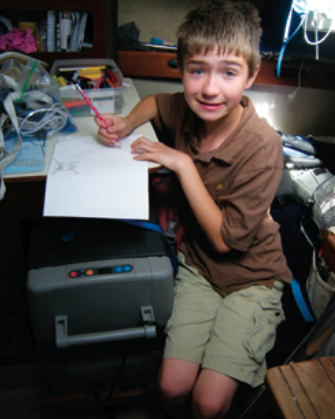
Our mornings begin the same every day. The boys take turns holding the anemometer to measure the wind speed. They collect observations of the weather — the date and time, the waves, clouds, and temperature — all as part of their daily journaling routine. It starts our day, it teaches them something, and it’s a cooperative event. Their journals are their own records of the previous day’s activities. This routine keeps both boys occupied and interested. Their nature notes, sketches, and photographs, along with their daily weather report, will be an invaluable record of our time together. We hope it will help them appreciate the amazing opportunities they’re experiencing every day.
Make time for activities
Avery has a love and talent for art, and Harrison has a fixation-obsession-addiction to paper and office supplies. This combination makes our boat a floating gallery of various expressions. We were pleased one day to hear both boys quietly and intently working down below as we sailed to Raspberry Island. When we arrived and went below, it looked as though a paper shredder had exploded. In their concentrated elementary-school handwriting, they had written labels and taped them on nearly everything in the cabin. For example, they named the quarter berth the “gest bedrom” and the head the “baff room.” The couple-hour project depleted our paper supply for the week, but their best phonetic efforts provided plenty of entertainment.
As is perhaps true of all family boats, ours looks as if it belongs to the Beverly Hillbillies. In an attempt to keep the boys interested in sailing, we have indulged them and ourselves with several blow-up floating toys, kayaks, and a very large inflatable . . . all attached to our boat. We may not be able to brag about having the tallest mast in the marina but we do have the largest dinghy. Decked out in our full-body wetsuits and kayaking life jackets, we are able to keep most cries of boredom at bay in a way we all enjoy.

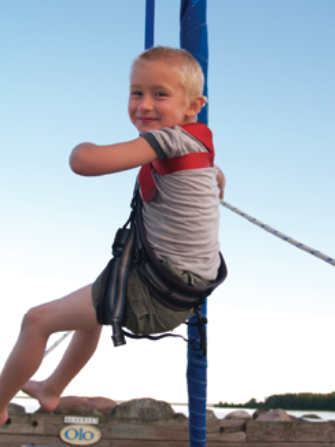
Finding joy in every day
We added a downrigger to the boat so we could fish. When we caught our first fish (a 10-pound lake trout), Harrison squealed and flapped his arms so much the boat moved with his uncontained joy. Avery said simply with his own sort of excitement, “I can’t wait to eat it.”
Harrison’s emotions did a 180; he started to cry, screaming and pleading for the fish’s life. He lifted his arms dramatically, saying, “That fish had a name like Slippery or Slimy, and it had a family, and its family will be looking for it! They’ll be sad!”
There was no reasoning with or soothing Harrison. He might have thought my tears were also for the fate of the fish, but I was overwhelmed with pride. He was showing empathy! My son connected with a fish and it was a moment to treasure.
These are just a few of the lessons we’ve learned about sailing with a family. Our experience is unique in many ways, but in some ways is perhaps no different from that of any other family. As parents, we want to do as much as we can to help our boys. In previous summers, we have enrolled Harrison in various programs and therapies, including summer school, speech, occupational, handwriting, audio-integration, and pragmatic-play therapy. We were proactive this past winter and spring, after Avery’s ADHD diagnosis, to hire weekly tutoring and spend extensive one-on-one time with him to help him improve his confidence and academic performance.
We struggle with how to make the best out of every moment of our parenting journey, so our sons can be capable, strong, and happy. This summer’s therapy has been sailing and we all benefited. There are beautiful things to discover and daily challenges to overcome. Both are better on the water. At the end of each day we ask the boys what their favorite part of the day was. Avery recites the catalog of daily events. The standard response we get from Harrison is, “Hanging out with you guys.”
Kari Halker-Saathoff is in her 15th year of teaching high school art. She loves spending time on the boat with her family. As a working artist, too, she takes inspiration from her experiences sailing on Lake Superior. Along with cruising their good old boat, she and her husband, Danny, occasionally race. Last summer, Kari skippered her first race.
Thank you to Sailrite Enterprises, Inc., for providing free access to back issues of Good Old Boat through intellectual property rights. Sailrite.com