It’s a versatile workhorse with many uses
Issue 15 : Nov/Dec 2000

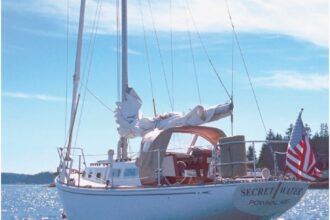
Like the majority of voyaging sailors, we are sold on the cutter rig. As we gunkhole around the rivers and bays of the U.S. East Coast, short-tacking into hidden coves on the Chesapeake Bay or Long Island Sound, we are reminded that for local cruising, this rig absolutely shines, especially for short-handed crews. The three smaller sails of the cutter rig are easier to handle and reef than the two larger sails on a sloop (all things being equal). And the cutter provides better windward performance than a two-masted rig while costing less and being easier to maintain. A windvane for self-steering can be installed more easily on a cutter than a ketch because the boom usually doesn’t overhang the transom. But most important of all, the cutter rig gives you the most versatile sail found on a cruising boat, the staysail. Getting the full potential from this special sail requires attention to rigging details, design, set-up, and sail trim.
The staysail we use on Taleisin is constructed of eight-ounce U.S. Dacron (probably two ounces heavier than sailmakers normally recommend for a 150-square-foot sail on an eight-ton boat). It has two rows of reefs and is set on a moveable stay. This gives us a sail that can be used in an amazingly wide variety of wind conditions. We have found it to be effective from Force 2 (5 to 8 knots of wind) all the way to storm Force 10 (50 to 55 knots). Since it is kept permanently attached to the stay, it is ready to use instantly when wind conditions change.
Sail combination
When one of us is alone on deck at night, it is easy to keep the boat moving well in any wind above 8 knots by using a combination of main and 100 percent lapper with the staysail set in between (double-head rig). The staysail can be dropped on deck if the wind increases or, conversely, we can hoist the staysail when the breeze drops. This easy increase of sail area improves our average offshore passage times and keeps us sailing faster when we are simply puttering around on the Chesapeake.
Everyone is eager to reduce sail area as the wind increases. But when I am sailing on a boat with a single headsail rig, I find myself putting off sail increases, especially when I am alone on watch or when port lies only a mile or two away. This reluctance to change up can easily cut 10 or 20 miles off a day’s run. For local sailing, it could mean deciding to start the engine instead of prolonging the pleasurable silence of continuing under sail.
A staysail adds flexibility to your life. If you are reaching at top speed with the full three-sail rig as you come into the lee of the land, and you find you have to short tack into the anchorage, you can drop the jib and use your staysail to tack easily into the bay. If we find we need more power once we get inside the anchorage, the jib is ready to go.
We often use the staysail/mainsail combination while we scout out the perfect spot to anchor. We can slow the boat down to about quarter throttle by coming about and leaving the staysail secured to the windward winch. The backed staysail and fully drawing main cuts our boat speed dramatically, yet gives us sufficient steerage so we can throw the leadline or spot our anchor where we want it among other anchored boats. If we want more speed, we release the sheet that holds the staysail in its backed position, sheet it in on the proper side and get under way.
Backed staysail
Even after we are anchored, we find the staysail handy. We pay out the appropriate amount of anchor chain, then let the boat settle back with the wind. If the wind is more than 10 knots, we hoist the staysail with the sheet secured snugly to windward (with the sail backed). The wind in the staysail pulls the bow off, tightens the chain, and makes the anchor dig in for a firm set.
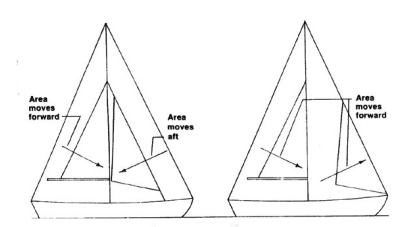
In strong winds, the staysail really earns its keep. When you use a staysail with a reefed-down main, your sailplan is moved inboard, toward the center of effort. In effect, you go from a big triangle of sail to a small one with the same proportions, the same fore-and-aft balance, and the same leads as with a full rig. Compare this to the deeply reefed, single-headsail sloop. (See diagram below.) You’ll notice the reefed sail area on the sloop moves forward. This often causes lee helm. A boat with lee helm has difficulty holding her bow up to the strong wind and seas and is usually a poor windward performer. Moving the sail area inboard helps reduce pitching in heavy seas.
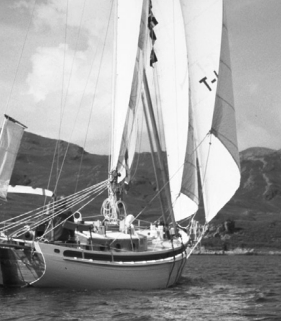
About 90 percent of our sailing on Taleisin is done with three sails: the seven-ounce 100-percent lapper, which has one row of reefs in it, the eight-ounce staysail with two rows of reefs, and the eight-ounce mainsail with three rows of reefs. (This gives us about the same total sail area as a sloop would have with a 150-percent genoa and mainsail set.) To do this we depend on our staysail which, unreefed, can be a heavy weather staysail. Reefed once, it can be a storm staysail, or in a hard flog to windward it becomes a spitfire staysail that can be set with the triple-reefed main. In extremely heavy conditions, it can be set with our trysail.
Another reef
Is this overkill? I was once down to triple-reefed mainsail and single-reefed staysail on Seraffyn as we reached into Malta in storm-force northwesterlies. I remember thinking, “If we get headed, if I have to beat into Marsaxlokk Harbor instead of reaching, I could use another reef in this staysail.” After another 100,000 miles of sailing, we still have never used that second reef in Taleisin’s staysail but we have been tempted a time or two. The older I get, the more reef points I collect. I’ve even got two in the sail of our 8-foot dinghy. When Lin teases me, I call it cheap insurance.
Why reefs, rather than roller reefing? I personally would not have roller reefing on any sails that the yacht or crew rely on for heavy weather, for two reasons. First, in winds above 20 knots you need flat-cut sails to keep the boat on its feet and driving well into head seas. A properly cut reefed sail becomes flatter as you tie in its reef, whereas roller-reefed sails become fuller. This is why class racers don’t use roller-reefed headsails — they just don’t work well to windward. Second, damage to sails usually occurs along the highly loaded leech or clew area. If your sail is damaged along its lower section, you can simply tie in a reef and sail on, using the undamaged upper section. If the leech, foot, or clew is torn on a roller-furling sail, it is completely out of business.
Although boomed staysails offer some interesting advantages for local cruising, we would not go this route because with a loose-footed staysail we can conveniently release the staysail stay and move it aft when we wish to short-tack in winds under 15 knots. Clearing away the staysail stay allows the jib to pass across the foredeck without hanging up on it. This means one person can tack the boat easily in light winds, freeing the other person to navigate and watch for coral heads, rocks, or fairway buoys.
Better efficiency
Another advantage of the boomless staysail is that it can overlap the mast a bit. This gives you more sail area and increases the slot efficiency of the sailplan. Furthermore, if you eliminate a club on your staysail, you will save the expense of tackle, traveler, gooseneck, and the spar itself. Your foredeck will be clear, which makes it easier to change sails, work the anchor windlass and ground tackle, or handle docklines as you come into a marina berth.
I can appreciate why so many daysailors love self-tending staysails on booms. They allow them to tack in and out of creeks, rivers, and narrow inlets with only the jib sheets to handle. But the boomless staysail works fine for open-water cruisers for whom short-tacking is not the norm. Our solution to the occasional short-tacking we have to do is using one headsail at a time. It is safe to sail with the staysail stay released in flat water or until the mast begins to bend aft, that is, to develop a curve toward the mainsail — a straight mast is a safe mast. Then the staysail stay should be set up again. This is especially true if you are rail-down, punching into a head sea.
There are times when we do want to short-tack using both headsails, such as when we are racing (that seems to be whenever there is another boat within sight) or when we are trying to reach an anchorage just before dark, and the winds are growing lighter. Rather than have two winches on each side of the cockpit, we have installed a fairlead on the aft corner of the deckhouse, port and starboard. We use these as aft staysail sheet fairleads so the leeward sheet can be led across the cockpit to the windward winch. Then, to make tacking with the double-head rig easier, we release the jib sheet first. Since the staysail is blocking the inner foretriangle, the jib will slide forward without hanging up on the inner stay. Once it’s around, you can release the staysail sheet and easily tack this smaller sail.
This is not the way a serious racing sailor would do it, but it does work well: no hang-ups, no need for someone on the foredeck to help the jib around, less wear and tear on sail fabric and nerves, too.

Trouble and expense
A question some people will be asking is, “If I had a sloop that met all my other cruising needs, would I go to the trouble and expense of converting it to a double-headsail rig?” I most definitely would add a staysail with a release lever if it met the following requirements:
- It was a masthead-rigged sloop.
- It had a generous distance between the jib stay and mast (J measurement), a distance about as long as the mainsail boom.
- It had a healthy beam, so the staysail could breathe easily in the open slot between main and jib.
- The staysail could be designed so that it was at least 22 percent of the total working sailplan (main, working jib, and staysail). Otherwise it would not have sufficient drive when the staysail and main were used alone.
Within these parameters, a staysail could be effectively added, and the extra sail area forward might even reduce that common fault, weather helm. In fact, if you had a sloop with a stiff weather helm, I would even consider the addition of a bowsprit to correct the bad balance and effectively lengthen the J measurement to give room for a staysail.
Connections aloft
The addition of the staysail stay would require a tang and halyard connection aloft, along with two supporting intermediate shrouds led to chainplates that are at least two feet aft of the mast (called swifter stays). On larger, more powerful boats, say 35 feet and more, running backstays might be required. The connection at the lower end of the staysail stay needs to be attached securely to the stemhead of a boat with a bowsprit, or if the stay is attached to the middle of the foredeck, a rod or wire below decks should tension the stay to either a bulkhead or the forefoot. Add to this some deck fairleads, and you have quite a hardware bill, not to mention the cost of labor. But I think it’s well worth the effort and cost if the boat you own now can gain the subtle, but important, advantages of a cutter rig.
It pays to get professional advice on this standing rigging addition and on the design of the sheet leads (inside or outside your lower shrouds). Some time spent with a rigger and then with a racing sailmaker will help you get your double-head rig working well to windward. The goal is to have both the staysail and jib break (start to luff) at the same time. This means the two sails should have a close-hauled sheeting angle of about 11 to 13 degrees from the centerline of the boat.
On Taleisin, our jib leads right to the bulwark rail, and the staysail lead is about two thirds of the way outboard of the centerline of the deck. The lead is about three feet aft of the chainplates. On a narrower hull, or one with a shorter J measurement, this lead could change substantially. Even if all the design and installation of the staysail is done by professionals, it could pay to try out different fairlead positions before fastening anything through your deck. One way to do this is to hoist your new sail while you are tied to a dock with a wind of about 6 or 8 knots. Set all three sails, then ask a pal to step on the new sheet.
Watch the twist
When you sheet in the three sails, check to make sure the upper leech area of the staysail twists off smoothly to open the slot between the staysail and main. Then try easing all sheets until the headsails start to luff — if they break at the same time, and the luff becomes soft all along its length, mark your fairlead position. If the upper part of the luff breaks before the lower part (a common fault), move your lead forward. If you see the mainsail backwinding when all three sails are set close-hauled, try moving your fairlead a bit more outboard.
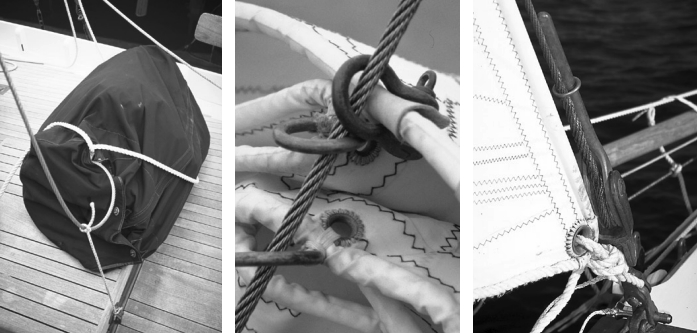
A short lanyard on the tack of your staysail can eliminate the need for fore-and-aft track and adjustable staysail sheet cars. The lanyard will let you adjust the sail up and down the staysail stay, and it effectively tightens or loosens the leech. This is the system we use on Taleisin. It allows us to use simple deck fairleads without blocks. We also like having the two-foot long lanyard right in place, since we use it when we reef the staysail to tie down the clew. (See photo above.)
You can eliminate the need to adjust the staysail sheet lead when you reef by having your sailmaker angle the reef patches so they are higher at the clew and lower at the tack. This keeps the lead angle constant.
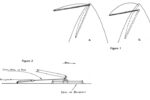
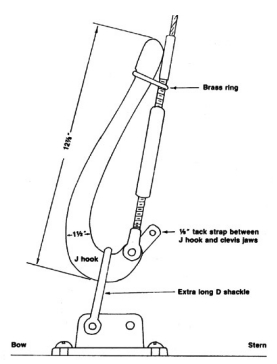
To be able to move the staysail stay out of the way in light wind, you will need some type of over-center tension release device (a staysail stay release lever or Highfield lever) with a drop-down ring to keep it from opening accidentally. Several companies make these. We use a stainless steel fast pin (quick pin) as the attachment link to the staysail stay fitting. This pin is attached to the lever assembly with a retaining lanyard, so it is always available. You can also make your own tension release lever from a quarter-inch plate of bronze, aluminum, or stainless steel (listed in my order of preference and for ease of working). The diagram on Page 14 shows a type of J-hook that would work for boats up to about 35 feet.
More flexible
The best wire to use for this staysail stay is 7 x 7 stainless steel. It is far more flexible and less likely to work harden than 1 x 19 wire. This is important because the staysail stay will flop around when it is moved aft. This will bend the wire back and forth and from side to side and eventually cause metal fatigue right where the wire enters the swage fitting. A toggle or shackle at the mast tang, in conjunction with shock cord, secured with a rolling hitch to hold the stay tight when you bring it aft, will help minimize wire bending and the subsequent metal fatigue. (See photo above.)
We stopped using normal jib hanks for our staysail a few years after we began cruising with our first cutter rig. We had been doing a lot of light-air sailing and either our big genoa or nylon drifter was in use a high percentage of the time. We noticed small semicircular holes developing on these two sails and upon looking into this mystery, discovered the hanks were responsible. We changed to hank rings and solved that problem, only to find we’d created another. Now we could not remove the staysail when we put the boat away for a month or two unless we cut the seizing on each ring, then re-seized them again when we wanted to go sailing. So, on Taleisin we switched to bow shackles, using bronze ones to cut down on the wear you get when stainless steel rubs against stainless steel. This has solved both problems. (See photo above.)
A key sail
The staysail is not only the key to the cutter rig, but the most used and — in extreme conditions — the most important. If your mainsail blows out offshore, you have a storm trysail as a back up. If your jib goes, you probably have a genoa you can use in its place. The staysail rarely has a back up. Because of this, we tend to watch this sail more closely than any other. Once we begin to see signs of fatigue (usually after three to five years of offshore passagemaking, or 20,000 miles of sailing) we have a new staysail built. We check it to see it fits, then stow it below so it is in reserve. That means we always have the two most important sails we need, the rugged storm trysail and the multi-purpose staysail that could allow us to beat free of the classic sailors’ nightmare, storm-force winds blowing onto a lee shore.
At 9, Larry Pardey had an Indian dugout canoe; at 17, a self-restored El Toro; and at 20, a self-restored Colin Archer cutter. His first racing boat was a self-restored 27-foot Tumlaren sloop. He and Lin met in 1965 while he was building Seraffyn. The rest, as they say, is history.
Thank you to Sailrite Enterprises, Inc., for providing free access to back issues of Good Old Boat through intellectual property rights. Sailrite.com