Tacking’s so easy you won’t know what to do with yourself
Issue 15 : Nov/Dec 2000
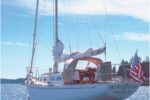
I’m alone in the cockpit of my schooner, Delphinus, short-tacking up a narrow section of the bay. Half aloud, I say to myself, “Ready about. Hard alee.”
I remain seated by the wheel as the bow comes up through the wind. The club-footed jib swings over, then the foresail changes sides, and finally the mainsail follows over to the new tack. I think of all the years I have spent sailing without the luxury of cruising with everything self-tending. Sometimes I feel a bit guilty, as if I should be doing something.
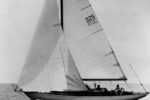
Many sailors have never encountered the club-footed jib, and are unfamiliar with its operation. With an understanding of the theory and terminology behind the basic jib-boom system, it should be obvious that the club-footed jib is truly an underestimated headsail.
Basically, the club-footed jib is a non-overlapping headsail set on a boom. The sail itself has a sailcloth weight and clew height similar to that of a normal headsail. The sail is fastened to the boom loose-footed, with only the clew of the sail attached to the after end of the boom. The boom has a gooseneck fitting at its forward end, so it is free to move horizontally and vertically.
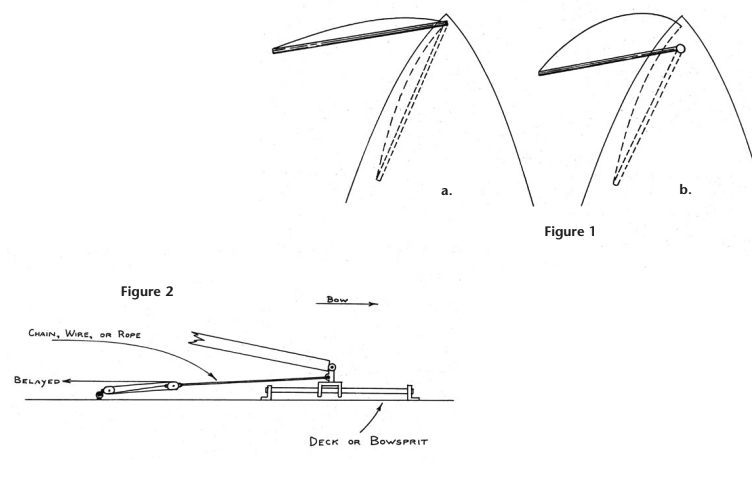
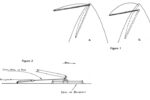
The gooseneck is attached either directly to the forestay or to a pedestal just aft, the latter being the optimal system, in my experience. The placement of the pedestal aft of the sail’s tack automatically allows the sail to become fuller when it is eased out on a broad reach or run. This is more aero-dynamically efficient than if the boom were attached to the headstay, which would make the sail flat on all points of wind unless the clew were retrimmed (see Figure 1).
Pedestal mount
The advantage of the pedestal mount was disputed by world voyager Eric Hiscock in his book, Cruising Under Sail. His contention is that such a method causes the belly of the sail to move too far aft, and the upper part of the sail to lose efficiency when the boom lifts. I have never observed this problem and tend to follow the recommendations of other experts such as Jeremy Howard-Williams, who, in his authoritative book, Sails, stresses the importance of mounting the jib boom on a pedestal aft of the forestay.
As shown in Figure 1, the system provides the headsail with a built-in whisker pole for downwind work, without the pole’s inherent disadvantages in handling.
Although not generally used today, in years past the fullness and shape of the eased club-footed jib could be controlled by adjusting the pedestal fore and aft (see Figure 2). The equipment to do this consisted of one or two rods, used as tracks, fitted with a sliding goose- neck fitting to which the boom was attached. Various names were used for this arrangement. In Gloucester, “boom horse” was usual. “Boom rider” and “horse rider” were other labels.
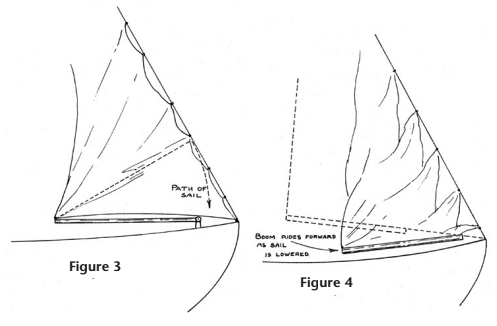
With the headsail hanked to the stay in the normal manner and the clew securely fastened to the boom’s aft end, we now have encountered our first potential problem: the lower part of the sail cannot be lowered down the stay. Because the sail will not stretch and is attached to the clew and luff, it will not pass a perpendicular line between the clew and the headstay unless one of several measures is taken. Figures 3 and 4 illustrate the problem. The solution lies in either moving the clew forward or the luff aft. This can be done in several ways:
- Unsnap the lower hanks from the forestay.
- Loosen the clew from the jib boom.
- Use a short jib boom, unattached to the deck or headstay, that rides forward as the halyard is eased off.
- Fasten the lower jib hanks to an artificial stay (called a jackstay or relieving line) that automatically becomes slack when the sail is lowered, allowing the luff to move aft.
Artificial headstay
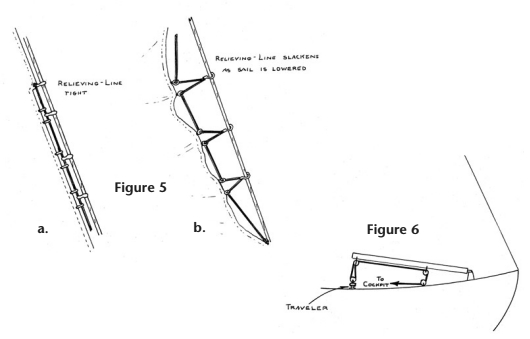
Solution 4 is the most practical. The relieving line is attached to the luff of the jib (see Figure 5a). The other end of the relieving line is fastened to the tack of the sail, so that with the jib raised, it is under tension, providing an artificial headstay.
Figure 5b shows that, as the jib halyard is eased and the upper part of the jib drops down the stay, the relieving line becomes slack enough to allow the lower sail luff to move aft, allowing that section to be lowered.
The self-tending aspect of the club-footed jib is accomplished with a car for the jib sheet. The sheet is led from multiple-part purchase on the traveler car through a block on the boom’s aft end, then to a block on the forward end, and finally back to the cockpit (see Figure 6). Leading the jib sheet forward before going aft to the cockpit is necessary to prevent the pull on the jib sheet from restricting the athwartship movement of the traveler car.
The foredeck traveler track should be wide enough so the jib sheet has enough athwartship travel to prevent backwinding of the mainsail (or, in the case of a schooner, the foresail). This usually requires a track that stretches nearly from rail to rail, and is a potential hazard on the foredeck. Recessing the track into the deck, while seldom done, is one solution. Being aware of the hazard and avoiding it is another.
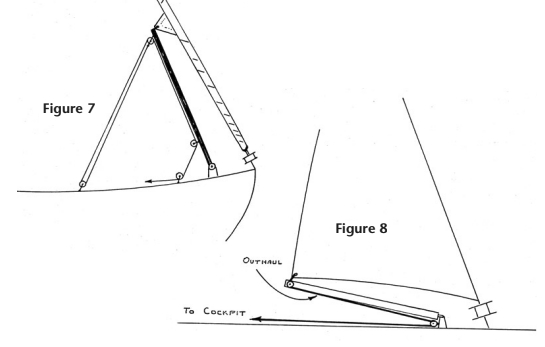
Roller furling may be used in conjunction with the boom headsail, and is as easily adaptable as with a conventional headsail. One method of roller furling (that ultimately will present multiple problems and is, therefore, unsatisfactory) leaves the clew of the sail fastened to the boom’s end. When the sail is rolled up, the boom rises vertically off the deck (see Figure 7).
Better rig
A far better rig is shown in Figure 8. The drum furling line remains standard. The clew outhaul line, however, is routed through a sheave on the boom’s aft end, then forward to the pedestal, then back to the cockpit in the normal manner. With the sail unfurled and the clew outhaul belayed, the self-tending feature of the club-footed jib remains unaltered.
Although considered archaic by many, lazy-jacks, when used on a club-footed jib, can be a fine asset. This is especially true when the headsail is set on a bowsprit. This allows strolls along the clear bowsprit to hand a jib that is already under control and not spilling onto the walk area. Lazy-jacks also provide the additional advantage of serving as a jib-boom topping lift, so that the boom will not fall onto the deck when the headsail is lowered.
There are several different ways to rig jib-boom lazy-jacks. Figure 9 shows one method. An alternative method calls for the lower section of the lazy-jack to be fixed, with the upper section led through a mast-head block and down to the deck, as is done with many topping lifts.
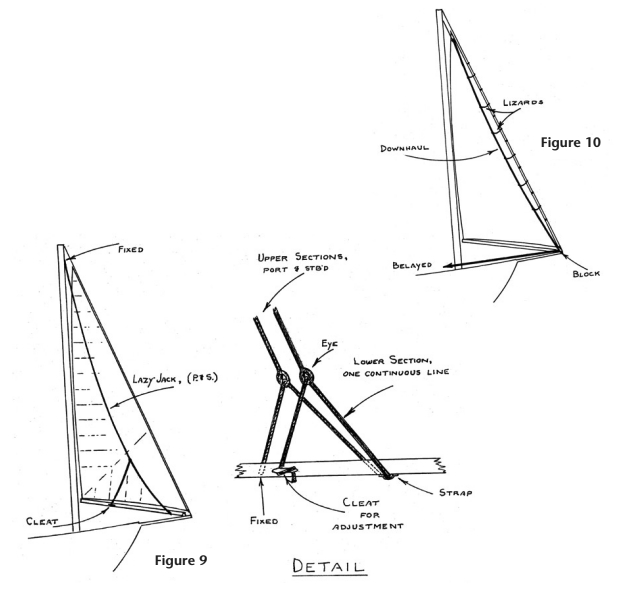
My preference, due to rigging simplicity, is the method shown in Figure 9. Once adjusted and in place, further adjustments of the lazy-jack are infrequent.
Another important item used with club-footed jibs is the jib downhaul. When turning up into the wind to drop the jib, the club foot naturally tends to swing across the foredeck. Trying to lower the jib under these conditions invites a smack on the shin, even under mild sea conditions, which doesn’t make for pleasant sailing.
Downhaul line
A jib downhaul line, led from the jibhead cringle, down through a block at the tack and aft along the deck, allows the jib to be pulled down from well aft of the swinging boom. Once down, the jib boom can be secured in a fixed position on deck. Some prefer to secure the aft end of the boom with a short halyard to the mainmast, others like to fasten the boom to a port or starboard lifeline, leaving the foredeck clear.
It is generally not wise to lead the downhaul line through the jib hanks; even though the line is of small diameter, there tends to be a binding problem. For those who prefer not to see the downhaul line blowing free in the wind when the jib is up, small lanyards, or “lizards” may be used at several intervals along the luff of the sail to keep the downhaul line shipshape (see Figure 10).
Those are the basics of the club-footed jib. At first it may seem overly complicated, but it is actually designed to remove complications and, in practice, becomes very simple. The convenience for the short-handed cruising sailor of sailing with a self-tending rig has to be experienced to be appreciated.
A group of sailing friends who frequently join me for an afternoon on my schooner have come up with a routine that tells the whole story. At the command, “Ready about. Hard alee,” all the seated guests stamp their feet as if wildly running about.
They say it sounds more like a racing boat.
Don Launer is a frequent contributor to boating magazines and holds a USCG captain’s license. His schooner, Delphinus, which he built from a bare hull, is berthed next to his home on Barnegat Bay in Forked River, N.J. He is the author of A Cruising Guide to New Jersey Waters.
Thank you to Sailrite Enterprises, Inc., for providing free access to back issues of Good Old Boat through intellectual property rights. Sailrite.com