Issue 16 : Jan/Feb 2001
I had always wanted a small rowing pram for a dinghy, so during our short cool winter, my daughter and I built one in the garage. Like many homemade boats, it ended up a little heavier and harder to pick up than I had planned.
Since we use the dinghy mainly for fishing and exploring the shoreline, we don’t tow it when we sail. It can fit on deck at the bow, but I didn’t like it there. I needed some creative ways to stow it when not in use.
My solution is primarily designed for a rigid dinghy, but with modifications it can be used on inflatables. The lower support that the dinghy rests on is about 8 inches long, but for the larger round tube of an inflatable, 16 inches is needed.
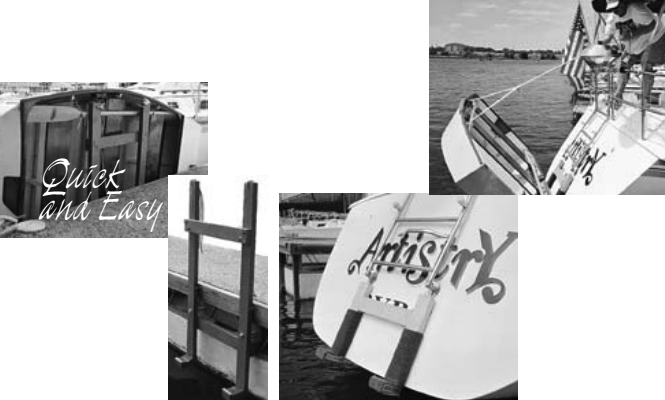
For boats with a slightly slanted transom and a swim ladder on the stern such as ours, this simple dinghy holder works great. The materials include 2 x 4 lumber, four flat L-shaped angle braces, two large screw hooks, and some carpet scraps.
This is an H-shaped frame with the hooks at the top of the H measured to hang on the swim ladder supports. At the bottom of the H are the two lower supports. These are reinforced with the L-shaped angle braces and covered with carpet to protect your hull and the dinghy. The entire length of the frame should be measured so the two lower supports are about 6 inches above the water. To help keep the dinghy in place, I attached a short piece of 1 x 1-inch wood strip on the top end of the lower support.
To raise the dinghy onto the frame, attach a Y-shaped rope bridle to one side of the dinghy, long enough to easily reach over the stern rail and into the cockpit. Center the dinghy against the lower supports of the frame and pull. The dinghy will pivot on the frame and rest against the stern rail, ready to be lashed down. This is a great way to keep the dinghy from filling with rain and to keep its bottom cleaner. We have sailed in light conditions with our dinghy lashed to our stern, but are careful to tow it or keep it on deck in rougher conditions.
For more permanent storage at our dock, I used similar materials and the same basic principle of the H-frame, except the top part of the frame is higher (about 4 feet). This frame attaches to the dock with two 10-inch bolts that go around the rod frame of the dock and into a backing board. Tightening the bolts clamps it securely to the dock. This frame was designed to fit our dock. Your dock might require some adaptations. At the dock, we raise and lower the dinghy the same way we do with the stern-mounted frame. Then we secure it to the top part of the frame.
Charles, here with wife, Lynn, has been an artist and sailor in the Dallas, Texas, area for more than 20 years. He dreams of retiring to paint and sail. These days the Duhons are sailing a Hunter 34.
Thank you to Sailrite Enterprises, Inc., for providing free access to back issues of Good Old Boat through intellectual property rights. Sailrite.com