. . . against two fellow Californians
Issue 75 : Nov/Dec 2010
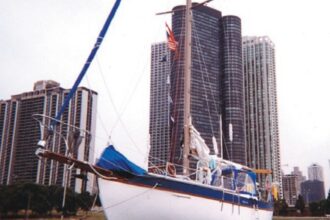
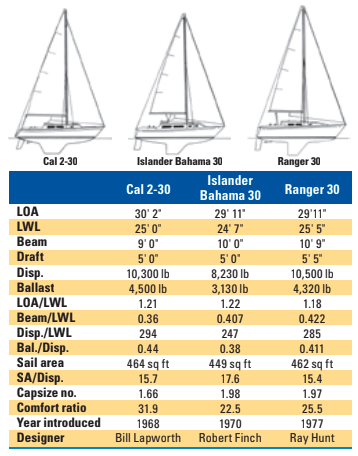
The Cal 2-30 is a descendant of Bill Lapworth’s famous Cal 40 and shares some of the characteristics that made her bigger sister the winner in so many distance races. She is a handsome boat, as was the 40, and has a very similar lateral plane with a moderate-length fin and a spade rudder. Both yachts, too, are of relatively narrow beam by modern standards. However, the 2-30 has a higher displacement/ length ratio and higher ballast ratio but, surprisingly, quite a bit lower sail area/displacement ratio.
The other two yachts in this comparison were also California-built but one of them, the Ranger 30, was designed by a New Englander, the very talented Ray Hunt. The astute observer will note the added fullness aft in the hull, almost a bustle, compared to the other two yachts. I did find conflicting information on the Ranger’s displacement, though; figures of 9,000 pounds and 10,500 pounds were given by different sources. Having known Ray Hunt in the years that I worked for Bill Luders, I tend to believe that the 10,500 number is the more likely and calculated the numbers accordingly.
The Islander Bahama 30 has the least displacement of the three, but Bob Finch apparently felt that giving her a foot more beam than the Cal 2-30 would permit lighter displacement and a lower ballast ratio without a great loss of stability. The Islander carries almost the same sail area as the two heavier yachts, and this could give her the edge in light to medium air. Still, when the breeze increases, the Cal 2-30 should come into her own as her added weight and momentum, combined with narrower beam, will enable her to punch through choppy seas that could slow a lighter, beamier boat.
The dark horse is the Ranger 30, with its husky displacement, even wider beam, deeper draft, and a good ballast ratio. She will undoubtedly be the stiffest of the three boats and, with her deep fin, should stand up and move out to weather in the heavier breezes. Her sail area appears moderate, given such a powerful hull, but the Ranger has a longer foretriangle than the others, so can carry larger genoas, while her higher-aspect-ratio main will be more effective to windward.
In some ways, I prefer the Cal 2-30 for extended bluewater sailing, as her modest beam and good displacement combine to give her an unusually high motion/comfort ratio for a boat of her type and size. She also gets a very favorable capsize screening number, well below the other two in this comparison and also below that of most other fin-keel 30-footers. This can be reassuring to both skipper and crew when the storm winds blow. The Islander and Ranger, with their capsize numbers approaching the cutoff of 2.0, may be more at home as coastal cruisers and club racers but should also be capable of reasonable offshore voyaging and distance racing given a good skipper and crew.
I do feel that the 2-30 has a rather unfortunate interior arrangement for offshore cruising, with the galley along the starboard side of the saloon and a U-shaped dinette opposite to port. The setup may work fine in harbor but, even then, the cook will be in the way of anyone trying to get forward. It would seem even worse at sea. Only the crew in the middle of the dinette can brace properly when on port tack while those on the ends of the dinette may find themselves sliding onto the cabin sole, unless the skipper has the foresight to provide seat belts.
Also, the head takes up the full width of the vessel so, when it’s in use, access to the forward cabin is closed off. There are other, better solutions to interior layouts, even on a relatively narrow 30-footer. Both the Islander and Ranger, with the galley aft and settees on both sides of the saloon, make much better use of the available space.
Of course, these three boats were all designed more for vacation cruising and racing than for extended bluewater voyages. Any one of them will make a comfortable cruiser for a week or a month and will also provide a great deal of fun and excitement as a club racer. To top it off, their price on today’s market will not break the bank.
Ted Brewer is a contributing editor with Good Old Boat and one of North America’s best-known yacht designers. He has designed everything from celebrated ocean racers to world-girdling cruising boats, many of which are good and old and still sailing.
Thank you to Sailrite Enterprises, Inc., for providing free access to back issues of Good Old Boat through intellectual property rights. Sailrite.com