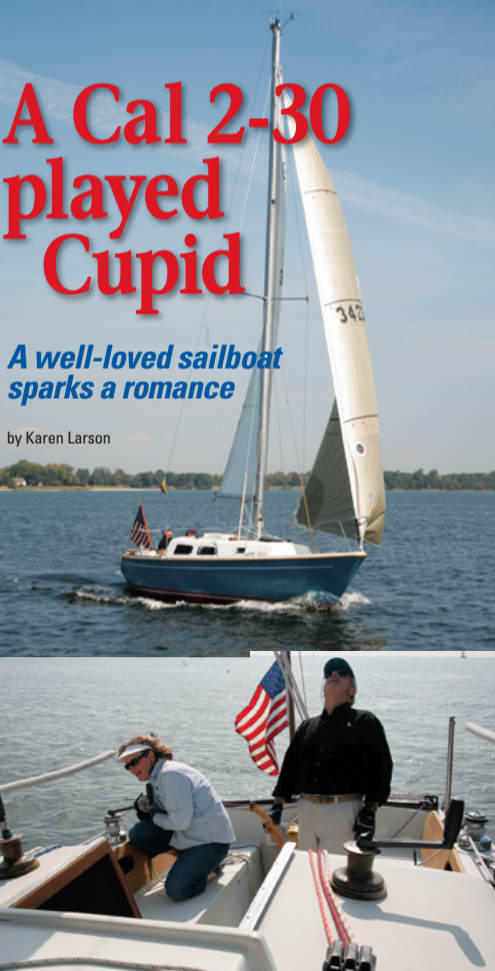
A well-loved sailboat sparks a romance
Issue 75 : Nov/Dec 2010
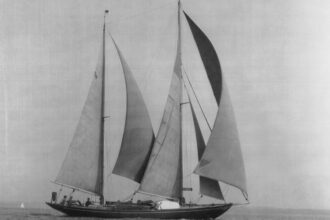
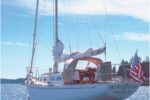
The town of Annapolis has a reputation as a drinking town with a sailing problem. If that’s true, I would add that many of the sailboats there are racing boats with a cruising problem. Checkmate, a Cal 2-30, is among that number.
Checkmate’s current stewards are Bob and Cindi Gibson. Before they met, Bob hardly knew that sailboats could be used for such a frivolous activity as cruising. He was a racer through and through, and Checkmate was his boat. Cindi changed Bob’s life in many ways. For one thing, he was a confirmed bachelor — until at age 42 he tied the knot with Cindi.
They met on a raceboat, but their first date was a star-crossed cruise. As is always the case, once the plan was made, there was no time to do everything. Bob stopped by Checkmate to turn on the bilge pump and went off to get provisions. Cindi was rushing around elsewhere on a similar agenda. By the time they met up at the boat, water was over the floorboards. They discovered that the check valve for the bilge hose had failed and the pump was filling the boat rather than emptying it.
What do you do in a situation like that? They pumped and bailed, mopped up and laughed. Then they loaded the provisions and went sailing.
Early immersion
Bob discovered the joy of sailboat racing at age 19. He was invited along as rail meat for a Wednesday-night race on a Westfall 28. Its owner, Alan Westcott, was his dad’s attorney and a family friend. Bob says he was “overwhelmed by the terminology: vang, outhaul, gimme two clicks . . .” But then, on a starboard tack, the whole thing made sense. “I said, ‘Oh! So this is how it’s done!’” Bob recalls. He’s been perfecting that understanding over the course of any number of races (and even a few cruises) ever since.
His father and Alan Westcott jointly owned several boats. One of them was Cal 2-30 hull #13, built in 1967, originally owned by the DuPont family of Annapolis and named Nicole. Alan purchased her in the spring of 1972, named her Checkmate, and began racing her. Bob was fortunate to become her sole owner several years later.
When Bob joined the Annapolis Yacht Club, Alan was his sponsor. As a young member in his early 20s, Bob found a cadre of friends who raced against each other and rafted up together afterward. During the decades that have passed since then, Checkmate has won silver in each year, about which Bob is justifiably proud.
Checkmate has collected additional honors. She was the first boat to finish in the first Governor’s Cup from Annapolis to St. Mary’s City, Maryland, an 80-mile overnight race. Bob and Checkmate didn’t return to this race for 10 years. When they did, they won their class again.
Cindi in the offing
So, Bob Gibson was busy starting a business, actively engaged in the yacht club’s social program, and happily unmarried. Enter Cindi.
Cindi had grown up as a ranch girl in Wyoming. She was flying airplanes before she was driving. She earned her pilot’s license at age 16 and was flying a single-engine Piper Cherokee 180 instead of driving the family car. This is a woman with a strong sense of “can-do.”
Cindi’s career in textile chemistry and fashion merchandising took her east to Washington, D.C. When her mother visited her, they made a trip to Annapolis. “We went there to see the nation’s first capital,” she recalls. “But I just wanted to look at the boats.”
The magnetic attraction was there — this woman was bound to become a sailor, and not just a crewmember on someone else’s boat. Cindi, the pilot, would have no qualms about being captain of her own ship.
She met a guy with a Catalina 22 who taught her to sail. Together they purchased a house with a 20-slip marina on Mill Creek, near Annapolis. During their marriage, they raced in several Catalina fleets and Cindi discovered cruising. Eventually, they divorced and went their separate ways. Cindi kept the house and the marina and over the next couple of years, with the help of slip renters, replaced the docks.
That waterfront property, now known as Sailor’s Wharf, is where Bob and Cindi live. For some time, Cindi managed the property as a bed and breakfast but has discontinued that business. Sailor’s Wharf’s real claim to fame, as far as I am concerned, is that it has been the location of every Good Old Boat Regatta party since that Annapolis race was founded 10 years ago. Bob and Cindi are the “hosts extraordinaire” at each event. But, before all this, the two had to meet.
Cindi was crewing for her friends Jeannie and Howard Kluttz on a Rogers 32. Bob was invited to serve as guest skipper one day when Howard couldn’t make it. Jeannie thought Bob should take an interest in another member of the crew and told Cindi to stay on the foredeck where she belonged. (That’s girl talk for “Hands off this guy; I have something else in mind for him.”) You see how well that worked out!
Bob and Cindi were soon a “thing.” She began crewing on Checkmate during the fall series that year. At one point early in their relationship, the halyards became tangled and Cindi volunteered to go aloft to sort them out. As she hung there in the rigging on a level with the Spa Creek Bridge, right next to the Annapolis Yacht Club, a sailing friend walking over the bridge remarked, “Would you look at that? This must be the future Mrs. Bob Gibson.”
Only five weeks after the two met, and just following their first cruise, Bob told Cindi she should captain Checkmate (his baby!) in an all-women’s race. He trusted her completely to take Checkmate out, put her through the stresses required to win a race, and to make critical split-second decisions . . . all without Bob nearby. Cindi had never heard anything so romantic.
These days, Cindi always captains Checkmate with an all-female crew during the Good Old Boat Regatta while Bob is busy running the committee boat. (The couple also own a powerboat, a Back Cove 29 named Crescent Moon, that serves as the platform for the committee.) Checkmate typically takes a first in her division. Is it Cindi’s skill at the helm, Checkmate’s incredible speed, a great crew, or all of the above? You decide.
Constant upkeep
Jensen Marine produced the Cal 2-30 between 1967 and 1973. It followed the Cal 30, which was produced from 1963 to 1966, and was in turn superceded by the Cal 3-30 in the years 1973 to 1976. Virtually all the Cals produced by Jack Jensen’s Jensen Marine were designed by Bill Lapworth. The Cal 24 was the first of the line in 1958. The last Cal was built in the late 1980s as the company succumbed to the usual sequence of company ownership changes, factory relocations, and false starts. The Cal 2-30 has a PHRF rating of 186 in the Chesapeake area.
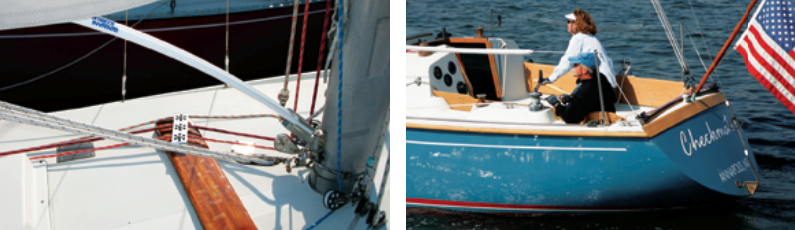
Since Checkmate was built in 1967 and raced hard most of her 43 years, Bob says he’s modified pretty much everything aboard. She’s on her third engine (all have been rebuilt Atomic 4s), her second boom, and a similar number of spinnaker poles. He and Cindi can’t count the number of winch handles they (and helpful crewmembers) have donated to Poseidon. The story of how Cindi knocked a primary winch right off the boat is a tale to hear over a glass of wine in a quiet cockpit some evening. Self-tailing winches followed.
Even the mast has been modified. The original Sitka spruce spreaders have given way to aluminum replacements. That was part of a refit in the late 1990s that included new instruments, interior lighting, upholstery, and more.
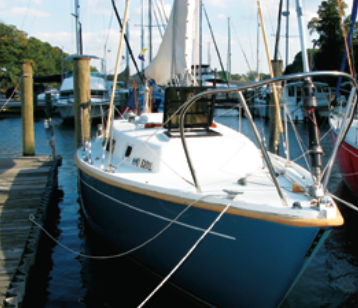
Bob says Checkmate is the only Cal 2-30 you’ll see with a teak rubrail and aft trim. That rubrail, he notes with a grin, has been replaced by the inch. Ah well! This Cal has led the hard life of a working girl.
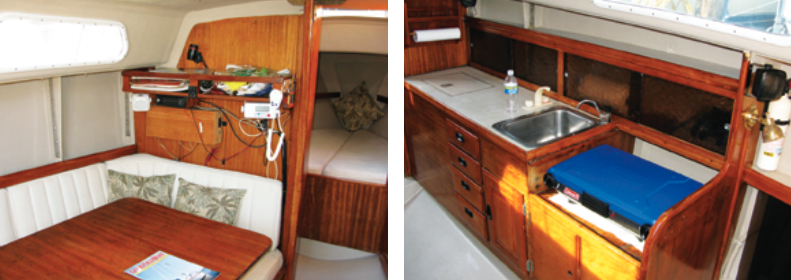
Bob and Cindi have added roller furling and a Boomkicker and led all lines aft to the cockpit. They’ve followed the trends from Loran to GPS to portable GPS. Checkmate has run through uncountable VHF radios in 40 years; she now has a command mic in the cockpit with a primary radio at the nav station.
They’re on their third head, second electrical panel, second bilge cover, and the third or fourth tiller. Who’s counting? The stanchions have been repaired or replaced over the years. The pressure alcohol stove was removed and a propane camping stove has been substituted. Bob and Cindi have added a chart shelf, a navigation station, a holding tank, a 35-gallon bladder water tank, and pressure water. There’s a new sturdier base for the cabin table. They particularly like the Strong Sail Track they added over the original mast track.
In 2002, Checkmate received new running and standing rigging and her hull was painted. The list goes on — the true story of most good old boats: chainplates, rebedded deck hardware, new hatches, ports, hatchboards . . .
In fact, as the three of them age, Bob, Cindi, and Checkmate are contemplating more cruising, so some of Checkmate’s most recent modifi cations have been made with an eye to comfort rather than speed. Bob has discovered there’s a whole lot more to Chesapeake Bay sailing than racing from government mark to government mark. No matter where they cruise, they’ll be taking sail trim and speed seriously. They can’t help themselves. Any cruise with these racing sailors will be of the “get there fast and take it slow” school of sailing.
But perhaps someday, Checkmate will become a cruising boat with a racing problem, instead of the other way around.
Karen Larson, together with her husband, Jerry Powlas, founded Good Old Boat. This past summer, they took off cruising on the Great Lakes, leaving the magazine in the hands of the motley crew listed on the masthead. That’s what sailing does to otherwise sane business people.
Thank you to Sailrite Enterprises, Inc., for providing free access to back issues of Good Old Boat through intellectual property rights. Sailrite.com