Maintenance seems less onerous in the right surroundings
Issue 76 : Jan/Feb 2011
If the definition of cruising is performing boat maintenance in exotic locations, does that mean the more maintenance, the more exotic? During last summer’s cruise from Tacoma, Washington, at the bottom of Puget Sound, to the Canadian Gulf Islands about 200 nautical miles to the north, my wife, son, and I learned just how much fun working on a 1975 Cal 34 could really be. The project felt less burdensome because we did the work in many of our favorite places.
While my wife, Melissa, readied Moonrise’s cabin for our two-week vacation in the islands off the coast of British Columbia, I focused on routine maintenance on our Westerbeke diesel engine, replacing the raw-water impeller, pump belts, zincs, and any other item within my nascent abilities. The engine had always been a reliable workhorse. As I tinkered, I noticed that it needed to be topped off with fresh water. It wasn’t really low, and I couldn’t see any obvious leaks, but I did wonder when I had last added water.
The next day, after a long stretch of hot sunny weather, we left the marina in rain and fog. Was this a foreshadowing? Summer breezes are notoriously fickle in Puget Sound and, with no wind to speak of, we motored 75 miles up to Port Townsend, our jumping off point for Canada. The next morning was just as flat with an added bonus of dense fog. During our 30-mile crossing of the Strait of Juan de Fuca, the engine held strong and true.
By temperament, we are a lazy sailing family, preferring to find a nice quiet anchorage and explore the area for a few days. The Gulf Islands provide plenty of opportunities for such idleness. Slowly going nowhere pretty much sums up our entire itinerary. On the first day, the sun came out, the wind kicked up, and we were greeted by orcas feeding off the southern tip of San Juan Island. Sailing with the orcas! It couldn’t get much better than that.
An inkling of trouble
After a week of island hopping, we were ready for showers and a bit of civilization. We took off for a nearby harbor. The sailing was great at first, but we had to motor the last couple of miles. By the time we found our marina, the engine alarm was going off and my blood pressure was going up. Navigating through a mooring field in a busy harbor with the engine alarm blaring is not a good way to unwind at the end of a day.
During our stay, I refilled the engine’s freshwater tank and tried to figure out why we were losing water. We had a slow leak, but I couldn’t determine its location.
Fortunately, we enjoyed great sailing weather for much of our Gulf Islands vacation. Throughout our stay, I monitored our engine water closely.We were losing just enough water to be worrisome. We were reminded, Maintenance seems less onerous in the right surroundings by Michael Boyte however, that it could always be worse. After anchoring one night between the Secretary Islands, we enjoyed coffee with the owners of a Catalina 30 as they waited for the tide to return and lift their boat from their too-snug anchorage.
Our water woes came to a head as we motored into an anchorage one evening. By now, the high-temperature alarm was going off with increased frequency. Life at anchor required a running engine to charge our batteries and the freshwater system was losing water at, well, an alarming rate.
Melissa chided me for messing with the engine. “It’s a delicate balance. If you fix one thing, it stresses the other stuff,” she said as she headed off in her kayak in search of otters. Andrew, after I pried him out of a book, was a bit more helpful. We lay on either side of the engine and peered inside the compartment.
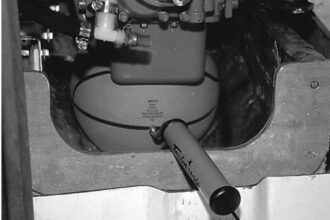
On a Cal 34, the engine is mounted backward and a V-drive is used. That means the belts, alternator, and pumps are all less accessible for inspection and maintenance. A few minutes of poking, however, revealed a damp freshwater pump. Running the engine for a few minutes made the problem more obvious; we could see a trickle of water coming from the bottom of the pump.
Trouble revealed
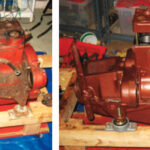
The weather was perfect for a pump-removal project. We were moored at a popular marine park with a light breeze rocking the boat as we slowly unbolted and coaxed the pump from the engine for the first time in 34 years. As we removed the pump, the source of the failure became obvious. The bearing and seal were shot. No amount of poking, chin rubbing, or hitting the pump with a hammer could repair it. Andrew and I reinstalled the pump and considered our options.
Now, to the delicate equation of provisioning for another five days, we had to add an unknown quantity of water to provide for the needs of the engine. Our tanks were already pretty low, so I transferred a few gallons to a spare container as a reserve just for the engine. Then I began praying for wind.
Melissa is an adept shirker of worry. She says she doesn’t have to worry because she has such a resourceful husband, but I suspect the truth lies elsewhere. After Andrew and I described the ramifications of our findings that day, Melissa suggested that the best course of action was to stay nestled at anchor for a few more days. I admit the plan had some appeal. However, the possibility of running out of water, engine, and battery power in the near future forced us to consider getting back to a marina in the U.S. This would allow us to clear into customs, pick up water, and begin to make our way back to our home base in Tacoma.
Sailing out of our protected anchorage the next morning, we found plenty of wind and used the engine for a mere 15 minutes. Our run south was beautiful — a beam reach southwest toward the open strait. Melissa kept a sharp eye out for orcas and other wild things. While sailing close to the south side of one island, we spotted feral goats on the steep slopes. Slowly, the trouble-some engine faded from my mind.
As we approached the strait, Melissa began to mope. “I don’t want to go back! There’s nothing to do in the harbor!” she whined. “Oh look! I see more orcas!” She pointed vaguely toward the Canadian side of the strait. With such beautiful wind and warm weather — a rarity in the Pacific Northwest — I was none too anxious to return myself. Engine? We don’t need no stinkin’ engine! So we sailed over to an island anchorage on the Canadian side for one more night on the hook.
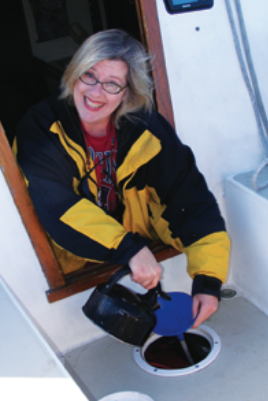
Although we’d been given great wind for sailing that day, this is the Pacific Northwest and you cannot count on wind. Ever. Andrew and I toyed with different strategies for dealing with our water loss. The fill for the engine water tank can only be reached through a small deck plate in the cockpit. With only 3 inches of clearance between the top of the cockpit sole and the engine, removing the radiator cap meant burned fingers and scraped knuckles. We decided that leaving the radiator cap off would ease the tank-filling chore so, whenever we motored, we constantly watched our engine temperature and listened for the high-temperature alarm. That was our cue to reduce engine speed and slowly add more water to the system. This approach worked, but it was cumbersome and required that we leave the cockpit deck plate off, inviting an accident if someone stepped in the hole.
By the next morning, our water situation was becoming dire. We were out of fresh water in our tanks and were now down to the reserve containers I had put aside earlier. Running the engine during the night to top off the batteries made it clear to us that the water loss was accelerating.
As we left our anchorage, our luck held and we were greeted by a grand breeze. We headed for the American side of the strait on a close reach. The 6-mile crossing to San Juan Island felt like a reward for the callous disregard of our engine. The engine had the last word, though. The high-temperature alarm was in full voice as we wound our way through the mooring field and up to the customs dock.
After clearing customs, we headed directly to the fuel dock to fill up on fuel and water. By now, it was nearly noon. We had hopes of sailing farther south before dark, so we made haste. While we made our way through the mooring field and down the narrow, rock-strewn pass, I became more anxious about the engine. The seal on the water pump had now failed to the point that water was pouring out at a prodigious rate. Threading through the pass heightened our anxiety and Melissa stood ready to add water while I drove.
More trouble
As soon as we were safely through the pass and headed out into the strait, I handed the wheel to Andrew and went below. Melissa immediately greeted me with a question. “The water pressure seems kind of low. Why would that be?”
She asks questions like this with a certainty in her voice that implies that I will always know the answer. I do hate to disappoint her, so I have developed the ability to lie convincingly until I figure out the truth. “It’s probably just an air bubble in the line. That’ll clear up in a minute,” I said, while secretly wondering if water pumps belonged to a strong union and were banding together in solidarity.
The truth was more prosaic than sentient water pumps but no less ridiculous. Looking in the head, I found the sink, cabinets, and floor thoroughly soaked with all of the fresh water we had just pumped into our tanks. Someone — and I want to make it perfectly clear that this someone was not me — had turned the faucet on full when we were out of water and forgot to turn it off when nothing came out. Once the water tanks were full and the breaker to the pump was turned on, water poured out with abandon all over the head compartment. The engine had hidden the noise and our attention was diverted as we ran through the pass.
It appeared that forces beyond our control were conspiring to keep us on vacation. We turned around and headed back to the harbor for another refill. We anchored for an hour to have lunch, enjoy the view of the harbor, and collect our thoughts. It was now around two in the afternoon. The days were still long but winds were building and gusts to 30 knots were predicted in the Strait of Juan de Fuca. I was due back at my job on Monday morning. We really needed to get across that strait.
A topping (-off) solution
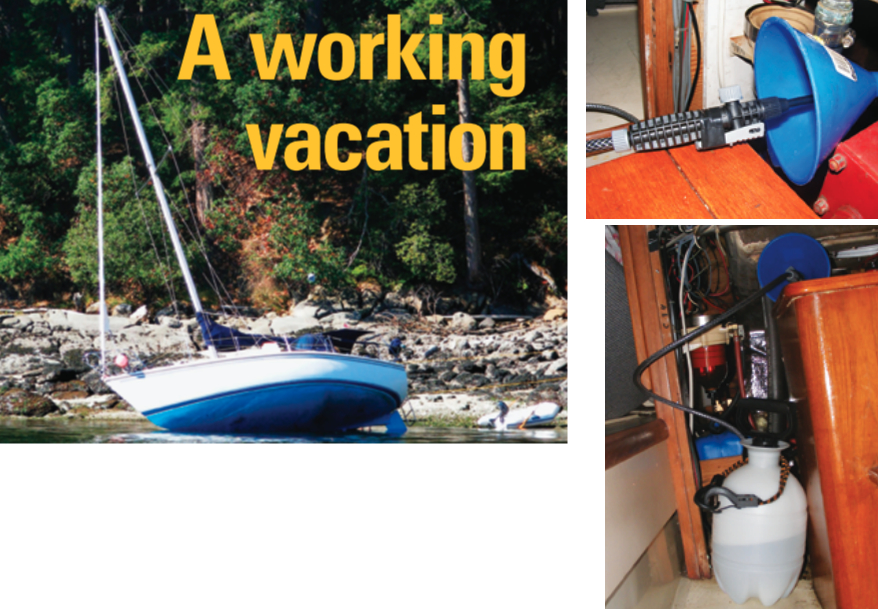
While we were bobbing at anchor, Andrew went below and began rummaging about in the storage area. He came back a few minutes later with the garden sprayer that Melissa had brought along. These little sprayers make pretty good portable showers; just fill with warm water, pump it up, and you have a good stream of water for washing off the funk of the week. Andrew had other ideas though.
“If we had a little longer hose,” he said, “we could fill the sprayer with water and then pump water into the engine without having to open up the compartment or burning our hands.”
These are the moments that fill a father with pride. Encouraged, and feeling a spark of hope, we put our minds to finding the extra hose and various other parts to build our new fill system. Within a few minutes, we had rigged up the sprayer to deliver water into the engine with a minimum of fuss. Just a few pumps on the sprayer and we could add water whenever our now sharply attuned senses felt the engine might be getting a little too warm.
Greatly encouraged by Andrew’s engineering prowess and with freshly filled water tanks, we left the harbor for the second time. As we rounded the top of the island, Melissa shouted, “The whales! I knew we would see them again! Now I know why we had to be delayed for so long! If we had left on time, we’d have missed them!”
We were now fighting the incoming tide and heading into a nicely building breeze. Having an engine we could depend on was more important than ever and, so far, the fill system was working well, providing a much-needed sense of control and a dawning realization that I might actually make it back to work on time. Now we had one more command to add to our sailing lexicon. In addition to “Prepare to tack!” and “Hard a’lee!” we had “Give ’er a pump!”
We headed out into the strait and raised sail for the long slog home. It was going to be a long day and night until we would rest, but the teamwork and ingenuity we’d used to keep our engine running replaced our anxiety with excitement and a new confidence in our abilities. We continued on our way, ready for the next adventure in old boat maintenance.
Michael Boyte sails the Salish Sea with his wife, Melissa White, aboard their Cal 34, Moonrise. Currently, they are developing a cunning plan to ditch the house, kids, and other shore-based responsibilities to pursue the cruising life full time.
Thank you to Sailrite Enterprises, Inc., for providing free access to back issues of Good Old Boat through intellectual property rights. Sailrite.com