A poor sailor is someone who just can’t afford New Stuff. Here’s one man’s $3,500 solution
Issue 16 : Jan/Feb 2001
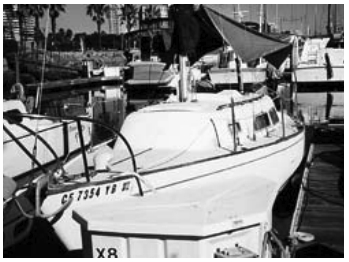
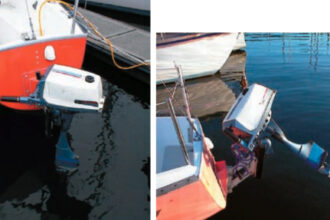
My boat, Seaker, a 1971 Ranger 29, had been donated to the Boy Scouts. From what little I learned about her history, she had been raced hard in open-ocean events until it was felt she could no longer compete. She carried large two-speed winches. An unending array of blocks and lines led to the cockpit. Her deck-to-hull joint not only had rivets but also screws as well as nuts and bolts. Extra layers of fiberglass beefed up the main bulkheads. Her light racing sails (main and 130 genoa) were shot. Before the donation, prior owners removed the engine and sold it. When the boat came into my hands, she had a 4-hp Suzuki outboard dangling from a rickety bracket on the transom. That setup had to go.
My racing days are far behind me, but many tired racing vessels can be refurbished to make excellent cruisers. I don’t mean open-transom, over-canvassed, flat-bottom machines with skinny keels so long they drag the ocean bottom. I mean elderly boats that were designated racer/cruisers and were used mostly for racing.
A poor sailor is an individual, who, when it comes to sailing and boats and big-ticket equipment, just can’t afford New Stuff. It might be other priorities that eat up funds: clothing, housing, food, vehicles, or keeping a spouse happy. Or perhaps there isn’t much money to begin with. A brand-new, shiny, fiberglass sailboat doesn’t exist in the solar system of a poor sailor. Nor does most of the equipment on that shiny new boat, including the brand-new gleaming diesel engine.
I’m a poor sailor. I could no more afford a new diesel engine than I could a date with Madonna. But I found my diesel engine, and I installed it. The total cost was about $3,500.
Difficult to clean
I specifically did not want through-the-hull drive. The material for those drive units is aluminum, very similar to the bottom end of outboard engines. Divers report that there are so many appendages, it’s difficult to clean them. And the drive unit eats up zincs like a handful of M&Ms. Besides, Seaker already had a short bronze shaft with a folding prop. I intended to use everything I could that came with the boat.
Along a backwater side street sat a small building with a large chained yard patrolled by a man-killing dog. They advertised Volvo parts. Inside, the place smelled of diesel fuel and engine oil. The sounds were of hammer blows and drill motors. Two big forest-green four-cylinder engines sat resplendent on the floor in front of the counter. Both were much too large for my little boat.
I was led to a shop where nailed-together shelves were stacked, bending and lumpy with engine parts. A two-cylinder engine block, stripped of all paint, was pointed out to me. It looked clean, no scoring of cylinder walls, nor any sign of dents, welds, cracks, or saltwater crystal buildup. The block felt slick without barbs or lumps. A box next to it held most of the parts.
The owner, the counter man, the mechanic, the teenage porcupine-head gopher, and I talked. We agreed they would build the engine, an MD-6B 10 hp, using only factory-spec parts, which I would inspect. The engine would be started and run on the day I picked it up. I asked about a heat exchanger to flow fresh water through the water jackets. I was told that those particular blocks had so much nickel in the castings that a heat exchanger was neither necessary nor recommended. It was good for 20 years, or longer, depending on my care.
Twenty years. Would I have the boat for 20 years? Would I even be alive in 20 years? If it gave me good service for 10 or 15 years, I’d be a happy sailor. They needed 30 days to build the engine. The price was $2,500, including engine mounts. I left with my checking account lightened and a Volvo factory manual in my hands.
Added more wood
Back aboard Seaker I applied measurements taken from the block to the empty cavity under the companionway steps. My main concerns were engine bearers and shaft alignment. The bearers were made up of fiberglassed 2 x 6 planks. They didn’t quite line up. I added more wood and lots of fiberglass centered where the engine mounts would go. The height of the transmission looked like it might match up with the shaft. One problem with exact measurements was that the coupler looked like a softball of rust. I used a grinder-cutter mounted on my drill motor. It was slow, tedious work, but I managed to get a slice from front to back. Hammer and chisel widened the crack enough to drive the old coupler off. I didn’t score the shaft as badly as I thought I would. The new coupler fit the shaft just fine.
The wiring around the engine compartment looked like the mutilated wire-harness of a crashed 747. I had no idea how I’d find what wires went where. Some of the wire looked fairly new, and I’d use as much of it as I could. The rest I’d yank out and replace. Wire is cheap. What’s expensive is hose. But wire-supported hose is much cheaper at Home Depot and Pep Boys than at marine outlets. Other expensive items I decided to buy used were throttle and transmission cables. I found them by pawing through a waist-high stack of push-pull cables at a used-supply marine store. Forks and eyes I had to buy new.
I’d heard several horror stories about seawater backing into exhaust hoses to mutilate valves. Two such incidents happened to people I knew. Since I’d already installed anti-siphon vents on inlet and outlet hoses in the head, I intended to do the same with the engine. I glassed a square of plywood to the floor aft of the engine bed, then screwed a water-trap muffler to the plywood. I installed the vent on the inlet water hose at the engine.
Throw them out
I also sprang for a raw-water inlet strainer. A three-way valve allowed me to run a hose from the bilge to the strainer so I could use the engine as an emergency bilge pump. It would be one of three bilge pumps, hand, electric automatic, and engine. Hose inlet strainers are too expensive. I’ve always had good service from bronze or stainless scrub pads wired to the end of the hose. Works well for shower drains, too. When they clog up, throw them out and drop in new ones.
Finally, the fuel tank still looked OK. I drained and cleaned it and replaced all fuel hoses, installing the fittings myself. I filled up with clean diesel from a truck station, using portable containers. The tank took about 20 gallons.
The day arrived to pick up my new engine. At the time I worked as an outside hydraulic repair salesman. Since my territory covered all the Los Angeles basin out to Riverside, the company handed me a Dodge Dakota truck and a Shell credit card. I used the Dakota to haul the engine. When I backed into the fenced yard, the owner chained the killer dog so he wouldn’t go for my throat. The engine sat on a rolling cart with a chain come-along beside it. A battery was wired to the starter and the fuel sloshed in a one-gallon paint thinner can. A long, curled hose was used for exhaust.
The engine looked beautiful, shiny in that special green paint. The owner and I exchanged pleasantries about everything except the engine. Then the time came. He hit the starter, and the little diesel chugged to life. I leaned in close, listening for thuds or knocks. I fiddled with the throttle, revving and backing down. I shifted to forward and reverse, listening for grinds and clunks. The diesel chugged along without complaint. It seemed like the perfect engine for my boat.
Easier said than done
Using the come-along on the overhead arch of the cart, the owner and I hoisted the engine into the bed of the Dakota. He told me he figured the weight to be about 300 pounds. We shook hands and said goodbye. I drove to the marina.
My son and I slid the engine to the back of the pickup then horsed it onto a three-wheel wooden dock cart. That task sounds a lot easier than it was. It took a total effort from both of us to control the cart as we rolled it across the parking lot, through the dock gate, and down the dock to Seaker. Using the boom on Seaker, with the mainsheet working through one of those two-speed winches, we huffed and grunted until the engine was lifted then lowered into the cabin and rested on the bearers. It fit perfectly.
The next task became alignment. The face of the coupler had to match the transmission within 0.002 inch, otherwise the shaft would wobble like the end of a garden hose with full pressure on. And that would tear up the Cutless bearing, and water would pour in, and on and on. After a week of pushing and pulling and sliding and loosening and tightening, the closest I could get was .004 inch. I was over my head. I needed professional help (something my ex-wife has always maintained).
Expert #1, at $30-plus per hour, spent more time than I felt necessary and came no closer than I did. He called in two buddies (Experts #2 and #3) who, he said, were the sharpest in the business. Watching those two attack the problem made a believer out of me. They were a couple of men in their early twenties, and they worked together as a team, one at the coupler calling directions while the other, at the engine mounts, adjusted. Four hours later, with everything cinched tight, the coupler mated to the transmission within 0.001 inch. I was impressed. I’d always thought that to get to the mature and wise stage of life I now enjoyed, you had to first go through a young and stupid phase. Those youngsters apparently skipped that part.
Dreaded part
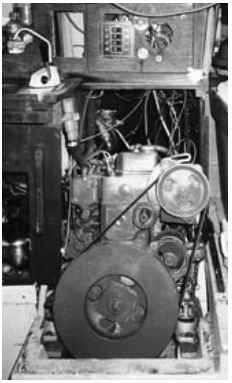
Plumbing for the water intake and exhaust was straightforward, but tedious. Hose fits were tight, and I had to be careful of hose bends. The water hoses were the worst. Several had to be end-soaked in boiling water, then rubbed with soap to get them to fit. But eventually everything was hose-clamped and tight, and my new engine was in, lined up to the shaft, and plumbed. Next came the most dreaded part for me, the electrical system.
I understand the principles of water, hydraulic, and fuel systems, but electric and electronic stuff flattens me. Some of it has to do with my mental makeup. I can change batteries in a flashlight without cartoon instructions. But I’m still amazed when, after I fix something, it works. In my youth, when I installed plugs and points in a car, it was with much anxiety that I turned the key and hit the starter. When the thing actually started, I sat in wonder, trying to think what I did right and how I might repeat that accomplishment.
I had spent hours studying the wiring diagram of my Volvo shop manual. I knew my little diesel did not need electricity to run. It needed electricity to start and to charge the battery while it ran. But I had instruments, too: a tachometer, a temperature gauge, ammeter and oil-pressure gauges. These all, somehow, had to be connected by wire and made to work.
This was the most difficult part of the installation. I began by yanking and throwing out the rats’ nest of wiring in the boat. The best of the wire I kept, the rest went in the marina dumpster.
Island party
I began to feel pressure from my son to finish. He had just sold his boat. The Buccaneer Days Festival was coming on Catalina Island, 25 miles from the mainland and the only real weekend island available to Los Angeles County sailors. An annual event, Buccaneer is the wildest, raunchiest, most fun-filled, dancing, island party of the year. It is not a family event. People dress like pirates and act accordingly. It is decadent and awful. I can usually be talked into attending. My son told me we were going aboard Seaker if we had to tie the dinghy alongside and use its outboard.
With that kind of pressure, I managed somehow (using three wiring books plus the manual) to get the wiring in and tightened. With the throttle and transmission shift cables connected, that was it. But would it all work?
The big day came to actually start the engine. Since my son had been so much help, it was fitting that he should be there. I felt the tiny hand pump on the engine to be anemic so I had installed a bulb-pump, generally used in outboard gas lines, to the fuel line at the tank. While my son cracked the injectors, I pumped until we saw a trickle of airless fuel. We tightened everything down, and I hit the starter. Almost immediately one cylinder lit, and the thing chugged like a power lawnmower. Then cylinder two came in, and the little engine purred. I leaned over the stern to make sure water flowed from the exhaust. We ran it in reverse and forward against the docklines. Everything worked perfectly.
On the open sea
The big test, of course, would be the trip to Catalina Island. I knew that with a folding prop, the torque in reverse would range from little to none. In fact, at the dock, with the engine at half-throttle in reverse, I could stand at the bow pulpit and pull the boat forward. But, to the amazement of my son, on a Thursday morning, I backed Seaker out of the slip, shifted to forward and — waving farewell to my dubious, harassing dock neighbors (who knew the boat would never leave the slip) — chugged toward the open sea.
Going to Catalina Island, a sailor can count on two conditions: no wind at all or wind directly on the bow. The sail home can be boisterous and exciting. The wind usually comes up about noon. Since my main purpose was to test the engine, we left at around 10 a.m. in windless conditions. Once clear of the harbor jetty, we found a smooth sea with long non-breaking swells.
At three-quarter throttle, Seaker slid through the swells at 5.5 knots. By moving the throttle forward just a little, I could get 6 knots. Good enough for me. Since I always raise the main when I motor, I figured when the wind did pipe up, I’d fall off a bit to give the little engine some help.
There are all sorts of graphs and charts by experts to tell the sailor what is the best size engine for the boat. They run from 1 horsepower per waterline foot, or so-many horses per ton of displacement, to everything anyone can think of. And, since the birth of internal combustion, we Americans have felt there is no substitute for cubic inches. I always figured up to around 30 feet, 9 or 10 horsepower is a good auxiliary engine for a sailing vessel. Since horsepower is rated at the rpm speed just before everything blows apart, the sailor will never see advertised horsepower. At three-quarter throttle, I probably had 5 or 6 horsepower spinning my folding prop.
Dragging laundry
Ah, the folding prop. What a robber of drive and torque, and what a grand invention for maximum sailing speed. My previous boat had a three-bladed prop that gave as much torque in reverse as in forward. But when sailing it I felt like I dragged 30 pounds of laundry behind me. What I really wanted was the Cruising Design Inc. (CDI) three-bladed feathering prop. But chugging across the open ocean toward Catalina, I was very happy with my auxiliary drive system.
On the trip to the island, the Navico steered while my son and I lounged about as passengers. We sipped beer, snacked on cheese and crackers and hard-boiled eggs, discussed world and personal events, and checked the horizon. When we were about an hour from Bird Rock, the wind came up. I fell off a little and moved the mainsheet on the track as far to windward as it would go and cinched it down tight. Our speed picked up to 6.5 knots. When we reached Bird Rock, the island stole the wind, so we dropped the main and motored to my favorite anchoring spot. The engine had burned one gallon of fuel.
Our weekend was wild and crazy as expected. Also as expected, the sail home gave us 20- to 30-knot winds and mixed, breaking 6-foot seas, coming from the stern quarter. Our speed stayed at 6 knots plus, and at times we surfed to 7.5 knots. Even though we didn’t feel quite as perky as we did on the trip over, due to so much cavorting, we had a grand time. The 130 and racing main had us over-canvassed, even with a reef in the main, but those were the only sails I had on board. I feathered them to slow us, but just before we made the jetty entrance, wind and seas increased to where the Navico couldn’t handle it. I had to hand steer the last few miles. But we made the distance in less than three-and-a-half hours, which equaled any previous best time I, or my son, ever had.
Seaker still has much work to be done on her. Other than new rigging, most of it is cosmetic. It’ll take time, but it will get done. I’m proud of my little boat and very satisfied with the $3,500 engine installation.
George has been living aboard and sailing boats less than 30 feet in length for 20 years. Ten of those years were spent aboard Runaway, a Columbia 26 MkII. He has singlehanded from Seattle to Juneau, Alaska, and cruised the Baja and the Sea of Cortez. He has also designed boats and built three. His present sailing home is a 1971 Ranger 29. When not sailing, George writes. He has 18 published books, the most recent of which is Baja Sailor Tales, available from Amazon.com for $12.95.
Thank you to Sailrite Enterprises, Inc., for providing free access to back issues of Good Old Boat through intellectual property rights. Sailrite.com