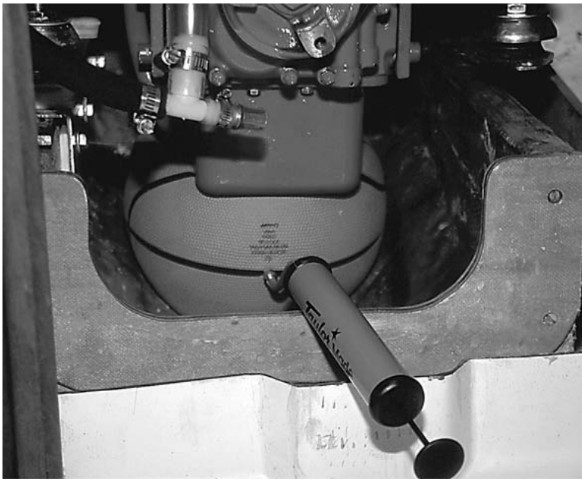
How to lift your engine with a spherical air bladder
Issue 27: Nov/Dec 2002
AS I WAS GROWING UP, I SUSPECT SEVERAL COACHES SAID, OUT of earshot, “Now there’s a boy who doesn’t know what to do with a basketball.” In all fairness, that was certainly true. In those days, once coaches had made such a determination they hardly knew you were there at all. That didn’t trouble me much, because I had the same attitude toward them.
I could have remained uninterested in basketballs for the rest of my life, but I did not. Recently, I chanced upon a box of basketballs that were made in a well-known Pacific-rim country and shipped halfway around the world to sell at retail for less than we probably can make the raw materials legally in this country: $6.59.
At that price I did not see each ball as an important sporting implement, respected and revered by millions; instead I saw it as a fairly tough spherical air bladder that could hold several atmospheres of internal pressure. There were possibilities in that.
I bought a ball, and headed for my boat. I had an engine to move. In repowering articles you read of scissors jacks and bottle (hydraulic) jacks being used to lift an engine off its mounts or bed so it can be taken out of the boat. There are also times when you might want to take all or most of the load off the engine mounts during the alignment process. There are problems associated with using conventional small automotive jacks for this work.
The hull under the engine is not usually flat and horizontal, and there is not always a strong spot on the engine or the hull that can safely take the concentrated stress of lifting the engine. The problem is further complicated if the engine is mounted close to the hull below it, leaving no room for the jack.
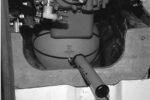
A deflated basketball-turned-engine-jack requires no flat strong point on the hull, nor does it normally need one under the engine. As you inflate the basketball, it expands and comes into contact with a fairly large area of hull bottom and a large area of oil pan under the engine. You have to be careful here, but in most cases the lack of point loading on the pan and hull allows you to lift the engine with no harm to either.
How does it work? One formula for force is pressure times area. Because of the large area of the flattened basketball, it needs very little pressure to lift a typical small-boat engine. If you have a really big engine, you might try two or more balls.
Cautions
There is certainly an oil pan somewhere that can be crushed by an inflated basketball. My pan was cast aluminum and was plenty strong enough. I used to lift automobile engines with a block of plywood under the oil pan when I was a kid. Still, make sure you don’t crush your pan. Lift a little and look to see what’s happening. It would be the same deal with a metal jack.
There may be hulls, also, that cannot take this stress, but they’ll be in more trouble if you use a metal jack because that jack will cause concentrated stresses and off-axis loading. So check to see how things are going, maybe even use a little plywood reinforcement here and there. There’s more room for that sort of thing with the basketball.
One last caution: use only a hand pump, not an air compressor. If you inflate the ball without loosening the mounting nuts or bolts, you can crush the pan or blow out the bottom of your boat, as would be the case with any type of jack.
Thank you to Sailrite Enterprises, Inc., for providing free access to back issues of Good Old Boat through intellectual property rights. Sailrite.com