A fairly rare coastal cruiser with an intriguing layout
Issue 42 : May/Jun 2005
A Chinese immigrant by the name of Ti Ouyang is the man responsible for the creation and success of Ouyang Boat Works of Whitby, Ontario, the manufacturer of Aloha Yachts. Upon his arrival in Canada, Ti gained employment with the Whitby Boat Works. After a few turbulent years with Whitby, mostly due to his independent nature and refusal to compromise quality, this self-taught woodworking craftsman started his own company. In a friend’s garage, during the late 1960s and early 1970s, he built a plug for what is now known as the Matilda 20. The boat was a success, the company flourished, and other Matilda models, a 16 and 23, were introduced. Today, more than 1,000 Matilda 20s are sailing worldwide.
The main thrust for Aloha Yachts came in the early ’70s, in the form of Mao Kang, one of Ti’s three sons. He provided the fledgling company with much needed management direction and named the company’s new line of cruising boats Aloha. (While in college, Mao Kang dated a girl from Hawaii and the rest is history.) Unfortunately, his contributions were short-lived. He died of cancer at the age of 27. Soon after Mao Kang’s death, his brothers, Mao and Stan, joined their father in the family business.
Several naval architects, including Ted Brewer, Robert Perry, and Mark Ellis contributed designs. In five years Ouyang Boat Works introduced the Aloha 27 (8.2), 28 (8.5), 30, 32, and 34 (10.4). In hindsight, it appears that the popularity of the Aloha line came too quickly for what an under-financed family could withstand. The Ouyangs eventually ran out of money and turned to a friend and dealer, Canadian Yacht Charters, for a needed cash infusion. The partnership was rocky from the start. Soon Stan and Mao left their directorships with the company, and Ti went into retirement. The three were subsequently bought out for a paltry $100,000. The year was 1986. Aloha Yachts continued production for the remainder of the ’80s but, like so many of its contemporaries, it closed its doors prior to the new decade. All in all, approximately 700 Alohas were built.
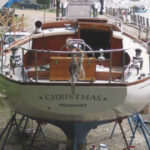
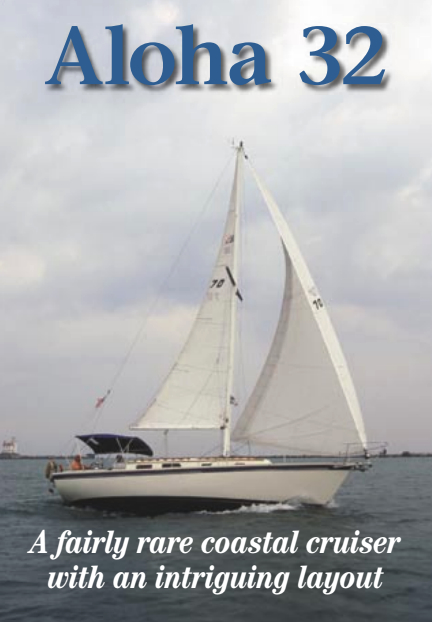
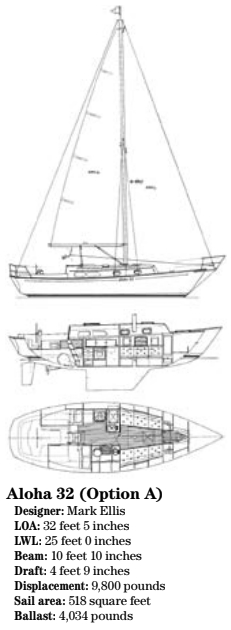
The Aloha 32 was designed primarily for cruising comfort. That is not to say that it doesn’t sail well. It has an overall length of 32 feet 5 inches, a waterline length of 25 feet, a beam of 10 feet 10 inches, and a displacement of 9,800 pounds, 4,034 pounds of which is ballast.
Design and construction
This cruising sailboat’s classic yachty look is the result of designer Mark Ellis’ reliance on traditional styling. The boat exhibits a strong spring to its sheer, a delicate spoon bow, and a short counter stern. Aesthetically, the short bowsprit actually extends the sheerline, giving the boat a longer appearance. Technically, it compensates for the somewhat forward placement of the fin keel by moving sail area forward to balance the boat. The wide cove stripe accentuates the sheer, while the cabintop’s teak trim piece visually reduces the cabin’s height.
Underwater, the hull is about what one would expect to find on most modern cruising sailboats. There is a fin keel, which draws 4 feet 9 inches, and a balanced spade rudder.
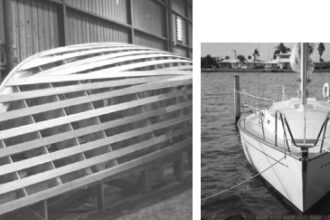
The hull is solid, hand-laid fiberglass, while the decks are a sandwich comprised of fiberglass above and below with an end-grain balsa core. This construction technique increases strength and rigidity without adding weight. The balsa core also affords good sound and temperature insulation. The hull-to-deck joint is an inward flange, which is actually the toerail, that is chemically bonded and mechanically fastened on 4-inch centers. All deck hardware is through-bolted and secured to stainless-steel backing plates.
On deck
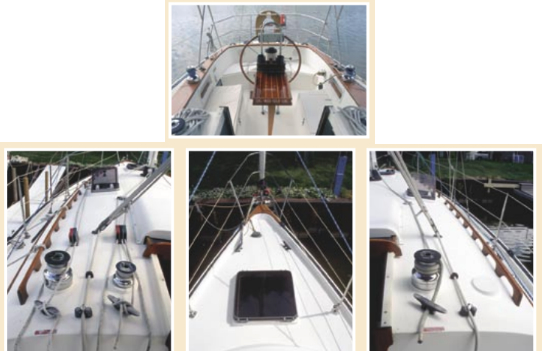
From the stainless-steel bowsprit, with two built-in anchor rollers, to the turtle-shaped cabinfront, the expansive foredeck makes an excellent platform from which to anchor or make sail changes. Deck fittings include a pair of open-base cleats, a corresponding pair of closed chocks, and a deck pipe leading to a rope locker in the forepeak. There is a generous 26-inch square hatch through which crew can easily maneuver and pass bulky sailbags. For safety, the deck has a continuous non-skid surface and is rimmed with a molded-in toerail capped with a continuous aluminum track from stem to stern. A bow pulpit and 27-inch stanchions with dual lifelines complete the package.
The sidedecks are a generous 20 inches wide. However, fore and aft movement is somewhat impeded by the shrouds and the jib track situated in the center of each sidedeck. For handholds, there is a teak handrail on each side of the cabintop. Located amidships and on each side is an open-base cleat and closed chock. These are convenient for attaching spring lines and fenders.
Located on the cabintop, which is also non-skid, is a 20-inch-square forward hatch, a pair of 12-inch-square amidships hatches, and a sea hood with smoked plastic companionway hatch.
The T-shaped cockpit is surrounded by straight-backed coaming 13 inches high and capped with 8-inch-wide teak. This makes for comfortable back support. There is a bridge deck and a pair of opposing cockpit seats. Beneath each of these 4-foot-long seats is a shallow locker. Additional stowage is located beneath the helmsman’s hump, which also opens to the lazarette by means of a locker with a false bottom. In each coaming is a sheet cubby. In the aft deck there’s another shallow locker, ideal for stowing mask, fins, and snorkel. Propane tank lockers flank the helmsman. To starboard of the Edson wood-rimmed wheel is the engine control panel, while to port is the manual bilge pump. For water removal, there are two cockpit drains and two aft-deck scuppers. There’s a stern pulpit with an integrated, centerline swim ladder, plus a pair of open-base cleats and accompanying closed chocks.
Belowdecks
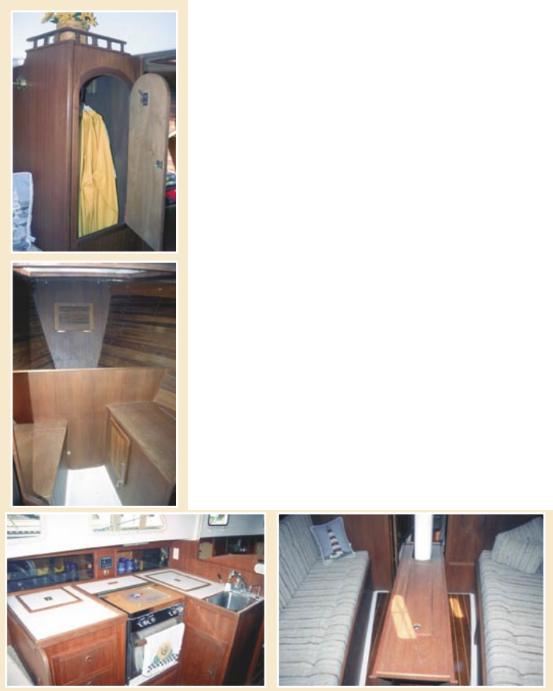
The interior of the Aloha 32 was available in two configurations. Option B is the classic V-berth and opposing settee configuration. These areas are separated from each other by the head on one side and a hanging locker on the other. No surprises here. Our review boat’s interior is of the more novel Option A arrangement. Instead of a V-berth, there is a large sail stowage bin and two illuminated worktop areas with lockers beneath. Directly above is the large hatch. The worktops are of different heights so they can be used as steps to enter and exit the hatch (see photo on Page 6).
Separating the forward “all-business” space from the main cabin are two hanging lockers with a fiddled shelf above each. Since the main cabin is pushed forward somewhat, the 6- foot 2-inch opposing settee/berths are toed in slightly. While the port settee can be converted into a narrow double, the starboard settee is not convertible. Beneath each settee is a 35-gallon aluminum potable water tank and stowage space. Outboard are four lockers with cane doors and four fiddled bookshelves. The centerline drop-leaf table measures 44 x 40 inches when open and conceals a built-in spirits locker. Ventilation and natural illumination come from four opening ports and a 20-inch square hatch. Four reading lamps provide illumination. A pair of grabrails overhead helps maintain balance in rough conditions.
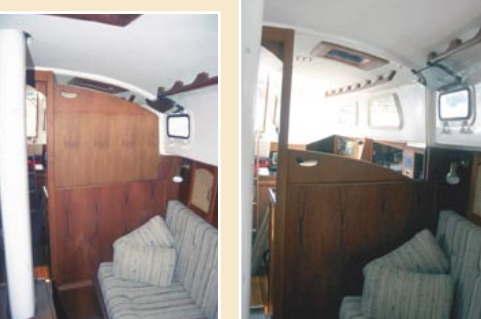
Just aft of the main saloon and amidships is a bulkhead. The starboard bulkhead denotes the beginning of the private head compartment, which measures a generous 29 by 42 inches. There is a stainless-steel sink, hand shower with its own sump, pressurized hot and cold water, an additional foot pump for cold water, a vanity with four drawers, a mirror, a wet locker, and three additional lockers/bins. A fixed port provides light, while an opening hatch offers light and ventilation. A fluorescent fixture provides nighttime illumination. There is also a grabrail for balance.
Sliding bulkhead
The port bulkhead is a partial; the upper portion can be slid up and down (see illustration on facing page). In the down position, there’s an openness to the cabin. It also creates a pass-through from the galley to diners in the main saloon. With the sliding bulkhead in the up position and the door closed, fore and aft privacy doesn’t get much better.
The port side galley is L-shaped and consists of a deep centerline stainless-steel sink, with pressurized water and a foot pump for sea water; a gimbaled, two-burner propane stove with oven; a deep well-insulated icebox; two dry stowage bins; four drawers; and several lockers with sliding or hinged doors. There are two fixed ports for light and an overhead hatch for light and ventilation. Six feet of overhead handrail spans the galley area for safety.
Aft from the galley is a small flip-up chart table, which is almost useless except for extending galley counter space. Located outboard and above is the AC/DC panel. Continuing aft is the port quarter berth, which measures 6 feet 3 inches long by 2 feet 3 inches at its widest. It has stowage beneath and a reading light above.
Aft of the head compartment on the starboard side is a reasonably large (6-foot 3-inch by 45-inch) double quarter berth. Beneath is the 35-gallon holding tank and stowage. Small items can be kept within easy reach in the deep, full-length, fiddled shelf, located above and outboard of the quarter berth. For illumination, there’s a fixed port and a reading lamp.
The Aloha 32’s construction incorporates a fiberglass pan and an overhead liner. While the liner is noticeable, the pan is not readily apparent. Teak has been carefully applied to almost all of the pan’s exposed surfaces. The oil finish on the solid and on the veneer teak, combined with the teak-and-holly sole and cane locker doors, gives the interior a warm, homey appeal.
The rig
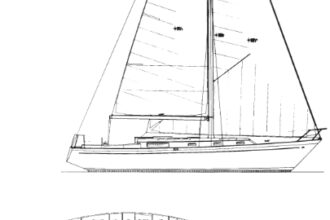
The Aloha 32 sports a keel-stepped mast that towers 46 feet above the water. It uses single airfoil-type spreaders and is conservatively stayed with single uppers and fore and aft lowers. There is a split backstay, and the spars are aluminum and Awlgripped white. The halyards (one main and two headsail) are internal, as are the two reefing lines and the outhaul. This sloop’s high-aspect-ratio masthead rig consists of a 213-square-foot main and a 464-foot genoa.
With the headsail tack out on the bowsprit extending the “J” dimension, there is room in the foretriangle for a staysail.
All sail controls are led aft to the cockpit. The headsail halyards, outhaul, and reefing lines are routed to the port aft cabintop, where they can be controlled by a series of clutches and a pair of Barlow winches (a #23 two-speed and a #15 single-speed). On the starboard side, the main halyard is lead to a single clutch and a single Barlow #23 winch. In lieu of a traveler, the Aloha incorporates two mainsheets in an inverted V arrangement.
These are cleated on each side of the companionway’s sliding hatch at almost mid-boom. With the exception of the headsail winches (Barlow #26 self-tailing, two-speeds), located on the cockpit coamings, this concentration of running rigging keeps most all of the controls on the aft cabintop. With a dodger installed, they all would be comfortably protected.
The Aloha has a 3-cylinder, 21-hp Westerbeke. Coupled to a V-drive, this freshwater-cooled diesel can adequately push the boat along near its hull speed of 6.7 knots. Access to the engine is achieved from behind the companionway steps and through side panels. Because of the V-drive and the gymnastics involved, access is only fair. The capacity of the boat’s aluminum fuel tank is 20 gallons.
Under way
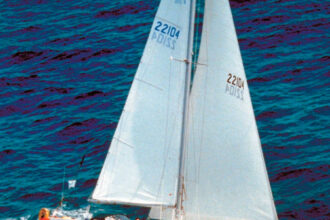
The Aloha 32 was designed as a cruising sailboat. It is light and accelerates well. The tall rig helps it move along in light air. And when the air gets heavy, there are two sets of reef points. If they’re properly employed, this boat will sail on its feet at or near hull speed.
The wheel steering and the engine and sail controls are, for the most part, straightforward. However, the mainsheet arrangement may take a little time to get used to.
Things to check out
As with all boats that employ end-grain balsa as coring material, the deck should be sounded for possible areas of delamination. Osmotic damage or hull blistering is a minor problem with Aloha 32s. Still, the hull should be carefully inspected.
There have been several reports of loose aft keel bolts. This is due to the degradation of wooden or mild-steel structural components that have been continually subjected to bilge water.
Along with water seeping into the coring material, water has also been responsible for rotting the wooden chainplate knees. Even though these are glassed to the hull, water (via capillary action) can rot these critical support members. While in the chainplate area looking for rot, examine the chainplates for signs of excessive wear.
Summing up
The Mark Ellis-designed Aloha 32 is a comfortable, traditionally styled, cruising sailboat. It’s a little light for serious bluewater work but is more than adequate for coastal cruising and that escape to the Bahamas. Even though its production run is purported to be 1979 to 1988, there weren’t hundreds built.
Consequently, there aren’t many on the market at any one time. If you are fortunate enough to locate one for sale, expect to pay in the neighborhood of $30,000 to $45,000, with condition being everything.
Thank you to Sailrite Enterprises, Inc., for providing free access to back issues of Good Old Boat through intellectual property rights. Sailrite.com