Issue 12 : May/Jun 2000
Over the years, Dick and Judy Kilroy have made many changes to Vixen, but the motor is the original.
“The motor is fabulous,” Dick says. “It’s a Yanmar 3QM30 diesel, and it has been phenomenal. It was new with the boat, and it still runs like a top. We put between 100 and 125 hours a year on the engine.
“I do all kinds of treatments with the fuel,” Dick continues. “Basically, I use four things: Marvel Mystery Oil, cetane booster, sulfur replacement since they changed the diesel fuel, and Stor-N-Start stabilizer, which I put in with every bit of fuel. You use so many ounces per hundred gallons. I keep a calculator on hand to do it right.
“We’ve never had a plugged filter. We change the Racor filter annually.”
Dick has also cleaned out the heat exchanger, removed the manifold, and had it completely cleaned.
Sail inventory
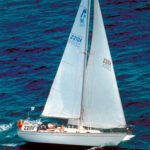
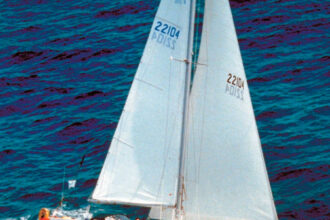
The sails are all heading toward 10 years old — and this was in the year the Kilroys placed third in class in the biennial Marion-Bermuda Race, despite a broken boom topping lift (replaced with the spinnaker halyard).
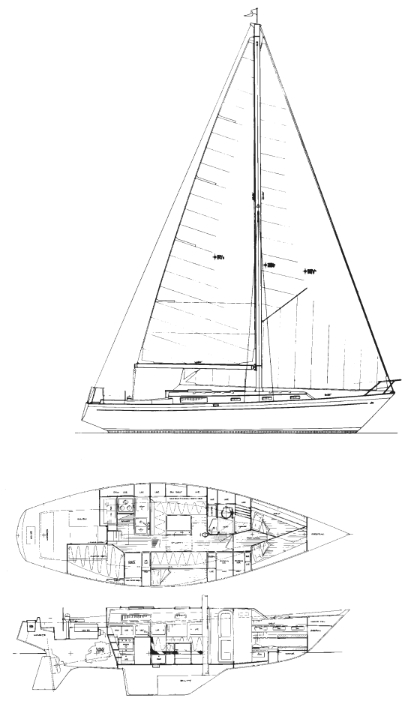
“The animal on the forestay is a 1991 Thurston Mylar double-laminated 140, which was recently rebuilt by local sailmaker, Sperry Sails,” Dick says. “The existing main is a 1989 Thurston, of Dacron. A sail the boat loves is a Hard 90-percent full luff blade, to which Sperry has added a sun shield. Vixen likes smaller sails. Morgan 38s like to sail on their bottoms, and we have big winds in Buzzards Bay.”
Vixen also has a Shore RDR (reacher-drifter-runner), a cruising spinnaker, of Dacron. The Kilroys have never been tempted by Spectra.
“I prefer to stay with Dacron,” Dick says. “If I buy another headsail I’ll go back to Dacron and get away from Mylar. Dacron is friendlier and has more longevity. With new developments in Dacron you can get better, stronger sails.”
Because it is required of all boats racing in the Marion-Bermuda, Vixen has a storm trysail and storm jib.
Race gear
In fact, the Marion-Bermuda has had a major impact on the equipment they carry. The Kilroys bought an offshore life raft last year. The raft is another thing which is required in the race, but in their four previous races they had rented one, “So, in essence,” Dick says, “we paid for it twice.”
“We went in the first race with a friend,” Dick remembers. “Judy was the cook.”
“There were seven of us on the boat,” Judy recalls. “Dick and I were the only ones who didn’t get sick. We loved it. We thought it was fun. So we took the kids off to Maine offshore and said, ‘Do you like this?’ They said, ‘Yes,’ so we said, ‘Let’s do it,’ and there we were.” They raced Vixen in the 1989 Marion-Bermuda with their children, then in their early 20s, as crew.
“We paid more money to do that,” Dick says, pretending to be grumpy. “We could have taken the five of us to Europe for three weeks for what we spent. All the stuff you have to buy! Flares, storm sails, a heavy weather jib, and all at once that first year. Another $2,500 bucks for a life raft seemed like just one thing too much, so instead of buying, I rented. Dumb, dumb.”
They raced every subsequent Marion-Bermuda. “We never had an offshore gear failure to amount to anything,” Judy says, but the winds of the 1991 race were a sobering experience.
“We were under once. We broached and slid down the face of a wave which landed on top of us. I was lying on the bunk with one of the plastic ports leaking in my face so I thought I’d do something with those,” Dick recalls. He replaced them when they got back.
The Kilroys also installed a cutter rig after that race. “We had hurricane-force winds and 40-foot seas,” Dick says.
“I estimated them at 25 feet,” Judy remarks. “The wind speed was pegged at 60 knots for eight hours. You can’t sleep when it’s like that. It’s like trying to sleep in a washing machine. Even though Vixen has a cored hull, it makes a lot of noise. It’s like a train — there’s water hitting the hull, stuff on the mast is banging around, the wood is creaking, and water is slapping the hull.” A cutter rig, they decided after safely landing in Bermuda, would be a more controllable rig.
Other gear
A year after they bought Vixen the Kilroys replaced the kerosene stove with a compressed natural gas (CNG) stove made by Shipmate. “With the kerosene stove, you needed kerosene and alcohol to start it. If you ran out of alcohol, you didn’t have the stove,” Dick says.
“And the kerosene was filthy on the bottoms of the pans,” Judy adds.
The boat didn’t have a propane locker so they went with CNG which the Kilroys feel is safer since it’s lighter than air.
They replaced the 44-size winches with three-speed Lewmar 48s in 1979, too. The 44s were undersized for the winds on Buzzards Bay. In the early 1990s, when they bought the reacher-drifter-runner, they added two-speed 25s as secondary winches. The 25s also serve to secure the headsail when it’s reefed.
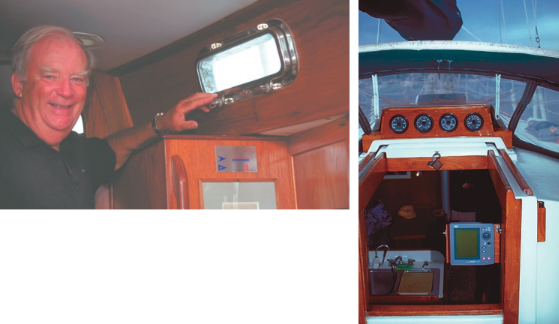
They added a console for instruments at the head of the companionway when the boat was new. Dick and a friend who had bought a Morgan the same day created the console design and each had one constructed by a local craftsman named Brian Snow (see photo on Page 8.) The electronics are all analog, as opposed to digital. “We like pointers, which show history, better than numbers,” Dick says.
They have an Autohelm 5000 that they use when motoring. “It will handle the boat under sail but I don’t like to hammer the batteries,” Dick remarks.
Having equipped the boat for offshore racing, they have a full complement of communications equipment, including a handheld VHF radio, handheld and hard-wired single-sideband receivers, and a 406 MHz EPIRB.
An Automac enables them to control the alternator’s output. “It has a meter, so it tells you what it’s done,” Dick says.
The bilge pumps have been replaced quite a few times. Their Adler-Barber refrigeration was added “10 or 11 years ago.” The clock, barometer, and oil lamp came from their previous boat.
The bunks have lee cloths “for offshore sailing, to keep you in your bunk,” Judy says. “We spend a lot of time reading catalogues and thinking, ‘Hmmm,’ ” she adds.
Dick also had the stemhead fitting rebuilt by Marine Fashion, of Guilford, Conn., to take 1 3/4-inch nylon tubing chafe gear on both sides — an important consideration in hurricane-prone New England waters. All too often, the cause of boats breaking loose during a hurricane in New England harbors is inadequate chafing gear.
They also added two mushroom vents when the boat was new.
In 1994 they installed a tricolor for running lights. “It’s all your lights in one fitting with a 10-watt bulb so when you’re sailing overnight the light won’t hammer your batteries,” Dick says. Since 1994, their batteries have been Sam’s Club golf-cart 6-volt batteries, which they find work like a charm.
In the cabin they installed low-energy-demand Alpenglo lights, made by a company in Montana for people in the woods without electricity. “The guy found a way to hop up fluorescent bulbs big time,” Dick says, “and if we’re offshore at night we can turn on a red light so it won’t blind people in the cockpit.” (See Alpenglow’s ad on Page 72.)
The Kilroys also added a deck wash so they can pump salt water to flush off the anchor and chain. They also have a fitting on the stanchions to hold a sailboard.
Maintenance
When the Kilroys took delivery on the Morgan 38, none of the wood surfaces had any kind of finish coat. The first season they put six coats of 626 Woolsey High Gloss varnish on the teak-and-holly cabin sole.
“We also did three coats of California satin varnish on all the other vertical teak below so it would look like it does this many years later,” Judy says. “You need a sealer. Otherwise you get fingerprints all over the place. Sikkens Cetol Marine has been great on the toerail.”
The Kilroys used Epifanes on the coamings and bridge deck. “It has held up well, but it’s more work. We put eight coats on,” Judy says.
The Kilroys have always done their own maintenance work, waxing the boat twice a year, among other things. After an initial winter in Barrington, R.I., for spreader repairs, Vixen was stored at Barden’s Boatyard in Marion until 1985 when the Kilroys started having it hauled home — first to Holliston and now to their house in Marion — where Vixen is handy for maintenance projects such as replacing the opening ports in the cabin.
Whatever the Kilroys are doing works. Vixen looks like a new boat, inside and out. No wonder they couldn’t find another 1978 Morgan 38 to suit them when they decided to purchase a second Kilroy cruising yacht for Caribbean adventures.
Thank you to Sailrite Enterprises, Inc., for providing free access to back issues of Good Old Boat through intellectual property rights. Sailrite.com