Issue 12 : May/Jun 2000
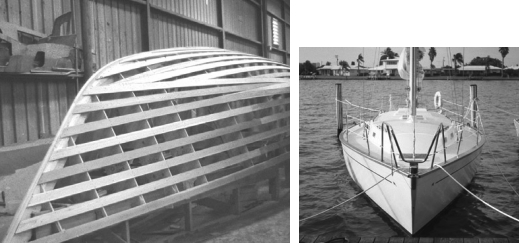
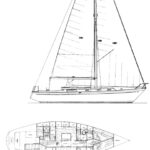
Charlie Morgan had sold his interest in Morgan Yachts when we (Brewer, Wallstrom, and Associates) were approached by them in 1976 to design a 36- to 38-foot fast cruiser; there was no mention of its being a cruiser/racer, and that was never the intention at the time. I got hard at work at the drawing board and submitted several preliminary sketches showing possible layouts, outboard profiles, and sail plans. Morgan’s brass picked out the one they liked, and then I was told they wanted to use an existing 36-foot, One-Ton Class, IOR racer hull, an old Charlie Morgan design, as the basis for the hull of the new yacht.
It had the typical faults of an IOR yacht of its era, with extremely pinched ends and a deck plan shaped like the ace of diamonds. This made no sense for a cruiser, so I was able to argue for a big change of shape. I fattened her up from midships aft, and then I fattened her up again, so that the 38’s transom wound up being more than twice as wide as the One-Tonner’s and with considerably more “beef” all the way down from sheer to centerline. Then I pulled out the bow, lengthening her to 38 feet. There was not much left of the original hull after that.
The powers that be insisted on a draft of 5 feet to please their clients in Florida and the Bahamas, so we gave her a new fin, a fat NACA section, in order to get the ballast as low as possible. At the same time, I persuaded Morgan to offer a 6-foot-draft version for skippers who were not concerned with shoal draft and wanted more performance. Then Morgan decided they wanted to investigate a super-shoal-draft keel shape patented by Henry Scheel, so I sent Henry the hull lines, and he drew up a keel to suit. Finally, to our relief, Morgan could not make a decision and decided to tank-test the hull using both keels.
The model was made with interchangeable fins and extensively tested at Stephens Institute. Jack Corey, head of Morgan’s design staff, and I watched over the tests and were quite pleased to see that the chunky NACA fin was definitely superior in every respect, as we had both argued strongly for it.
Once we had the hull settled, I went back to Maine to complete the design of the interior layout, deck, and rig. At the same time, Jack concentrated on construction, coming up with an ingenious inner module that combined the water tanks with the basic furniture, all tabbed into the hull. He also worked out the engine installation and such details as chainplates and other fittings based on the builder’s standard practice. There was no use re-inventing the wheel when Morgan yachts had been successfully building boats for many years, and Jack was one of the best men I’d ever seen at mechanical design and problem solving.
Finally, the great day arrived, and we were to take #1 on a trial sail. Jack Baratelli, the president of Morgan was there, along with Jack Corey, other Morgan luminaries, and yours truly. The 38 was skimming along. It was a great day for a sail until it clouded over, as black as ink, and we found ourselves in the middle of a ferocious lightning storm! Morgan did not believe in lightning protection on their boats, and we had bolts hitting the water 50 yards from us. Being sensible people, we all hurried below and left Jack Corey at the helm until the storm blew over! Fortunately, he survived.
That was how the Morgan 382 started life. Eventually, we found that the boat was stiffer than we anticipated and could carry more sail, so the 383 came into being. I consulted over the phone on the changes, and Jack Corey did the actual work, giving her a taller mast and slightly greater sail area. The added sail was negated to some extent, though, as they also increased tankage and raised the displacement, so the 383 has a slightly lower sail area/displacement ratio.
However, any of the 38s will have had so much equipment added, so many changes and personal touches made by the owners, that none of the original figures will be correct today in any case. Their displacement/length ratios will be higher and displacement/sail area ratios lower than indicated in the table above.
I added the C&C Landfall 38 specs for comparison purposes, and I was very surprised at the similarity all down the line. I don’t think I’ve ever seen two yachts so close in all their major particulars. I know that C&C were a great team of designers, so all I can say is that we must have done something right to have the 38 come out so close in every respect.
Lenny Reich of the Morgan 38 Owners’ Group adds this note: “Despite its being intended as a cruiser, tank tests of Brewer’s hull at the Stephens Institute revealed a surprisingly fast shape, and the boat has competed successfully around the buoys and offshore since its introduction. Early M-382s came equipped with the Yanmar mentioned by the Kilroys; later ones came with the Perkins 4-108. The hull is solid glass below the waterline, foam-cored above. Storage is exceptional for a boat of its size. Substantial bulwarks around the deck add beauty and safety and, as with other Morgans, the M-38 is built like a tank. Many M-38 owners recount that they have kept their vessels year after year as sailing friends traded around. Even after they’ve looked carefully, most find it’s difficult to replace an M-38 with anything that fits their needs better for less than $100K.”
Thank you to Sailrite Enterprises, Inc., for providing free access to back issues of Good Old Boat through intellectual property rights. Sailrite.com