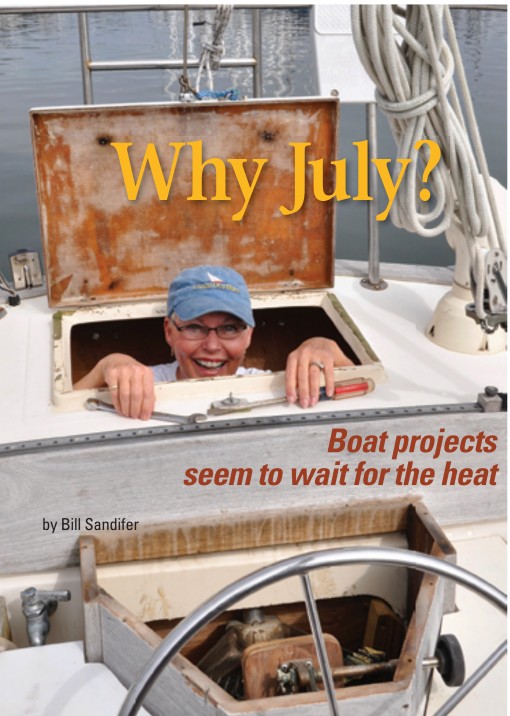
Boat projects seem to wait for the heat
Issue 79: July/Aug 2011
Fate has proclaimed that I should perform hard labor on the boat in the heat of July in the South. It was July when I had to drop the rudder on my first keelboat, an Ensign. This necessitated digging a 4-foot-deep hole under the rudder in the rock-hard soil of the Gulfport, Mississippi, boatyard where she was hauled. Then there was the soft cabinroof of the Pearson Ariel in need of re-coring . . . in July, of course.
Lately, things have been a little more dramatic. Genie, my wife, was at the helm of our Eastward Ho 31 trying to break into a line of boats so we could exit our slip. She had to gun the boat in reverse to get steerageway. Then, with sternway on, she shifted to forward and turned the wheel. With all seven tons of the boat rushing astern, the wheel got away from her and the steering system slammed against the port rudder stop. She recovered, but with a cry of, “I have no steerage!” Fortunately, our dependable Edson rack-and-pinion steering system reset itself and we were able to leave the harbor safely. However, the damage had been done to the rudder stop, and another repair project got under way — in July.
It didn’t stop there . . .
Revising the port rudder stop quickly escalated into revising the whole steering system, which the builder of the boat had enclosed in a wooden box that allowed water to accumulate, leading to a lot of rot.
The rotten box was not a pretty sight and had probably been deteriorating since Hurricane Katrina, when the boat filled with a fair amount of water and sat idle in a bayou. Because the original builder had failed to design and build the steering support system as specified by Edson International, what started as a minor job grew into a major effort.
The first task was to remove the old plywood and rotten framework and the multiple layers of fiberglass that covered them. To get at this system, I had to climb down through an 18- x 30-inch deck hatch into the lazarette, a space that is 3 feet high. How I inserted my 6-foot, 220-pound frame into this area is worthy of an article in itself. I was able to bend, twist, and otherwise force myself into this coffin-like hole, but once there I was not sure I could work in the extreme heat and confinement. My daughter, being physically much smaller than I, volunteered to do the work required there.
A close inspection showed the bulkhead separating the lazarette from the seat lockers to be free of rot and structurally sound. This bulkhead would serve as the basis for the rebuild.
A solid solution
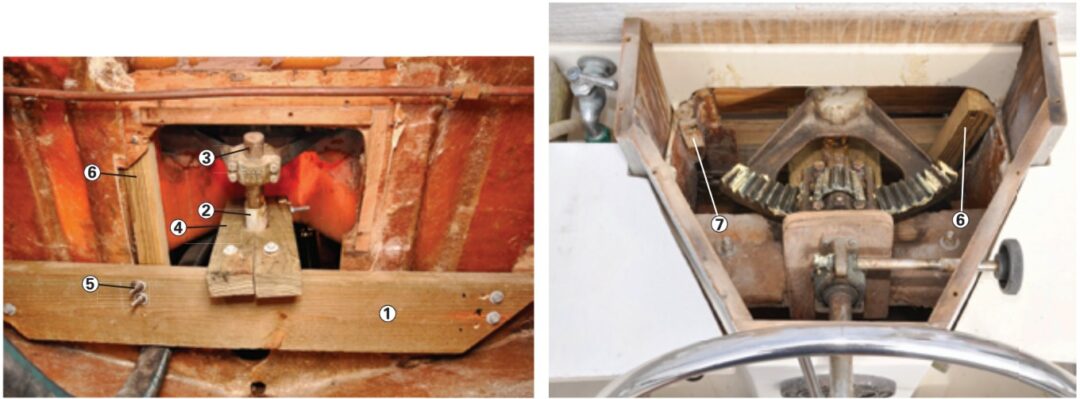
After much pondering and head scratching, I determined that I could construct a foundation for the new system with a 2- x 6-inch athwartships beam coupled with a 2- x 6-inch split plank running fore and aft.
My friend Jim Schmitt, a photographer and professional builder, suggested that I purchase a length of full-dimension 2 x 6 marine-treated lumber (as opposed to a readily available 2 x 6 sold by conventional lumberyards that is really 1 1/2 x 5 1⁄4). The difference is amazing. The lumber is pressure-treated with some potent insect repellent and relatively knot free, and makes a truly first-class foundation beam.
I fastened the beam to the bulkhead with 3⁄8-inch galvanized through-bolts with nuts and washers. My wife performed an incredible trick of fitting into the cockpit locker, where she was able to put the washer and the nut on the bolt I thrust through the bulkhead from inside the lazarette. Jim assisted with some 3⁄8-inch socket extensions so we could reach and tighten the bolts once they were “started.”
To hold the rudder tube rigid, I drilled a hole on the centerline of the fore-and-aft split plank, then bolted the two halves of the plank together, squeezing the rudder tube between them. I then bolted the plank to the beam.
I installed the rudder stops against the bulkhead and the beam using Marine Tex epoxy as an adhesive and through-bolted them for strength.
It took two long days in 103-degree heat to accomplish the task. By the end of each day we were exhausted.
All’s well that ends well. The new system performs admirably and the boat is again operational and safe to steer, but I wonder why Fate has decided I should have to perform these labors only in July.
Bill Sandifer started sailing at age 8 or 9 and taught sailing at Sagamore Yacht Club in Oyster Bay, New York, through high school and college. He has cruised the Far East, the Mediterranean, and the East Coast of the U.S. and has had a boatbuilding business. Bill currently sails an Eastward Ho 31 cruising sloop that he’s owned for 12 years.
Thank you to Sailrite Enterprises, Inc., for providing free access to back issues of Good Old Boat through intellectual property rights. Sailrite.com