Bird sightings enrich the cruising experience
Issue 78 : May/Jun 2011
We never took much notice of birds before we went to sea. We didn’t need to. We had human company everywhere we went. Not all of it was pleasing, of course, but it was there.
When we went to sea, and every wave looked like every other wave on the unchanging ocean, I began to suffer from sensory deprivation. One day, I called my wife, June, up on deck to look at a half-submerged plastic bottle floating past. It was the first thing I’d seen in the sea for more than a week. I was so excited I nearly stopped the boat to rescue the silly thing.
On our voyage across the Atlantic on our 30-foot sloop, June was more affected by isolation, the lack of human company. Our teenage son and I were of little solace to her. We were consumed with the business of sailing the boat. Separately, we each did our stint on deck and then we went below to sleep. We passed June in the companionway.
“I felt very cut off,” she recalled later. “I felt we were a small totally detached cell, moving and existing entirely independently. Even on our own boat there was a sense of isolation. Each person had his own duties, his own time to sleep, his own concerns, his own reactions and feelings.”
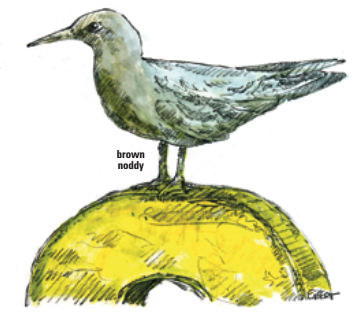
So when a lone brown noddy visited us in the South Atlantic, hundreds of miles from the nearest land, June was delighted. It was a sign that we weren’t alone on this uneasy face of the earth, a sign that she had badly missed.
The tern arrived at 0300 in the middle of a thunderstorm, with lightning crashing all around, just after we had doused all sail and were lying ahull, drifting broadside-on to the swells as the wind lashed us.
With his webbed feet, he couldn’t perch on the aft pulpit, so he ended up swaying back and forth to keep his balance on the flat top of the lifebuoy, where he made the kind of noises a crow makes. He was apparently unafraid of us, as well he might have been, being the owner of a large and vicious-looking beak. In fact, he ignored us completely and flapped away quietly at dawn, after the storm had passed.
Avian memories
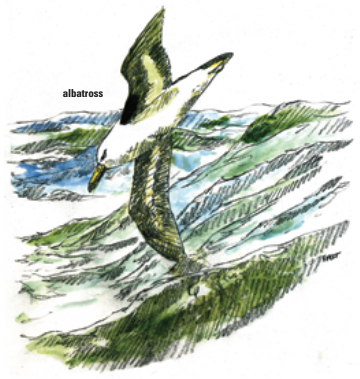
Birds have enhanced our cruising experiences on so many occasions that now we often recall a special anchorage or a memorable passage by referring to a bird we saw there. Down at the tip of Africa we came across an albatross, 6 feet from wingtip to wingtip, soaring up the faces of large swells, swiveling his head and watching us intently with a beady eye. It was near there, too, at the Cape of Storms, that we saw one of nature’s great sea spectacles: Cape gannets in a feeding frenzy. Gannets are large, handsome birds, blinding white with deep, black, trailing edges to their wings and pale yellow heads.
Hundreds of them filled the sky over to starboard, attracted by a large school of surface fish. While some hovered with their heads at an angle, peering intensely into the water below, others were already plunging down at full speed. Soon, hundreds of white arrows were shooting into the sea, sending plumes of white water leaping skyward. Some came straight down at the speed of bullets, forming their wings in a W shape as they approached the water and then, at the very last millisecond, folding them flat against their bodies. Others came in at angles, crossing each other as they darted into the sea.
In the reddish morning sun, this savage scene of slaughter was drenched in color and vibrant movement — a seething battlefield in which the frenzied blue-and-white sea surface was stained red in patches with bloody froth and foam.
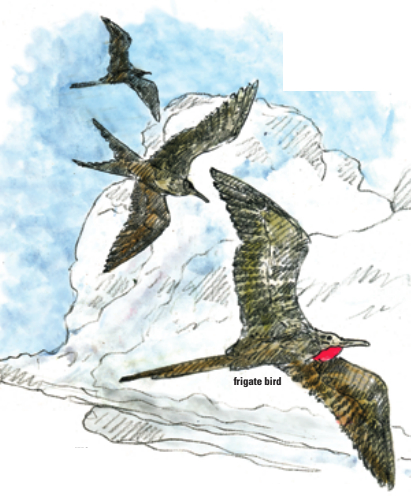
When we think about the little island of Fernando da Noronha, off the coast of Brazil, we think “pterodactyls.” They filled the sky over the sandy white beach where we landed our dinghy — scores of tropical frigate birds, diving into the surf and grabbing small wriggling fish. With their long forked tails and angular wings, they looked just like pterodactyls. They’re an extraordinary sight, large birds, all arms and legs and elbows sticking out, and they move like lightning — that is, quickly and erratically. They seem to be either permanently out of control or deliberately reckless and abandoned, but they can certainly catch fish. They’re also experts at chasing and harassing other seabirds in mid-flight, especially boobies, until they cough up the fish they’ve just caught. Frigate birds should really be called pirate birds.
Comics and actors
We still can’t talk about cruising in the British Virgin Islands without remembering the pelicans and the laughing gulls. In Gorda Sound we stopped overnight at Drake’s Anchorage on tiny Mosquito Island, where pelicans did impossible high-speed belly-flops into inches of water and came up with their beaks full of tiny fish. They looked so panicky and out of control on their dives that we burst into laughter every time we saw them do it. But even more surprising was the sight of the little laughing gulls that would stand on top of the pelicans’ heads, darting at the pieces of fish that fell out of those capacious beaks. Mosquito Island and its funny birds were so fascinating that I incorporated them in a children’s novel I wrote later.
On the remote island of St. Helena, where Napoleon was exiled until his death, little fairy terns as delicate as thistle-down fluttered around their nests in the cliffs just above our anchorage, their pure white bodies contrasting strongly with the forbidding brown fortress of volcanic rock.
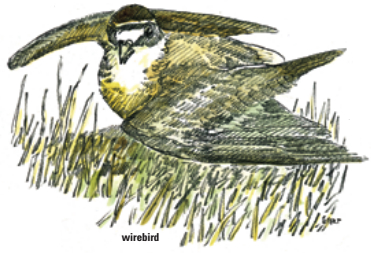
But St. Helena’s special treat was the wirebird. We did a lot of walking on the island and one day we were in rich grassland when a wirebird, a kind of plover, appeared in front of us. This was the first good look we’d gotten of one of the rarest birds in the world. He was a brave little male, obviously guarding a nest somewhere nearby, and he put on a wonderful display to lure us away from it. He would run a little way to one side, but when we didn’t follow he went into a very convincing wounded-bird act, fluttering, swooping, and crumpling up on the ground. He would come within a stone’s throw to entice us away. He dragged a wing to show us how easy it would be to catch him, truly, truly, if we would only come that way. He went through the performance several times, always coming back to start from the same rocks near us. He was a great actor, a real avian ham, and we applauded his lively show. We’ll never forget him.
Closer to our home in the Pacific Northwest, we once came upon a flock of phalaropes in the Strait of Juan de Fuca. They were tightly grouped, floating on a calm sea, but as busy as bees, fluttering and pecking the water constantly. They were obviously feeding on small surface fish we couldn’t see.
We had some trouble with the phalaropes; the first problem was how to pronounce their name. We think it should be pha-LA-rohpeez, not PHAL-a-ropes. I never thought to check with one man who certainly knew. The famous South African author Alan Paton wrote a book (many say his best) called Too Late the Phalarope, and had all the critics furrowing their brows in puzzlement. It was a love story about sex across the color line, which was forbidden in South Africa at that time, and nobody could figure out how the title related to the book. I think they’ve stopped trying now. I used to see Paton from time to time but never thought to ask him. Or perhaps I knew what his answer would be. He was a crusty old grump. “If you can’t work it out for yourself, then it doesn’t matter,” is likely what he would have said. However, according to the bird books, the phalarope is promiscuous and not a good parent, which may have some bearing on the title. And apparently (according to Paton, anyway) it’s not a very punctual bird.
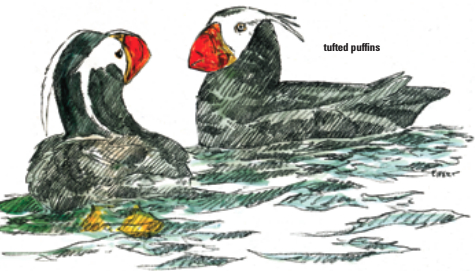
Another bird that reminds us of a foggy day on the Strait of Juan de Fuca is the tufted puffin. He was alone when we came out of a bank of mist and startled him. He, too, made me laugh outright. He looked like a technicolor clown as he took off, his little wings flapping at warp speed and his eyes wide above his oversized beak. In days gone by, tufted puffins were harvested by coastal Native American groups. Their bills were used to make rattles for dance ceremonies.
Where eagles soar
We always associate our northern neighbor, British Columbia, with magnificent bald eagles. In fact, when we’re cruising up there we always seem to find a greeter eagle leading us into port. In both Port Hardy and Ucluelet, where they clean the catch of the sport fishermen and dump the entrails in the sea, dozens of large eagles swirl and dip like pigeons after peanuts. We see them occasionally in Bedwell Harbour, too, where we usually clear customs, but we now remember Bedwell better for its ospreys.
Last time we were there, anchored at the foot of a tall cliff, two lovely ospreys were gliding back and forth along the top of the ridge, riding the soaring wind currents and never flapping their wings. These magnificent raptors have special talons for catching and carrying fish. They can manipulate their four toes so that either three are forward and one back, or two are forward and two are back.
Our cruising memories of popular Desolation Sound, farther north in British Columbia, are closely tied to the only loon we’ve ever heard calling. It’s an unmistakable sound but not a common one around here. There was only one call, and we never did see the bird, but it was enough for us to pair the beautiful bird with one of the most beautiful cruising areas in the Northwest.
Not all birds have pretty calls, of course. I might mention the heron, for a start. It always reminds us of Shallow Bay on Sucia Island, where we were anchored early one September, in our Cape Dory 27, Sangoma. The peace and tranquility of this sheltered haven in the San Juan Islands was all around us.
A lanky, gawky heron was fishing in the shadows on the western side of the bay when a cheeky little kingfisher came flitting along and disturbed him. The heron flapped clumsily into the air, protesting vigorously, complaining loudly and bitterly in a harsh, grating, echoing croak. If a creaking door could roar, that would be the heron.
“How could God give the heron such a terrible voice?” I asked June.
She looked at me for a while and then she said: “Have you heard God’s voice?”
I was quiet for a long time. I had no answer to that but it served to remind me how much the birds of the sea now add to our cruising pleasure and our cruising memories.
“Sorry, Mr. Heron,” I said quietly. “I didn’t mean it.”
John Vigor, a former newspaper columnist and editorial writer, is the author of 12 sailing books. He is a sailing and navigation instructor accredited by the American Sailing Association. He writes three boating columns a week on his blog, www.johnvigor.blogspot.com.
Thank you to Sailrite Enterprises, Inc., for providing free access to back issues of Good Old Boat through intellectual property rights. Sailrite.com