Not all trim needs to be bright
Issue 81 : Nov/Dec 2011
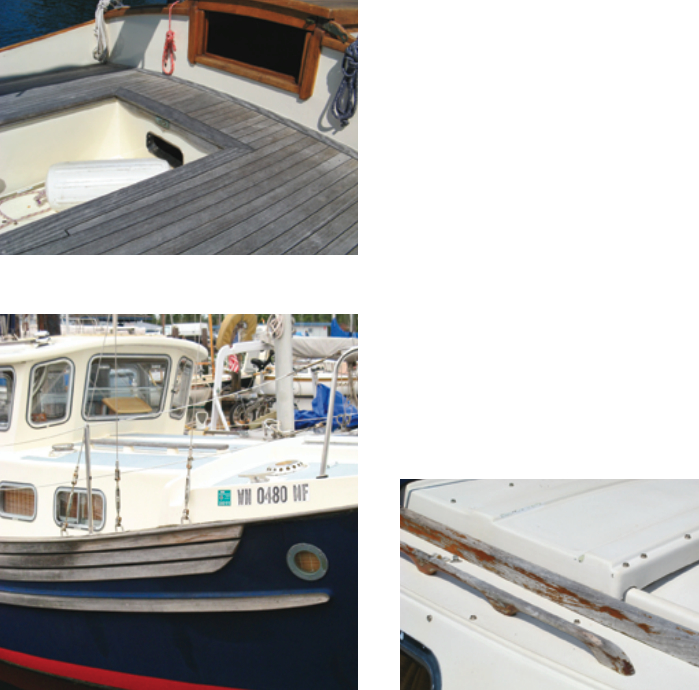
Some boats have large amounts of varnished trim while others have little or no brightwork at all. Most good old boats fall somewhere in between; mine certainly does. Handrails, coamings, companionway slides, and cockpit grates require frequent refinishing, but I leave other areas of teak to nature’s care.
Every sailor has an opinion about the type of finish to use on teak — teak oil, polyurethane- and Tung-based varnishes, Cetol, and so forth. Some like to slather on pine tar mixed with linseed oil and Japan Drier (a drying agent) in a variety of recipes that trade a brighter finish for ease of application, excellent protection, and a shippy aroma. Others just let teak naturally weather to a soft gray finish for which maintenance amounts to scrubbing down fore and aft with a stiff brush and seawater. I know someone who treats her beautiful teak to a scrubbing with Joy each spring.
Whether you choose to finish your wood bright or let it naturally weather doesn’t really matter. It’s a personal choice — the teak doesn’t care. Pick a treatment that fits with your schedule and finances, that you think looks good, and that rewards you with the satisfaction of a job well done.
Mix and match
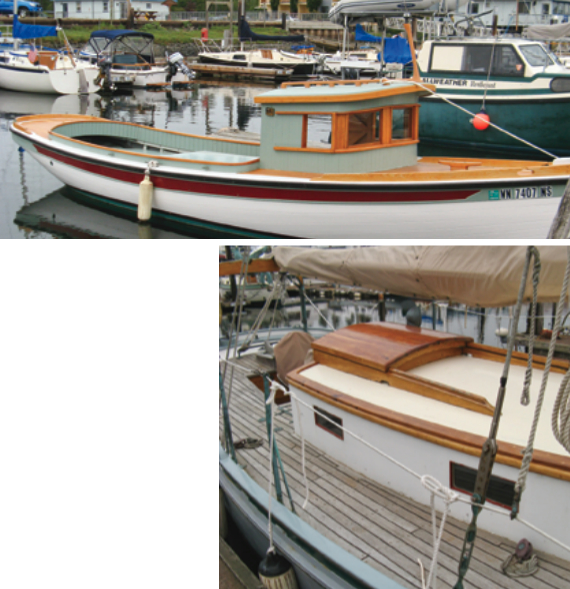
You don’t have to choose whether to varnish or not to varnish. Consider combining a small amount of brightwork with stretches of teak left to weather, and possibly some painted surfaces. As well as being practical, a combination of finishes can be good looking, and you can tailor the mix to your time and budget.
A stroll down the docks of a large marina reveals many good examples of this sort of blend of disparate but well-chosen finishes. Commercial boats tend to use more durable paint surfaces, but a gillnetter, bow picker, or tug will often show a bright-finished sliding door or hatch. A bare teak deck or coaming often goes well with varnished rails or companionway slides.
Over the years, I’ve begun eliminating much of the brightwork on my boat, varnishing only the parts that are easily done, such as the top of the propane-tank box, companionway slides, floorboards, and anything I can get off and take home. I painted the business end of my anchor sprit white, partly to better protect the end grain, partly because it’s a traditional way of treating the ends of spars, and partly because it looks good. The difficult bits like handrails, toerails, and eyebrows, I scrub annually but otherwise leave to weather.
Essential maintenance
Teak does get dirty in time and can attract mildew. I use 3M abrasive foam pads on mine and have had good luck with a power sprayer on nasty bits. I use minimum pressure and don’t get too close; excessive force can wreak havoc on a boat.
If your varnish needs a “makeover,” you’ll have to remove the old blistered and peeling bits first. There are several ways to do this, including chemical stripping, hand and power sanding, heat guns, and so forth . . . with advantages and disadvantages to each method. I prefer scraping down to the bare wood.
The scraper
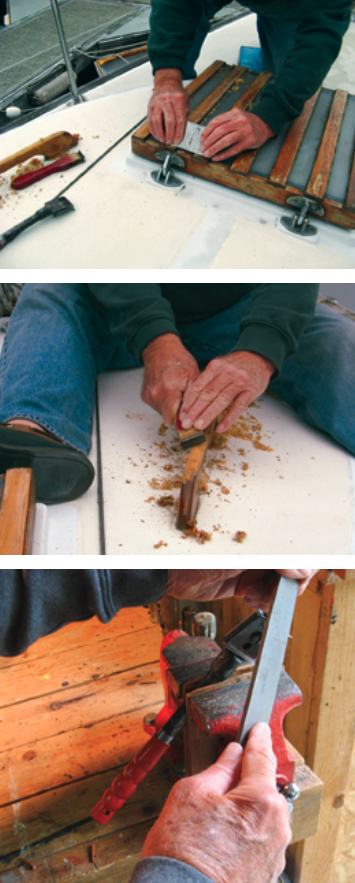
Several types of scrapers are available from your local hardware store. One of the simplest is a cabinet or card scraper, a postcard-sized rectangular piece of steel, 2 1⁄2 x 5 x 1⁄16-inch thick. These scrapers are fine for light work on flat surfaces. I use one on the teak battens that span my plastic hatches. I can use all four edges of the scraper, and the long edge will span two battens at a time and reduce the risk of nicking the plastic.
If you try a card scraper, apply firm pressure with the fingers and either pull or push, bending and holding the blade at a slight angle to the work. Experiment to find the most efficient angle and direction of motion.
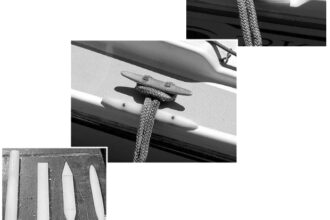
To scrape handrails, toerails, and cockpit grates, I use a hook scraper, sometimes known as a Skarsten or Red Devil scraper. Scrapers of this type use a removable blade — straight, concave, convex, serrated, or double-ended — held in a wooden or metal handle.
Hold a scraper of this type with both hands and pull the tool toward you. As with all scraping, hold the tool or blade firmly while applying sufficient pressure to cut through the old finish and leave the wood bare. Use a serrated blade to break up layers of old paint or varnish prior to producing a smoother finish with a standard blade. Sanding is often unnecessary. When the scraper starts to produce dust rather than shavings, it’s time to sharpen it.
Sharpening
A sharp scraper will leave a cleaner finish than a power sander, which can leave swirls or gouges and can also clog the grain with dust. Hardwoods, such as teak, benefit particularly from scraping. And so will you, as you’ll breathe in less sawdust.
The finer points of sharpening these tools can be found on the Internet by searching with the terms “cabinet or Skarsten scraper sharpening.” Here’s how I sharpen my scrapers.
Put the cabinet scraper in a vise with about 1⁄4 inch of edge showing. Using a good sharp metal file, grind the edge flat at right angles to the sheet of steel. Then change the angle of the file slightly downward and give it a few swipes to create a sort of hook on the edge. This will raise a burr. This burr is what does the work. Professionals use a special burring tool for this operation but my method seems to work well enough.
Put the Skarsten handle in a vise, filing at the original angle before raising a burr with a few final downward strokes to the main edge. It takes a little practice, but keeping a sharp cutting edge is essential to efficient scraping.
Once while cruising, my scraper went dull, so I ended up using pieces of broken picture-frame glass to finish scraping my teak handrails. Glass shards of different shapes and sizes don’t require sharpening, but it’s a good idea to wear gloves when using them as scrapers!
Balance toil and leisure
Take a good look at working boats and power cruisers as well as fine yachts and other good old boats. Think carefully and realistically about the time you’re prepared to spend and the work involved. If you’re going to do the work while the boat is hauled out, remember there’s a lot of dust blowing around the yard. On the other hand, there’s no better place to lay on a few coats of varnish than while at anchor . . . a fine time to just sit there and watch it dry.
Richard Smith , a contributing editor with Good Old Boat, is an architect. He specializes in designing and building very small houses and has built, restored, and maintained a wide variety of boats. These days, he and his wife, Beth, sail their Ericson Cruising 31, Kuma, on the reaches of Puget Sound.
Thank you to Sailrite Enterprises, Inc., for providing free access to back issues of Good Old Boat through intellectual property rights. Sailrite.com